

The Global LPE Network is part of the @LPECollective and co-sponsors LSA CRN 55.
- Tweets221
- Following532
- Followers769
- Likes142






ALT What is Capitalism? Reading & Discussion Group Friday, Sept. 27 at 3 pm ET Zoom The New Antitrust with Frank Pasquale


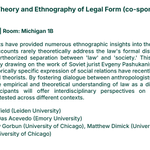
ALT Panel: Popular Constitutionalism Beyond the Nation State (co-sponsored with CRN 21 and CRN 50) 10:00 AM - 11:45 AM | Room: Mineral E This panel extends the dialogue from "Constitutional Revolution, Revolutionary Constitutionalism, and the Agonies of Democracy," delving into forms of constitution-making in our economic, ecological, and digital spheres, as well as among municipalities and regions and across national borders. In so doing, these papers make visible popular law, probing into the processes through which new institutions and systems of governance are articulated and realized by movements seeking more democratic, egalitarian, and ecological societies. What insights can be gleaned from these trials in prefigurative legality and popular constitutional design? Which models can aid in moving past the intensifying crises we face?

ALT Roundtable: Sociolegal Projects on Law, Democracy, and Democratic Backsliding 10:00 AM - 11:45 AM | Room: Quartz B In recent years, sociolegal scholars have shifted their focus to address challenges to democracy and the rule of law. This shift has given rise to various projects with different names, such as "Autocratic Legalism," "Multi-Sited Dynamics of Autocratization and Resistance," "International Law and the Rule of Law Under Pressure," "Global Resistance to Authoritarian Diffusion," and "Legal Underpinnings of Democracy." During this roundtable, the organizers of these projects will share insights on their research questions, methods, initial findings, and organizational approaches. The aim is to assess the work of sociolegal scholars on topics like law, democracy, and democratic backsliding and to identify areas for further research and potential actions. Chair: Fabio de Sa e Silva Participants: Octávio Ferraz, Gregory Shaffer, Kathryn Hendley


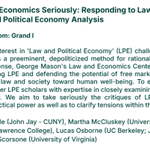
ALT This roundtable will introduce participants to the Law and Political Economy (LPE) movement, highlighting its origins and increasing influence in both academic discourse and organizing. With the decline of democratic institutions and the rise of right-wing leaders, the LPE movement offers a renewed critical approach to legal scholarship. It provides essential analytical tools for understanding the role of law in exacerbating racial, gender, and class inequalities, as well as contributing to global political instability and environmental crises. It also invites critical attention to the relationship between law and organizing and the role of power-building in transforming political economy. In this roundtable scholars will share their scholarly and theoretical engagement with the LPE movement.

ALT In the United States, the "state" monopoly on the use of force is primarily delegated to local police. Local police are, nominally, agents of local governments. In form, this means that the delegation of the state's monopoly on the use of force rests on the local democratic processes. In practice, the picture is less clear. This roundtable will bring together scholars of policing and local government to try to make sense of the descriptive and normative questions raised by the interaction between the police and local power. Should policing be localized? If so, how does (and how should) local democracy interact with the professionalized (and often militarized) local police forces? To what extent are contemporary problems with local policing problems of local democracy-and to what extent could they be solved by resort to local democracy?

ALT Today, a transnational constellation of 'rule of law' experts advise on 'good' legal systems to countries in the Global South. Yet these experts often claim that the 'rule of law' is nearly impossible to define, and they frequently point to the limits of their own expertise. In this innovative book, Deval Desai identifies this form of expertise as 'expert ignorance'. The book draws on insights from legal theory, sociology, development studies, and performance studies to explore how this paradoxical form of expertise works in practice. With a range of illustrative cases, Desai considers the impact of expert ignorance on the rule of law and on expert governance more broadly. Contributing to the study of transnational law, governance, and expertise, demonstrates the enduring power of proclaiming what one does not know.

ALT Panel: Law and Social Movements in China (co-sponsored with CRN 21 and 33) 2:45 PM - 4:30 PM | Room: Mineral E This session explores different group dynamics of law and social movements in China, covering homeowners, LGBTQ groups, lawyers, environmentalists, and advocates of women rights such as the "me too" movement. All the papers are based on in-depth fieldwork in China. Such a wide coverage of different social groups in China enables us to identify commonalities and differences of different subfields of law and social movements in China, and to explore an unified theoretical framework together. Chair and discussant: Shitong Qiao (Duke Law School) Presenters: Chi Hin Peter Chan (City University of Hong Kong School of Law), Yun Tang (Princeton University), Shitong Qiao (Duke Law School), Ying Xia (University of Hong Kong), Huina Xiao (Macau University of Science and Technology), Qin Ma (NYU School of Law)


ALT Panel: Unsettling Legal Productions: Socio-Legal Co-Creation of Subjects, Technologies, and Social Divides (co-sponsored with CRN 23) 12:45 PM - 2:30 PM | Room: Centennial F From a legal point of view, entities such as subjects, markets or technologies often just happen to be there. They are stripped of their histories, political struggles and social embeddedness. They are there, born in a nowhere, and the law would not add anything to them. In this panel, coming from different fields of action and expertise, we look at how law (co-)produces entities and especially the social divides that come with legal categories. In doing so, the different panels look at the underpinnings of fields of law that are often used to address inequality, including anti-discrimination laws, social rights, and labour law.

ALT This roundtable will explore the role of epistemic violence in the obfuscation of certain forms of experienced violence, affecting groups of people whose oppression, lived experiences, and demands for reparative actions, tend to be minimized, casually dismissed, or ignored altogether. The roundtable will do so by examining how instances of interconnected historical and present-day mass harm in the United States and Canada are dismissed and in so doing, how victims fail to be recognized, thereby silencing them from the outset through a second form of epistemic violence, one that denies their lived experiences. It will do so by looking at otherwise disparate examples of such denied violence affecting Indigenous and/or racialized communities in locations such as Flint (Michigan), Puerto Rico, and Hawai'i.

ALT Author Meets Reader (AMR): The Privacy Fallacy: Harm and Power in the Information Economy (co-sponsored with CRN 37 and CRN 54) 10:00 AM - 11:45 AM | Room: Mineral B The session is an author-meets-reader for The Privacy Fallacy (CUP 2023). The book argues that privacy law is grounded on concepts from contract law, which sets the rules for voluntary agreements, and we need to instead ground it on concepts from tort law, which sets the rules for harms caused to others. It proposes a program for building accountability into the information economy for individual and group harms, departing from existing regulations and liability proposals. Author: Ignacio Cofone, McGill Faculty of Law Chair: Claudia Haupt, Northeastern University Readers: Nikita Aggarwal (UCLA School of Law), Scott Skinner-Thompson (University of Colorado Law School), Ari Waldman (University of California, Irvine School of Law)

ALT In 2019, a group of Global South scholars responded to the call made by the then-LSA president Kim Scheppele to investigate how rising autocrats use law to consolidate power and sideline their political opponents. This led to the establishment of the Project on Autocratic Legalism (PAL). PAL initially worked as an LSA-IRC and a pilot topical laboratory in the Association's Global Collaboration Program. PAL has produced comparative studies that began with Brazil, India, South Africa, Hungary, and the US and were expanded to cover several other countries and themes. This session showcases some of the studies currently being conducted by PAL contributors. The session focuses on state/society relations in contexts of democratic backsliding.

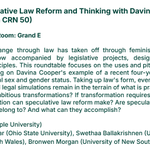
ALT This panel concerns the mutual relationship between law and inequality in society. Papers in the panel address the role of law in the racialized care economy, class and the governance of the consumer Bankruptcy Code, the legal effects of financialization on public childcare provisions, the role of gender in the interdisciplinary field of LPE, and a Foucauldian approach to the relationship between poverty and capitalism. Chair: Liam McHugh-Russell (Schulich School of Law, Dalhousie University) Discussant: Angelica Cocoma (Max Planck Institute for Social Anthropology) Presenters: Michael Sousa (University of Denver College of Law), Yael Cohen-Rimer (Harvard Law School), Leanna Katz (McGill University), Maj Grasten (Copenhagen Business School), Komal Vaidya (Villanova University School of Law)