

Cambridge, UK
Joined February 2012
- Tweets2.2K
- Following98
- Followers490
- Likes843





Euclid in Syriac, from the new exhibition at @theUL. nitter.cf/theUL/status/183133394…


Endless Stories, opens on 28 Sep at Cambridge University Library. It showcases the extraordinary manuscripts collected by 17th-century visionary, Thomas Van Erpe. The exhibition includes works in Arabic, Hebrew, Persian, and Malay.
Book your free ticket: lib.cam.ac.uk/endlessstories

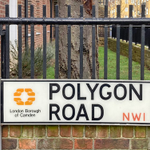
I passed Polygon Road in Camden the other day, which turns out to be quite interesting, according to @diamondgeezer: diamondgeezer.blogspot.com/2…

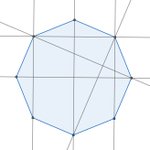
Some variations of Pascal's hexagon, where one or more pairs of points have merged so a hexagon line becomes a tangent:


The Hjemslev quadrilateral, with right angles at A and C. If the lines DE and BF are such that the two green angles at B and the two red angles at D are equal, then DE and BF are both perpendicular to AC and the red segments AG and CH are equal:

And from Hartshorne's 'Euclid and Beyond', a proof of the concurrency of altitudes (if they intersect at all). 'fe' is the composition of reflections in lines f and e, etc, so fe = ef just when f and e are perpendicular:


Tetrahedral numbers: oeis.org/A000292
Dodecahedral numbers: oeis.org/A006566
Every dodecahedral number is tetrahedral - is there a nice geometric way to see this?
vec4 sphereFromFourPoints(vec3 a, vec3 b, vec3 c, vec3 d) {
a -= d; b -= d; c -= d;
a /= dot(a,a); b /= dot(b,b); c /= dot(c,c);
vec3 n = cross(c-a,c-b);
vec3 p = dot(a,n)/dot(n,n)*n;
p /= dot(p,p);
vec3 centre = 0.5*p;
return vec4(centre+d,length(centre));
}
I was thinking about a Shadertoy for the Voderberg tiling, but it's much easier to do such tilings with vector graphics using a 2D HTML canvas: matthewarcus.github.io/canva…


Apollonius of Perga, around 300 BC, wrote a brilliant series of books on conic sections, which, perhaps strangely, did not use the focus-directrix construction. This is his basic construction for an ellipse, equivalent to the equation y² = x-kx² (geogebra.org/geometry/yk4r32…):

Something on the complex plane? A stained glass picture in a window at @CaiusCollege, Cambridge.

A regex matcher:
data Pattern a = Lit a | Seq [Pattern a] | Alt [Pattern a]
match (Lit _) (_,[]) = mzero
match (Lit f) (n,a:s) = if f a then return (n+1,s) else mzero
match (Seq pp) ns = foldl (>>=) (return ns) (map match pp)
match (Alt pp) ns = msum (map (flip match ns) pp)