

Cambridge, UK
Joined February 2012
- Tweets2.2K
- Following98
- Followers490
- Likes843





Matthew Arcus retweeted
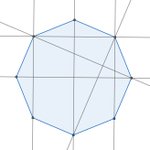
Perturbing the circle results in 4 intersections, so consider the pencil of conics making quadruple contact with the parabola x²-y = 0 at (0,0), generated by the parabola and the x-axis taken twice, y² = 0. The circle x²-y+y² = 0 is in that pencil and has radius ½:

Matthew Arcus retweeted

Ha, there is another problem in Fig 2, and it's very nice: There is a wood of length 2 Zhang and circumference 3 Chi. A vine grows from the bottom, circling the wood 7 times before reaching the top. Question: How long is the vine?
Matthew Arcus retweeted
1729 =
12³ + 1³ =
(9 + 3)³ + 1 =
9³ + 3.9².3 + 3.9.3² +3³ + 1 =
9³ + 9³ + 3.9² + 3.9 + 1 =
9³ + (9 + 1)³ =
9³ + 10³
Matthew Arcus retweeted

Decorated sphere resulting from a three-dimensional kaleidoscope. It generates a tiling which is the (hyper)surface of a four-dimensional hyperbolic honeycomb.

Matthew Arcus retweeted
Quasiperiodic tiling with 12-fold rotational symmetry at a very large scale. (Tiles are only a few pixels large.) Result of a challenge from @JamesPMillar. Using the substitution method.


Matthew Arcus retweeted

Per @ZenoRogue 's recommendation, moving the whole thing to a Poincaré Ball instead of H^2xE. Looking more "cartooney"
Matthew Arcus retweeted

Lucie Rie, born #OTD in 1902, is one of the 20th century’s most iconic and celebrated potters.
Her serene works reflect a simplicity of style which earned her critical and widespread popular acclaim.
#WomensHistoryMonth #fivewomenartists

Matthew Arcus retweeted

The work of Greek mathematician #Archimedes was thought lost until C19th when mathematical symbols were found behind the text of a Byzantine prayer book.
A leaf from this #manuscript, the Archimedes Palimpsest, features in our exhibition #ULghostwords: bit.ly/2PH8Ciu

Matthew Arcus retweeted

This Husun Star Globe helped observers find celestial bodies from their location or identify unknown stars.
Globes like this were used from the late 19th Century, mainly on long sea voyages. This one was made in 1920 by #London instrument maker H. Hughes & Son.
#HistAstro


Matthew Arcus retweeted
These illustrations are the most accurate observations of snow crystals made before the development of photomicrography.
They were created in the 1850s by Cecilia Glaisher.
She made them to illustrate her husband’s scientific paper, 'On the Severe Weather of 1855. #Winter


