

Retired stock analyst to Wall St firms (Software, Internet, AI). Since 2008, have donated time to provide picks & education on professional stock analysis. 🙏🏽
Miami Beach, FL
Joined March 2013
- Tweets2.9K
- Following921
- Followers8.7K
- Likes1K


Pinned Tweet
For those looking for it, my "Finding Multibaggers" Spaces (nitter.cf/pipelinedatallc/status…) & "Making Millions" video on YouTube (youtube.com/live/9PhWx9rzIaU…) are the two most critical episodes for anyone following my work.💰


Money Mark retweeted

Hedge funds just hit the panic button harder than at any time in the last ten years. Here is why that is good news for you.
Morgan Stanley tracks the total money its hedge fund clients have bet on stocks. When that total drops sharply, it means funds are being forced to cut positions, usually because their losses hit a limit. In the last 2 days, it fell 7.8%, a bigger unwind than the Covid crash, the GameStop squeeze, or the 2016 and 2018 selloffs.
Every time this number fell past 6% (2016, 2018 twice, 2020, 2021, 2025), the S&P 500 bottomed within a week or two and was higher one, three and six months later. Six out of six.
The reason is simple. Once the forced sellers have sold, there is nobody left to push prices down. Those same funds then have to buy back in, and that buying has powered every rebound in the table.
As for me, I am looking for great businesses that got dumped for no reason. That is where the bargains are.


Discussed this topic on Stock Talk Live
tinyurl.com/MoneyMarkLive


Heading into November I think the selloff in $NBIS, $CRWV and $IREN is getting a bit extreme when $NVDA B300 rental prices are up 52% since May and even older H100s are getting more expensive to rent.
Meanwhile AI token prices have fallen more than half from their peak which tells you a lot about where real pricing power sits in AI economy.
And while market worries about financing IREN just secured $363M against contracted GPUs and Nebius expects over $9B in customer prepayments which shows capital is still available for operators with real demand.

Money Mark retweeted

David Friedberg says every dollar Nvidia spends making chips turns into $18 of Anthropic revenue, with SpaceX making an 83% margin in between
“I basically said start with NVIDIA, how much does NVIDIA spend to make the chips? And then how much do they sell the chips for? So for every dollar of COGS, every dollar that NVIDIA spends, that turns into $4 of revenue for NVIDIA, 75% margin."
"And then that gets sold to SpaceX, and then SpaceX turns around, and they’re making, you know, an 83% margin on that chip spend, because they’re kind of looking at a five-year depreciation. So they spent $10 billion on Colossus one, five year life, $2 billion a year depreciation. And so that’s kind of the cost per year, but then they’re making $1.25 billion a month on Colossus."
"And then Anthropic is showing in this S-1 pretty remarkably to Sacks’s point that they’re making about 85% incremental gross margin on every incremental dollar coming in. It’s obviously a baseline of compute spend, but 85% is kind of the incremental gross margin. So at the end of the day, a dollar that NVIDIA spends turns into $18 that Anthropic is making selling to customers.”

Chamath admits he underestimated Anthropic’s cash, so it only needs to raise $80 to $120 billion, and he sees the IPO pricing around $1.5 trillion
“First of all, let me just say, the CFO of Ant, Krishna Rao, has done an unbelievable job. The fact that he entering June already had $125 billion is unbelievable."
"And there’s a chart I didn’t include, but their total net burn to get there has been like $9 billion or $10 billion. It’s just infinitesimally low relative to the market cap. So I thought that they had a lot less cash than this."
"So when I said they need to raise between $200 to $250 and they need to price closer to a trillion, I was assuming they had 30, 40, 50 billion on the balance sheet. I was wrong."
"So these guys need to raise between, I would say, $80 to $120 billion to get to that quarter trillion. And I think in order to do that the price is probably now going to come in between 1.3 on the low end to 1.7 on the high end. So call 1.5 the midpoint.”
🚨𝐀𝐈: 𝐍𝐎𝐖 𝐖𝐇𝐀𝐓???🚨
* When will the AI trade find a bottom?
* Did this week's earnings embolden the bears?
* What are my top picks RIGHT NOW???
* What stock did I buy $700,000 of ?
𝐅𝐢𝐧𝐝 𝐨𝐮𝐭 NOW 𝐨𝐧 𝐒𝐭𝐨𝐜𝐤 𝐓𝐚𝐥𝐤 𝐋𝐢𝐯𝐞!
youtube.com/@MoneyMarkStocks
The Wall Street vet who has covered Tech & AI since 𝐭𝐡𝐞 𝟏𝟗𝟗𝟎𝐬 gives his latest update, 𝐓𝐎𝐏 𝐇𝐎𝐋𝐃𝐈𝐍𝐆𝐒, and answers to 𝐘𝐎𝐔𝐑 𝐐&𝐀 with our global audience of 𝟏𝟎,𝟎𝟎𝟎 𝐟𝐨𝐥𝐥𝐨𝐰𝐞𝐫𝐬...
We highlighted $𝐀𝐄𝐇𝐑 @ $𝟑 !!! Also, $NVDA @ 40, $MU @ 100, $ARM @ 100, $MRVL @ 70, $KRKNF @ $0.60, $OPTX @ 4.50 (and 𝐨𝐯𝐞𝐫 𝟓𝟎 𝐨𝐭𝐡𝐞𝐫 𝐭𝐫𝐢𝐩𝐥𝐞𝐬!)🚀
Stock Talk Live is LIVE !
tinyurl.com/MoneyMarkLive
🔥𝟏𝟓 𝐲𝐞𝐚𝐫𝐬 𝐨𝐟 𝟒𝟎% 𝐚𝐧𝐧𝐮𝐚𝐥 𝐫𝐞𝐭𝐮𝐫𝐧𝐬!!🔥
NO picks closed at a loss since MAY... of 2024 !
What do you expect from the guy who literally...
* Sold picks to Wall St in the '99 bubble
* Was paid by JIM CRAMER'S funds!
* Called the rise/fall of MoviePass (& was in the movie!)
$AEHR, $AKAM, $AVGO, $CLFD, $CRM, $CVV, $CXDO, $DELL, $DBOXF, $DRAM, $DRSHF, $EVLV, $GEODF, $GKPRF, $IDN, $INFU, $IREN, $ITMSF, $IWM, $IZEA, $KRKNF, $KRMD, $MRVL, $MSFT, $MU, $NOW, $NVDA, $OKTA, $OPTX, $RDCM, $SMCI, $SPCX, $TPCS, $TRAK, $TSSI, $TWLO, $USIO, $VTSI, $WATT


$AMZN CEO says the company still expects about $220B in cash CapEx for 2026, with spending expected to increase "meaningfully more" in 2027.
"Customers are consuming new capacity almost as quickly as Amazon installs it."

Awesome post and great trip down memory lane. Was loaded up on Internet and Software stocks. One of my best years ever. #TrustTheTruth

There is nothing special about this pullback.
Much of the panic surrounding neoclouds, AI capital expenditures, and the sustainability of the infrastructure buildout is simply the market searching for explanations for falling stock prices.
When AI stocks were rising, record capex was evidence of extraordinary demand. When those same stocks started falling, suddenly the same spending became evidence of an impending financial disaster.
One fact with two interpretations that depend entirely on the price action of the market.
Go back to August 1998.
The technology bull market had been running for about three years.Amid fallout from the Asian financial crisis and Russian ruble crisis, earnings expectations were deteriorating, valuations were elevated, and investors were becoming increasingly concerned about unprofitable Internet companies.
On August 6, the New York Times published an article titled "Market Gyrations May Point to Shift in Investor Strategy." One fund manager declared, "Boring is going to outperform sexy."
Investors were supposedly abandoning momentum and speculative technology shares in favor of profitable businesses, balance sheets, dividends, and traditional valuations.
Russia defaulted on its debt. The Asian financial crisis was spreading internationally. The yen carry trade had imploded as the USD plunged 8% against the yen in a single day. US embassies were being bombed.
President Clinton ordered missile strikes against Afghanistan and Sudan while simultaneously facing a scandal that would result in his impeachment. Major financial institutions suffered enormous losses, and the spectacular collapse of Long-Term Capital Management threatened the stability of the global financial system.
Corporate earnings forecasts were falling. Investors feared a U.S. recession. Many of the same technology companies that had driven the bull market were now leading the decline. Many of them had fallen 40-60% from their 1998 highs.
Even the Federal Reserve's first interest-rate cut on September 29 initially disappointed investors. The Dow fell that day and plunged another 238 points the following session.
The news seemed almost uniformly terrible.
But the market didn't care forever.
After a violent reversal in early October, improving confidence in corporate earnings, Japanese banking reforms, and a surprise emergency Fed cut on October 15 helped restore risk appetite.
By November, the Dow was making new all-time highs. Internet stocks were exploding higher again.
What had looked like the end of the internet trade was, within about a month, actually a correction preceding one of the most extraordinary speculative advances in stock-market history.
In today’s market, Microsoft just reported 48% Azure growth. Google Cloud revenue more than doubled. Meta expects $135–145 billion in capex this year and has announced plans for a potentially record-sized $97.5 billion equity capital raise.
If the market really was that concerned over capex spending, instead of using it as an excuse to explain the pullback, the market would have sold off on the META news.
Anthropic has now filed its IPO registration statement. We have midterm elections approaching, another consequential round of earnings, and a Fed that just held rates steady even as another hike is widely anticipated in December.
There are plenty of potential catalysts over the coming two months.
More importantly, this does not resemble the sentiment backdrop of a speculative bubble climax. Generational bull markets don't die midway through a basing period, but typically after euphoric saturation and a parabolic rally in leading names.
Consensus on AI is deeply divided. Being loudly anti-AI has practically become fashionable. Some AI critics have even built enormous audiences around the idea that the economics of the industry are unsustainable. Plenty of investors seem almost eager to watch the entire trade collapse.
That isn't the sentiment or narrative around which tops are typically made.
The Internet trade didn't end in the panic of 1998. It ended after the extraordinary acceleration of 1999 and early 2000 when being bearish was the market equivalent of wearing a dunce cap.
History never repeats perfectly, and today's rate environment is very different. But I think the resemblance in investor psychology is striking.
I’d be genuinely surprised if we don't have at least one more months-long rally into new highs during this cycle.
Whether it begins into the midterms, after the elections, around Anthropic's anticipated listing, or following further earnings confirmation, I suspect this correction will eventually look more like an interruption in a generational bull market than the bursting of a "bubble."
The $NDX took four months to bottom in 1998. With the exception of a handful of leaders, most stocks that are holding up have been basing out since the May-July period. We could certainly go lower, but most of the signs point to another new high before this cycle rolls over.
However, I’d place the odds of any additional powerful rallies afterward as increasingly unlikely given the fact we are already about to enter the fifth year of this bull market. I'd be careful about buying the dips next year, at least with meaningful size.

IDK what's more scary, the post or volume of confirmatory comments below it.

As someone who has personally spent $500k / mo+ on Google Ads for years, I can tell you with certainty:
This revenue growth in Search is artificial & extremely unhealthy for Google’s business long term
Search volumes are declining as legacy search is being increasingly cannibalized by non-monetized LLM queries
Google’s response?
Manufacture revenue growth via short-sighted, highly extractive, customer-hostile tactics. I.e. charge advertisers more for lower quality clicks, including clicks they do not want and explicitly did not approve Google to charge them for
A few examples to illustrate:
For all of its history until recently, Google operated on a 2nd price auction model
I.e. if you bid $5 CPC and the next highest bidder bids $1 CPC, Google charged you $1.01 for the click (one penny more than the 2nd highest bidder) rather than the $5 you bid
This was a genius move by Google early on as it incentivizes advertisers to input their true maximum willingness to pay rather than trying to play the game of bidding low and constantly adjusting to try to stay just ahead of the next highest bidder while still not paying too much
However recently, Google silently deprecated the 2nd price auction and began charging advertisers as much as their bid and budget caps allow, regardless of what anyone else is bidding
It’s a short-sighted cash grab at the expense of the long term health of the advertiser ecosystem
Making thing worse, Google also recently nerfed keyword targeting precision
Google previously had precise keyword targeting settings that allowed advertisers pick individual search phrases to bid on, defined down to the character w/ exact match or phrase match targeting
This was one of the core features that made search advertising magic, enabling advertisers to run extremely precise campaigns based on exactly what their target customer typed
But now, even if you bid on a specific term or phrase using the strictest exact
-match targeting settings, Google will show your ad across 1000’s of unrelated keywords, labeling them as as “exact match (close variant)”
The definition of “close variant” means whatever they want it to and changes constantly. The result is advertisers get billed for clicks that are totally irrelevant to their business and that their targeting settings explicitly forbid Google from targeting. Google does it anyway and there’s no ability to turn this off
So now exact match is broad match, and broad match is just meaningless spam
This is all very bad for advertisers, but for Google, it allows them to show your ad and bill you for clicks across 1000x more searches that were previously going unmonetized (mainly because they’re garbage queries no one wants)
This is how you grow revenue atop declining search volumes
Lastly, and perhaps most egregiously, Google quietly stopped respecting budget caps by a factor of 2x. For example campaigns we’ve been running for years with $1000 daily budget caps suddenly began spending $2000+ per day
And the extra spend is entirely on the garbage keywords Google arbitrarily throws in as “exact match (close variants)” which have no value to our business, but can’t be turned off
Google offers no refunds nor any recourse for overspend or spend on keywords you explicitly did not target
These are not the actions of a healthy business. These are the actions of company whose core business is in decline but desperately needs to pump quarterly earnings so Wall Street will continue to fund insane capex while hopefully looking through their rapidly deteriorating negative free cash flow
Google operated a benevolent monopoly for the better part of 25 yrs
Meaning the value Google captured from Search was but a small fraction of the value it created, and that spread produced a potential energy that justified expectations of high earnings growth far, far into the future
This is now no longer the case
At the alter of AI capex, Google is sacrificing the golden goose
Money Mark retweeted

As someone who has personally spent $500k / mo+ on Google Ads for years, I can tell you with certainty:
This revenue growth in Search is artificial & extremely unhealthy for Google’s business long term
Search volumes are declining as legacy search is being increasingly cannibalized by non-monetized LLM queries
Google’s response?
Manufacture revenue growth via short-sighted, highly extractive, customer-hostile tactics. I.e. charge advertisers more for lower quality clicks, including clicks they do not want and explicitly did not approve Google to charge them for
A few examples to illustrate:
For all of its history until recently, Google operated on a 2nd price auction model
I.e. if you bid $5 CPC and the next highest bidder bids $1 CPC, Google charged you $1.01 for the click (one penny more than the 2nd highest bidder) rather than the $5 you bid
This was a genius move by Google early on as it incentivizes advertisers to input their true maximum willingness to pay rather than trying to play the game of bidding low and constantly adjusting to try to stay just ahead of the next highest bidder while still not paying too much
However recently, Google silently deprecated the 2nd price auction and began charging advertisers as much as their bid and budget caps allow, regardless of what anyone else is bidding
It’s a short-sighted cash grab at the expense of the long term health of the advertiser ecosystem
Making thing worse, Google also recently nerfed keyword targeting precision
Google previously had precise keyword targeting settings that allowed advertisers pick individual search phrases to bid on, defined down to the character w/ exact match or phrase match targeting
This was one of the core features that made search advertising magic, enabling advertisers to run extremely precise campaigns based on exactly what their target customer typed
But now, even if you bid on a specific term or phrase using the strictest exact
-match targeting settings, Google will show your ad across 1000’s of unrelated keywords, labeling them as as “exact match (close variant)”
The definition of “close variant” means whatever they want it to and changes constantly. The result is advertisers get billed for clicks that are totally irrelevant to their business and that their targeting settings explicitly forbid Google from targeting. Google does it anyway and there’s no ability to turn this off
So now exact match is broad match, and broad match is just meaningless spam
This is all very bad for advertisers, but for Google, it allows them to show your ad and bill you for clicks across 1000x more searches that were previously going unmonetized (mainly because they’re garbage queries no one wants)
This is how you grow revenue atop declining search volumes
Lastly, and perhaps most egregiously, Google quietly stopped respecting budget caps by a factor of 2x. For example campaigns we’ve been running for years with $1000 daily budget caps suddenly began spending $2000+ per day
And the extra spend is entirely on the garbage keywords Google arbitrarily throws in as “exact match (close variants)” which have no value to our business, but can’t be turned off
Google offers no refunds nor any recourse for overspend or spend on keywords you explicitly did not target
These are not the actions of a healthy business. These are the actions of company whose core business is in decline but desperately needs to pump quarterly earnings so Wall Street will continue to fund insane capex while hopefully looking through their rapidly deteriorating negative free cash flow
Google operated a benevolent monopoly for the better part of 25 yrs
Meaning the value Google captured from Search was but a small fraction of the value it created, and that spread produced a potential energy that justified expectations of high earnings growth far, far into the future
This is now no longer the case
At the alter of AI capex, Google is sacrificing the golden goose

Q2 was an amazing quarter, with our AI investments redefining what’s possible across every part of our business.
Alphabet revenue grew 24% YoY and Google Cloud accelerated to 82% growth. We saw exciting momentum across the board from Search to YouTube to the Gemini app (which reached 950M monthly active users). Our model APIs are processing 22B tokens/min (up from 16B+ last quarter) driven by our workhorse Flash models. We’re also seeing great adoption of Gemini Enterprise, used by 90% of the Fortune 100, as well as strong demand for our security solutions.
Outstanding results and momentum, and such an exciting moment—thanks to all of our partners and employees around the world! 🙌 About to hop on the call!

The market is down on GOOG's miss, but the AI readthrough from them (along with MSFT and ORCL) was POSITIVE. Here's the quick rundown:
markgomesstocks.wordpress.co…
$GOOG, $MSFT, $ORCL, $AMZN


Money Mark retweeted

The AI infrastructure bottlenecks are getting ridiculous, and some components now have lead times approaching an entire year.
According to TrendForce's latest report, six of the seven major components tracked across the semiconductor supply chain are experiencing supply constraints. What's interesting is that GPUs are actually the only component considered balanced right now, while nearly everything else needed to build AI infrastructure is facing significant shortages. The biggest bottleneck is ABF substrates, which are essential for packaging advanced processors. Lead times have reached 48–56 weeks compared to just 12 weeks under normal conditions. That's nearly an entire year just to secure a component required to manufacture advanced chips. And the problem is that demand is growing much faster than manufacturers can bring additional capacity online. This is important because it doesn't matter how many GPUs or CPUs companies want to manufacture if they cannot secure enough substrates to package them.
Memory is another major bottleneck. DRAM lead times have jumped to 20 weeks compared to the normal eight weeks, while enterprise NAND SSD lead times have doubled to 16 weeks. Memory manufacturers are increasingly prioritizing AI and server applications over traditional consumer products because that's where demand and profitability are strongest. This is putting additional pressure on an already constrained supply chain and could continue supporting pricing power for companies like $MU and Samsung. Storage is arguably even more interesting. HDD lead times have reached 50 weeks compared to just 16 weeks under normal conditions. Agentic AI is expected to generate enormous amounts of additional data that needs to be stored and retrieved, while hyperscalers are already competing for limited storage capacity. This is why companies like $WDC and $STX are worth paying attention to. Expanding HDD manufacturing capacity isn't something suppliers can accomplish overnight.
What I find particularly interesting is how the bottlenecks are spreading across almost every layer of AI infrastructure. We've spent years focusing on GPU availability, but the constraints are now showing up in substrates, memory, storage, and other components that are just as necessary to deploy computing capacity. And this is exactly why I've been so bullish on the less obvious parts of the AI supply chain. Companies like $MU, $WDC, $STX, and critical substrate suppliers are positioned to benefit if demand continues outpacing supply. Bullish on the overlooked parts of the AI supply chain and if you want to see how I’m investing around these bottlenecks, check out my portfolio below.
link.milkroad.com/d8cj6v

ALT TrendForce supply chain radar table showing current versus balanced lead times for CPU, GPU, DRAM, NAND eSSD, HDD, ABF and MLCC, Oct 12, 2026

According to Korean media, the AI shortage is spreading beyond memory.
Multilayer ceramic capacitors and chip package substrates are now seeing longer lead times and HIGHER prices.
Big tech is signing long term supply deals and even funding factory expansions to lock in supply.
Samsung Electro Mechanics is expected to grow Q3 operating profit 148% year over year to 645 billion won.
LG Innotek, still tied to smartphone camera modules, is expected to see profit slightly DOWN.
Same AI boom, very different results depending on where you sit in the supply chain.

Money Mark retweeted

Gavin Baker says the Anthropic S-1 will break a lot of investors' brains
"The Anthropic S-1 is going to be really important. And it's going to break a lot of people's brains. There are a lot of macro and value investors who are very confidently making these prognostications about AI with the assumption that tokens are subsidized."
"Anthropic is generating cash. They're profitable. Open source tokens are profitable. OpenAI, if they're not generating cash, they will be imminently. SpaceX, same thing."
"These macro and value investors are ignorant. They're very smart, but they're ignorant of the facts. They're making an assumption that tokens are subsidized and this is all going to collapse in some circular financing bonfire."
"They're just wrong. The overwhelming majority of tokens are profitable for everyone in the chain. Everyone."
"It's saying I'm very bearish on the world economy because oil is at $500 a barrel. If oil was at $500 a barrel, that'd be a good reason to be bearish. It's just not. They're just wrong. The central fact is wrong."
Money Mark retweeted

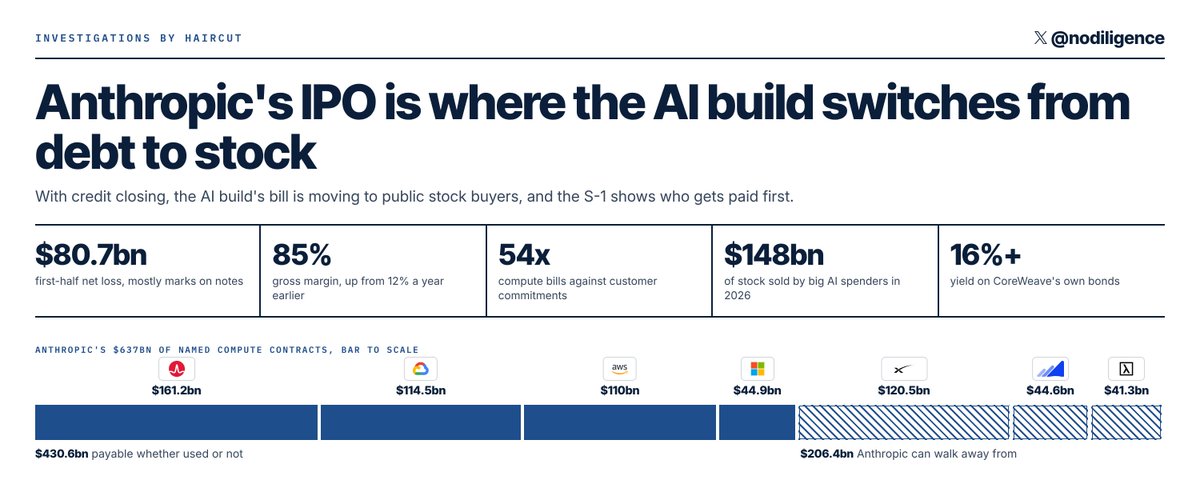
Anthropic's S-1 shows where the AI money goes:
- Broadcom $161bn
- Google $114.5bn
- Amazon $110bn
- SpaceX up to $84.5bn
- Microsoft $44.9bn
- AMD 2 GW (undisclosed)
That's ~$500bn of compute locked in across every major chip maker. No other AI lab is this diversified and every dollar Claude earns lands in Big Tech's backlog.
$AVGO $GOOGL $AMZN $SPCX $MSFT $AMD


A year ago Anthropic spent $2.84 to bring in every dollar of revenue. Today its operating loss is just 4% of revenue which is insane $693mn on $16.3bn.🤯
Ignore the $80bn net loss you'll see in headlines by these bears.
$72bn of it is a non cash accounting charge on convertible notes and it gets bigger the more the company is worth.
In other words, the scary number is a side effect of success. The more important stody is that the most compute hungry business in the world is almost at break even while growing 14x.

Money Mark retweeted

I am shocked, absolutely shocked, that Anthropic ARR has likely gone vertical in October after they cut token prices.
Except the exact same thing happened for the entire AI market, which is why GPU rental prices have surged while token prices declined.
$100b plus in year-end ARR looks possible again.


🚨𝐀𝐈: 𝐄𝐧𝐨𝐮𝐠𝐡 𝐢𝐬 𝐄𝐧𝐨𝐮𝐠𝐡!🚨
Stock Talk Live is LIVE... NOW!!
youtube.com/@MoneyMarkStocks
* Is the AI trade finding a bottom?
* Did Ken Griffin REALLY say AI is a bubble?
* Did this week's earnings embolden the bears?
* What are my top picks RIGHT NOW???
𝐒𝐭𝐨𝐜𝐤 𝐓𝐚𝐥𝐤 𝐋𝐢𝐯𝐞 is... 𝐋𝐢𝐯𝐞!
tinyurl.com/MoneyMarkLive
The Wall Street vet who has covered Tech & AI since 𝐭𝐡𝐞 𝟏𝟗𝟗𝟎𝐬 gives his latest update, 𝐓𝐎𝐏 𝐇𝐎𝐋𝐃𝐈𝐍𝐆𝐒, and answers to 𝐘𝐎𝐔𝐑 𝐐&𝐀 with our global audience of 𝟏𝟎,𝟎𝟎𝟎 𝐟𝐨𝐥𝐥𝐨𝐰𝐞𝐫𝐬...
We highlighted $𝐀𝐄𝐇𝐑 @ $𝟑 !!! Also, $NVDA @ 40, $MU @ 100, $ARM @ 100, $MRVL @ 70, $KRKNF @ $0.60, $OPTX @ 4.50 (and 𝐨𝐯𝐞𝐫 𝟓𝟎 𝐨𝐭𝐡𝐞𝐫 𝐭𝐫𝐢𝐩𝐥𝐞𝐬!)🚀
🔥𝟏𝟓 𝐲𝐞𝐚𝐫𝐬 𝐨𝐟 𝟒𝟎% 𝐚𝐧𝐧𝐮𝐚𝐥 𝐫𝐞𝐭𝐮𝐫𝐧𝐬!!🔥
NO picks closed at a loss since MAY... of 2024 !
What do you expect from the guy who literally...
* Sold picks to Wall St in the '99 bubble
* Was paid by JIM CRAMER'S funds!
* Called the rise/fall of MoviePass (& was in the movie!)
$AEHR, $AKAM, $AVGO, $CRM, $CVV, $CXDO, $DELL, $DBOXF, $DRAM, $DRSHF, $EVLV, $GEODF, $GKPRF, $IDN, $INFU, $IREN, $ITMSF, $IWM, $IZEA, $KRKNF, $KRMD, $MRVL, $MSFT, $MU , $NOW, $NVDA, $OKTA, $OPTX, $RDCM, $SMCI, $SPCX, $TPCS, $TRAK, $TSSI, $TWLO, $USIO, $VTSI, $WATT
markgomesstocks.wordpress.co…
🚨𝐀𝐈: 𝐄𝐧𝐨𝐮𝐠𝐡 𝐢𝐬 𝐄𝐧𝐨𝐮𝐠𝐡!🚨
* Is the AI trade finding a bottom?
* Did Ken Griffin REALLY say AI is a bubble?
* Did this week's earnings embolden the bears?
* What are my top picks RIGHT NOW???
𝐅𝐢𝐧𝐝 𝐨𝐮𝐭 𝐚𝐭 2PM 𝐨𝐧 𝐒𝐭𝐨𝐜𝐤 𝐓𝐚𝐥𝐤 𝐋𝐢𝐯𝐞!
youtube.com/@MoneyMarkStocks
The Wall Street vet who has covered Tech & AI since 𝐭𝐡𝐞 𝟏𝟗𝟗𝟎𝐬 gives his latest update, 𝐓𝐎𝐏 𝐇𝐎𝐋𝐃𝐈𝐍𝐆𝐒, and answers to 𝐘𝐎𝐔𝐑 𝐐&𝐀 with our global audience of 𝟏𝟎,𝟎𝟎𝟎 𝐟𝐨𝐥𝐥𝐨𝐰𝐞𝐫𝐬...
We highlighted $𝐀𝐄𝐇𝐑 @ $𝟑 !!! Also, $NVDA @ 40, $MU @ 100, $ARM @ 100, $MRVL @ 70, $KRKNF @ $0.60, $OPTX @ 4.50 (and 𝐨𝐯𝐞𝐫 𝟓𝟎 𝐨𝐭𝐡𝐞𝐫 𝐭𝐫𝐢𝐩𝐥𝐞𝐬!)🚀
Stock Talk Live is LIVE at 2PM !
tinyurl.com/MoneyMarkLive
🔥𝟏𝟓 𝐲𝐞𝐚𝐫𝐬 𝐨𝐟 𝟒𝟎% 𝐚𝐧𝐧𝐮𝐚𝐥 𝐫𝐞𝐭𝐮𝐫𝐧𝐬!!🔥
NO picks closed at a loss since MAY... of 2024 !
What do you expect from the guy who literally...
* Sold picks to Wall St in the '99 bubble
* Was paid by JIM CRAMER'S funds!
* Called the rise/fall of MoviePass (& was in the movie!)
$AEHR, $AKAM, $AVGO, $CLFD, $CRM, $CVV, $CXDO, $DELL, $DBOXF, $DRAM, $DRSHF, $EVLV, $GEODF, $GKPRF, $IDN, $INFU, $IREN, $ITMSF, $IWM, $IZEA, $KRKNF, $KRMD, $MRVL, $MSFT, $MU, $NOW, $NVDA , $OKTA, $OPTX, $RDCM, $SMCI, $SPCX, $TPCS, $TRAK, $TSSI, $TWLO, $USIO, $VTSI, $WATT
That's not what he said. Once again the 10,000 clowns are click baiting 🙄

Citadel founder and CEO Ken Griffin says investors are “almost certainly” in the midst of an AI bubble during an interview with Bloomberg's Dani Burger at Citadel's annual Future of Global Markets Conference in New York youtu.be/mV1V0FXixDE
Money Mark retweeted
Elon Musk says there's no AI demand issue and explains why SpaceX rents its compute on short-term contracts: AI compute is worth more per watt every year, renewals are coming in at higher prices, and the market is a “cheese shop” with no chips left
“Our belief is that the value of compute per watt will increase over time, not decrease. And the reason for that, I think it should be obvious to people really, is that as you improve the AI software, as the models get better and better, they’re able to, you get more useful intelligence per watt. And the value of that compute is proportionate to the useful intelligence per watt. And that’s why you see things like even old computers like H100s renting for more than they rented when they were new.”
“And I think that’s likely to continue. I think we’re going to face a shortage of superintelligence compute. And that shortage is going to remain for a long time. So, I think the smart move is to do short-term contracts and to essentially place the bet on useful intelligence per watt increasing rapidly, which obviously is done, so that’s what’s happened so far.”
“And also if you look at, say, how are our short-term contracts renewing? Are they renewing at higher dollars per watt or lower? And we see them renewing at higher dollars per watt, not lower dollars per watt. We are also frankly hounded relentlessly by every hyperscaler and by dozens of smaller companies to rent more of our compute. So we could rent out our compute several times over if we said yes to everyone. That’s just the situation here.”
“That’s why I posted that sort of video meme of the Monty Python cheese shop sketch where the guy goes into a cheese shop to get some cheese and they actually have no cheese. And so he goes like, what about this kind of cheese? What about that kind of cheese? And they really just don’t have any cheese.”
“So we’ve actually tried to offload some of our inference compute to other cloud providers so that we can use more compute for training. And we get the cheese shop sketch. You know, they’ll say, like, well, we’ll ask them about what about some, you know, GB300s? Nope, don’t have any of those. What about, you know, some GB200s? Nope, don’t have any of those. What about some TPUs? Nope. What about some Trainiums? Nope. What about some, okay, how about some H100s? And like, well, we might have some overseas somewhere and then they’ll check and come back and say, nope, we don’t have that either. So it’s like ridiculous.”
“Yeah. So I don’t think we’re going to have a demand issue here. And like, it’s not impossible. I’m not saying this will happen. It’s not impossible that we will have a six-month payback period for compute next year.”
Elon Musk says Starlink connectivity revenue has “a clear path to several hundred billion dollars,” and promises a separate presentation on the plan
“Yeah, I think we probably should do a longer presentation on the game plan for Starlink connectivity and why we think it will ultimately be a business that generates several hundred billion dollars in revenue a year."
"Because you are missing some of the pieces that we know about internally. I can say we do see a clear path to several hundred billion dollars a year in connectivity revenue."
"But I think we should probably describe that in more detail in a forum that’s not limited to a few minutes at an earnings call.”
Here's my current $AEHR risk/reward chart. Discussed this one on Friday's edition of Stock Talk Live youtube.com/live/u1KCg0VenpY…
