




NHID-Clinical retweeted

An FDA-cleared AI delirium monitor is now launching commercially for ICU use.
Ceribell's system uses a wearable EEG headband and AI to continuously track brainwave patterns associated with delirium, alongside seizure monitoring. Its delirium function received FDA clearance in December 2025.
The tool is intended to support screening and monitoring alongside clinical assessments, not diagnose delirium on its own. Ceribell says the launch follows a pilot across several hospitals.
The appeal is clear: delirium, particularly when patients appear unusually quiet, can be difficult to catch during intermittent assessments.
But the announcement doesn't report controlled evidence that continuous AI monitoring reduces delirium duration, ICU length of stay or mortality. Whether better monitoring leads to better outcomes is what matters next.
Source: Ceribell, November 2, 2026.

NHID-Clinical retweeted

Coding agents are most useful on your real repo. A sandbox gives them a safe place to work.
Docker Captain @ghumare64’s latest guide shows you how to isolate agents like Claude Code, set what they can reach, and keep your credentials private.
Every example comes from a real recorded run: bit.ly/4ik9gNR

NHID-Clinical retweeted

Got an AI engineer interview coming up?
These 25 questions come up again and again. Prep them and you'll walk in ready:
• What's the difference between a chatbot and an agent?
• How does an agent decide which tool to use?
• Explain the reasoning loop: think, act, observe, repeat
• When would you use RAG instead of fine-tuning?
• How do embeddings and vector databases work together?
• How do you handle a context window that's too small?
• Short-term vs long-term memory: how would you design both?
• What is MCP and why does it matter?
• Single agent or multi-agent: when do you pick each?
• How does an orchestrator split work between sub-agents?
• How do you stop an agent from looping forever?
• What guardrails would you add before giving it real tools?
• Where should a human approve actions?
• How do you evaluate whether an agent actually works?
• What metrics would you track in production?
• How do you debug an agent that gave a wrong answer?
• How do you reduce hallucinations?
• How do you cut token cost without hurting quality?
• How do you reduce latency in a multi-step agent?
• How would you handle a tool call that fails?
• How do you protect against prompt injection?
• How would you design an agent that books flights?
• How would you design a customer support agent?
• What breaks first when you scale agents to 1M users?
• Tell me about an agent you built and what failed
Most candidates can explain an LLM.
Very few can design a system around one.
Bookmark this and send it to someone with an interview this month.
NHID-Clinical retweeted

Grok Bot will not take no for an answer from Insurance Companies!
Insurance denied your claim? Don't just eat it. My new Grok Bot, Claim Denial Fighter, reads the denial, drafts the appeal and tracks every deadline. ReadMultiplex members got it first. Now it's yours: x.ai/bot/6J_YPko7HNztETQzvBY…
What did your insurer deny?

NHID-Clinical retweeted
Synthetic clinical data has huge potential, but I wonder how well it captures the complexity of real patients, particularly unusual presentations and rare conditions. If we're training AI on generated data, how do we make sure we're not just reinforcing existing biases and inaccuracies?
NHID-Clinical retweeted

Can fake doctor's notes train better medical AI? New in @npjDigitalMed: @uni_lu researchers reviewed 87 studies on synthetic clinical text. ChatGPT shows up in 47 of them, and utility is how most teams judge the results nature.com/articles/s41746-0… #DigitalHealth #AI

NHID-Clinical retweeted

If you’re a doctor, healthcare startup founder, or healthcare educator.
Let’s connect.
NHID-Clinical retweeted

BREAKING: Microsoft offering 60,000 employees money to quit, as it transitions spend from humans to datacenters.
NHID-Clinical retweeted

Voice AI Space grew by 8 subscribers today on @beehiiv. Subscribe below 👇🏽 voice-ai-space.beehiiv.com/s… – at Balma, France

NHID-Clinical retweeted
JUST IN: Anthropic bans Claude Code from recreating existing video games amid a viral trend of developers using AI to reverse-engineer popular games.
NHID-Clinical retweeted
60% of Americans say they'd be uncomfortable with their doctor using AI to diagnose or treat them.
A new Pew Research Center survey of 3,488 US adults found some interesting differences in how people feel about AI depending on what it's being used for.
78% were open to AI helping with translation, while just 3% were comfortable with AI making diagnoses independently. When human review was included, acceptance of AI-assisted diagnosis was considerably higher.
I think this highlights something important for hospitals implementing AI. Patients aren't necessarily opposed to the technology itself. They seem much more comfortable when AI is supporting healthcare professionals rather than replacing their judgment.
And it's not just about accuracy. People are also concerned about privacy and how AI might affect their relationship with their doctor.
As AI becomes more embedded in healthcare, involving patients in implementation and explaining where human oversight fits into the process could be just as important as demonstrating that the technology works.
Source: Pew Research Center, October 2026.

NHID-Clinical retweeted
JUST IN: Cisco's Chief Product Officer gives a Gen Z engineer unlimited AI tokens to vibecode a rewrite of 98% of the company's legacy code within 2 years.
NHID-Clinical retweeted

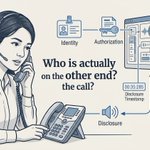
sounding legitimate was never the hard part... the hard part was figuring out who sent the caller and what it was allowed to hear, so that's the part i built for

Voice is not identity.
This week NewsNation ran several stories that show why. In one, a cloned voice convinced a mother her daughter had been kidnapped. In another, a deepfake doctor sold supplements through paid ads on legitimate sites. A fake officer nearly collected a jury-duty "fine." And an 86-year-old moved almost $500,000 while three institutions watched transactions she had never made before.
In every case, the attacker borrowed trust that should have been verified.
Healthcare phone lines face the same problem, with AI agents calling payers and claiming to act for providers. A cloned voice, a spoofed number, or a fabricated NPI can each sound legitimate. None of them proves who authorized the call or what the caller is allowed to see.
NHID-Clinical doesn't try to out-detect voice cloning. Its controls apply before protected data moves: has the caller disclosed it's non-human, can it show delegated authority, and does the request fall within that authority.
The better the fakes get, the more these decisions matter. Which of them does your intake process actually make?
#AIGovernance #VoiceAI #HealthcareSecurity #NonHumanIdentity
NHID-Clinical retweeted

🚨 BREAKING: Apple has warned iPhone users in 99 countries that mercenary spyware is targeting them.
Lebanese journalist Radwan Mortada is one. Apple had already warned him in 2021.
He says he doesn't know if this attack is linked to his film on Lebanon's 2024 pager explosions.


NHID-Clinical retweeted

Students targeting AI/ML Engineer roles in 2026, this is a goldmine.
buncho.live
NHID-Clinical retweeted

Agreed. Two I’d add for healthcare evals: does it share only what the request actually needs, and does it decline gracefully when it can’t verify instead of guessing? Will NHID-Clinical score partial disclosures, or just pass/fail?
NHID-Clinical retweeted

Introducing the Google AI for Healthcare Professionals Certificate, practical training developed by clinicians at Google to help healthcare professionals use AI responsibly in their daily work.
NHID-Clinical retweeted
JUST IN: OpenAI announces it is doubling usage limits for all Pro tiers & Business Premium, effective immediately.
NHID-Clinical retweeted
As hospitals adopt more AI tools, how are they supposed to keep track of what's being used, who's responsible and whether the technology is still performing safely?
Mass General Brigham has announced it's implementing Trustible's AI governance platform to help manage this.
The platform will support the health system's existing governance processes, including reviewing new AI applications, assessing risks, documenting approvals and maintaining an inventory of AI tools.
They're also exploring more structured vendor assessments and ongoing monitoring after deployment.
I think this is an area that's going to become increasingly important as healthcare organizations adopt more AI.
It's one thing to evaluate a tool before purchasing it. But what happens when a vendor updates its model? Who checks whether performance has changed? And how do you keep track of dozens, potentially hundreds, of AI applications across a large health system?
Having a structured process and clear accountability seems essential. Whether a dedicated platform makes that process more efficient and effective is something I'd be interested to see evaluated.
Source: Trustible / Mass General Brigham, October 2026.
