

Entirely self taught. I love of coding, games, history, and languages. Help my friend: https://nitter.cf/t.co/EYLJ4veaRn https://nitter.cf/t.co/w4SBs1WzZt
Joined February 2025
- Tweets4.9K
- Following2.8K
- Followers1.5K
- Likes13.1K







Nathan Merzke retweeted

In honor of a legend.
Patrick Stewart voicing King Richard in Lands of Lore: The Throne of Chaos (1993/94, Westwood Studios).

I personally think "vibe coder" is a misnomer. "Vibe coder" should mean someone who programs while high, drunk, and/or listening to blues or jazz music.
Instead, whether AI is involved:
If you produce or work on software, you are a developer.
If you make design decisions (game rules, how something should appear), you are a designer.
If you make a architectural decision (serialization strategy, whether to use an ECS), you are an engineer.
Only if you are making coding decisions are you a coder or programmer.
Nathan Merzke retweeted

I want to try a little experiment on X. 🌍
How many countries can ONE post reach?
If this post appears on your timeline,
just reply with the country you're from.
No need to follow me.
No need to repost.
Just your country.
Let's see how far one post can travel around the world.
Can we reach 100 different countries?
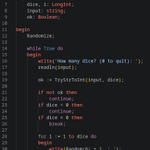
I did not realize until recently that Pascal was still alive and kicking. It might not be for everything, but it can still do work.
A Pascal dice roller.


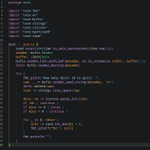
Odin has some similarities to Go, but I overall like it more, at least with the limited exposure to both that I have had.
Odin dice.

Wide adoption of a process or technology is not a proof of inherent superiority over the alternatives. In fact, it is often simply the easiest or cheaper option.


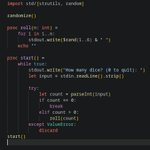
It isn't very well known, but Nim should actually be considered when discussing beginner friendly languages.
A dice roller.


While I generally think C or D are better programming languages to start if you want the best foundation, the fact that with just a text editor and a browser you can make a full application using HTML+CSS+JS is impressive.
I made a console style dice roller.


One role that will be overlooked by many when remembering Sir Patrick Stewart, my favorite has to be Khelben "Blackstaff" Arunson in the game Demonstone.


Nathan Merzke retweeted

A std::string in LLVM's libc++ can hold up to 22 characters without allocating any memory on the heap.
The entire string object is just 24 bytes on common 64-bit systems.
For longer strings, those same bytes store a pointer, length, and capacity instead.
the trick is small string optimization (SSO): a union that lets the string reuse the same memory for two completely different representations.
On a typical 64-bit system, both representations fit in 24 bytes.
the string doesn't need a separate allocation until it outgrows its own object.


Nathan Merzke retweeted
Sometimes you gotta try a different path.
Panzer General (SSI, 1994) was a highly popular turn-based strategy game and a significant style shift from SSI's earlier games. The biggest change was its simplified design and interface compared to prior SSI titles, which were rooted in complex war/strategy simulations, appealing to a smaller niche of (hardcore) players.
Panzer General's structure was much simpler compared to SSI's traditional deep, simulation-heavy titles like those from Gary Grigsby (e.g. Panzer Strike, Battlegroup or Typhoon of Steel). This move opened up their games to a more mainstream audience - and ultimately making Panzer General a commercial success.
Sequels such as Fantasy General (1996) or Allied General (1995) were based on the same engine, and also highly successful. SSI was suddenly not just for hardcore strategy-gamers anymore but a fan favorite among casual gamers, too.
I always liked turn-based strategy games (Battle Isle, Master of Orion, Civilization), so Panzer General was one of the many classics of the 90s, arguably the peak decade for such games.