

Solving policy challenges with legislative expertise, strategic communications, and coalition building. Former U.S. House staffer. Senior Fellow @aftfuture
SoCal | DC
Joined October 2014
- Tweets550
- Following547
- Followers575
- Likes321







This is what we need to be sharing about AI. It’s taken for granted now, all the daily and terrific things it does for people. Does AI pose infrastructure and ethical challenges? Of course. But don’t throw the AI out with the data centers. We can figure this out.

I know I'm gushing about AI a lot lately, but it's sincere and if anything playing down my excitement.
I LOVE building things. It's why I sew regularly, have a leather hole punch, do my own nails, dye my own hair, and have way too many kinds of glue. It's also why I love Zapier! Building automated workflows is so fulfilling.
And now AI intensifies all of my abilities here—making an offline lighting tracker for hiking, a full on video editor, creating Zapier Zaps for me, helping me sort my sewing machine needles, working through DIY methods with me.
It's like Christmas many times over
This is some of the best research I have read so far on data centers, AI, and the election. It is deeply sobering and also shows there is a path forward for AI in the US: real community involvement and tangible benefits. An over implication to be sure, but also a good start.

I had Claude Code run 100 agents to analyze candidate positions on AI and datacenters. 92% of Democratic Gov nominees and 87% of Republicans supported either moratoria or additional conditions on development. Bipartisan baseline is that data centers should pay their own infrastructure costs rather than shifting them to residential ratepayers. lnkd.in/p/eSC7BuP5
The 2026 exit polls found that 76% of voters opposed new data centers in their communities, 57% believed AI would do more harm than good, and 43% trusted neither party more on AI. AI and data centers ranked last among five issues tested, yet 56% considered them crucial or major factors in their congressional votes.
Among voters under 30, 88% opposed local data centers, compared with 70% of voters 65 and older. Opposition reached 82% among women versus 69% among men. White college graduates and non-college voters were remarkably similar, at 77% and 74% opposition. The backlash cannot be explained simply as a rural, older, or less-educated phenomenon.
Of the 44 ballot initiatives, 33 focused on limitations: dashboard-production-c2fc.up…
Two results are worth watching as models. Perry, Ohio, voters approved by 87% a requirement that hyperscale developers seeking tax incentives post financial guarantees, a conditions-based approach rather than a ban. Grove City, Ohio passed a requirement for voter approval of any project over 50 acres, 20 megawatts, or 500,000 gallons of water per day leading 55 to 45 percent. Could become part of the work going forward.

What could the next Congress look like for AI? Targeted bills, not frameworks, on AI and workforce development, cybersecurity, government use of AI, and education and AI.
Last night was a stress test for Republican governance and a partial roadmap for regaining voters' confidence. Republican leadership should take the first quarter of 2027, get outside Washington, DC, and go on the road to get yelled at by voters. Listen to them. Find out how we failed them and where we succeeded. Let the Iowa farmer, the struggling worker, the single mom trying to make ends meet build back our agenda.
What AI bills could move in the lame duck? Keep your eyes on the AI for Main Street Act (H.R. 5764), which passed the House 395–14, and maybe the Ratepayer Protection Act (H.R. 9340), which passed the House 417–3 but fell three votes short of cloture in the Senate.
A timely piece from my friend @nathanleamer. Effective altruism may be a modern movement, but its intellectual temptations are ancient. There’s more than a little Gnosticism in the belief that an enlightened few possess the knowledge needed to save humanity.

For years I have read @TGC, so it was an honor to write this essay on the shortcomings of the secular philosophy of Effective Altruism.
At first glance, its call to do the most good possible sounds like something Jesus might say.
Yet Christianity places those truths inside a much larger story, one where goodness is defined not by our calculations but by God himself.
thegospelcoalition.org/artic…

Another reason @JoinFAI is such a fun and effective organization: it takes the time to explore ideas like using ocean waves to power AI workloads.
Great piece by @SohamThoughts on @_panthalassa and the possibilities of offshore data centers.
thefai.org/posts/ocean-futur…

This is great and will be a must-read for me (it should be for everyone else interested in what an experienced Washington DC pro has to say)!

Bringing back something I did for years on Capitol Hill — sharing a few things I’m watching around Washington.
Congress, political spending, what’s happening around @S2RPubAffairs, the Browns, and Blessed Fulton Sheen.
My latest here: linkedin.com/pulse/few-thing…
Thank you @andashleysays for having me join @PaulSteidler and @KevinTFrazier on today’s webinar panel @CmteForJustice on all things AI!
One of the best teams working on tech policy in Washington DC. Don't miss this opportunity (and their events are righteous as well).


.@LEHogg and @JoshuaTLevine have been at the forefront of studying and explaining the importance of submarine cables for a while.
The internet is nearly 1.2 million miles of fiber optic cable running across the ocean floor, carrying the global economy, national security and the future of AI.
A remarkable piece on the physical infrastructure that makes the digital world possible, and why America must keep building it. 👇

The world’s most consequential infrastructure is a bundle of glass fibers under miles of water, doing its work so quietly that we only remember it exists when it breaks.
@JoshuaTLevine and I unpack the complex world of submarine cables.
New in @arenamag:

.@RyanFedasiuk writing on AI is always must read. This piece is no exception. Share this and bookmark it. Some of the best analysis on Kimi K3 is right here: “Kimi K3 is not exactly downloadable to your laptop. In fact, very few organizations on Earth will be able to host it locally—and understanding this fact reveals a deeper, important trend in the direction of the Sino-American contest to deploy AI services.”

We can’t ignore what just happened. The American moat in AI software is not as strong as many of us had hoped.
It’s time to recognize the AI race for what it really is: an industrial systems competition to build and install compute.
My latest for @AEI:
aei.org/foreign-and-defense-…

Neil Siefring retweeted

Tomorrow at 3:30 PM: The Fall of Humphrey’s Executor: Trump v. Slaughter and the Future of the FTC
Join us (@CmteForJustice) for a discussion with former FTC Commissioner Joshua Wright (@JoshWright1977) and Ilya Shapiro (@ishapiro) of @ManhattanInst.
Register: bit.ly/HumphreysSlaughtered
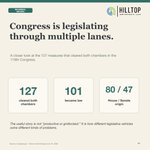
I reviewed the 127 measures that cleared both chambers of Congress this session through June 16 and a clear pattern emerges: Congress is legislating through several distinct channels, each with its own pathway to completion.
Here is what the bicameral record reveals. 🧵
Much of the work that crosses the finish line is built in committee around clearly defined, jurisdiction-specific problems. Specificity creates a workable path: a clear objective, an identifiable constituency, and a legislative vehicle designed to finish.

Congratulations are in order. I worked for an appropriator, and I appreciate how difficult it is to move these complex bills. Advancing them through regular order is a significant accomplishment and a testament to a well run committee.


