
Trying learn to live with doubt, uncertainty, and not knowing. (he/him)
New York, USA
Joined June 2009
- Tweets3.3K
- Following666
- Followers532
- Likes5.1K




Pinned Tweet
Why'd I do it?
nitter.cf/jhaushofer/status/1641…
TL;DR
Malengo targets education AND migration, which are fundamental to improving the world. Malengo's clever design makes it scalable and sustainable, meaning it has amazing potential if it can attract investors and donors.

Please meet Malengo's inaugural investor: Richard Nerland (on the right). (Also meet Melanie and Rose in supporting roles!) He's originally from Canada and is an economist at Citadel. Thank you for your patience, and $3.5m of support @Nerland87!

Richard Nerland retweeted

Very proud that today we’ve launched our new @WorldBankGroup report on Sub-Saharan Africa’s Urban Awakening: Catalysing Economic Growth & Job Creation. And many thanks to our partners, inc EC-JRC & @AfricaUrbanLab, on the report’s preparation. Download below 👇

Sub-Saharan Africa needs to create 15 million jobs each year for its growing workforce.
By 2050, 1.7 billion are projected to live in the region's cities.
📘 New @WorldBankGroup report explores how urban growth can translate into jobs and opportunity: bit.ly/3UmA5YG

Richard Nerland retweeted

🚨🚨New AUL Working Paper: “Tax Productivity & Economic Development” by @AfricaUrbanLab Fellow @AbdoulayeNdiaye and co-authors @RGoyal02, Anders Jensen, @LagakosDavid, & Yuntian Zhao.
Poor countries get $30 in revenue per $1 spent collecting taxes. Rich countries get $270! 1/

Richard Nerland retweeted

New paper:
Cities in South Asia are hotbeds of upward mobility for everyone, but especially for women.
This is the urban-minus-rural difference in the adult education rank of a child growing up in a bottom-half household. 🧵 1/

Richard Nerland retweeted

In 1995, 7 in 10 Nepalis lived in extreme poverty. By 2022, fewer than one in 40 did. Why, how? Migration.
@MaheshShrestha_ for @indevmag:
indevelopmentmag.com/moving-…

Richard Nerland retweeted

Other explanations are less sympathetic.
One school said it raised prices after gaining access to federal funding.
Another openly admitted it raises tuition when Pell Grants go up.

Richard Nerland retweeted

The development economics community is not AGI-pilled enough. The possibility is real and the stakes are high.
Imo, the main question is how poor countries can accelerate their growth after AI causes a frontier growth acceleration.
Here's a plan you can disagree with:


What do dad's think about when they are on paternity leave with a newborn?
Follow Greg to find out.

Richard Nerland retweeted

📄 Expenditure and Revenue: Two sides of the same coin?
Our latest blog post, by @astihaas, Lecturer & Fellow at the Africa Urban Lab, is out! Astrid explores why budget execution belongs at the center of the conversation on municipal revenue in Africa.
Underspending gets far less attention than revenue mobilization in African municipal finance. Cities raise the money, it sits in the budget, and the investment step does not follow. Kisumu, Kenya, spent just 32% of its budgeted capital expenditure in the 2019/20 financial year. In Nakuru, Kenya, development budget absorption fell from 9.4% in FY2018/19 to 8% in FY2024/25.

This!
Also, make another for entry by firms to global value-add chains.
Richard Nerland retweeted

Attracting top talent is one of the most popular pro-growth policies we have, yet the progress and abundance movements treat it as too dangerous to touch. I argue it can and should be unbundled from the rest of the migration debate now holding it hostage:

Richard Nerland retweeted

Global call center employment seems to now be dropping even in LMICs (data from @RevelioLabs via @a16z)


Call center jobs grew ~4% annually for 15 years
Now they’re shrinking 4% annually
Charts of the Week: a16z.news/p/this-week-in-cha…

The white pill is applying this logic to politics.

Assorted things I've been mulling over regarding agents in the economy:
• Companies are in some sense the original superintelligence. It's often the case that they can use their amortized cognitive surplus to advance their interests against those of certain consumers: relative to the optimization capacity of companies, consumers can be inattentive, underinformed, irrational, etc. (Think, say, of some of the classic insurance upsells at the end of a booking process, which is typically priced substantially above what a regular policy would cost.) Herbert Simon introduced the idea of bounded rationality, and firms often end up benefiting from it. Thanks to personal agents, we will probably get somewhat more rational in how we engage with companies.
• How exactly will outcomes change? Well, certain kinds of price discrimination will work less well (how do coupons work if every agent hunts fastidiously for them?), and certain kinds of customer cross-subsidy will change (today, people who forget to cancel subscriptions subsidize those who don't). Taken across the economy as a whole, I'm not sure what the incidence of all of this will be.
• In corporate strategy, people have long debated the relative importance of distribution and product quality. Perhaps you've made something better, but does anyone know about it? Won't people just continue to buy the ACME Corp Mousetraps? Personal agents will, I think, act as a kind of structural subsidy for product quality. How would markets look different if individuals always spent at least 10 hours researching their purchases? On the margin, focusing on making a product better is, I think, going to become a more effective strategy for companies. This is good!
• It true, a corollary is that information about product quality will become more important and impactful. Today, most people have very limited ability to aggregate and integrate such data, but agents will have insatiable thirst for such signals. (It's often said that data is becoming more valuable because it helps in the training of models. That's obviously true, but I think there's a secondary way in which it's more valuable simply as a complement to cheaper intelligence.)
• A big question is whether agents will increase superstar effects (rational agents all settle on the same product) or increase dispersion (because everyone has slightly different tastes and preferences, which agents are good at eliciting, finally overcoming the artificial clustering we've been subjected to).
• Many internet companies have monetized demand routing, which is in turn often predicated on short attention spans. "I'll click on the first thing I see." This has led to some amount of inefficiency, as companies try to propitiate capricious ranking algorithms and incur various placement fees. It's not all deadweight loss (willingness to pay is itself a kind of signal, which is valuable to buyers), but it's not great. How will the nature and value of this routing change in a world of personal agents? I don't know the answer, but I think that the effects might be pretty big.
• Much of what I'm writing hinges on the assumption that personal agents will be on the consumer's side. I suspect that that will be the winning strategy, but whether it's true, and what it means to be true, involves a lot of other questions.
Taken as a whole, the market is a massively parallelized, decentralized, and highly imperfect value attribution machine, and, taking stock of all of the effects, it seems to me that the quality point may well be the biggest: that agents will change the nature of the backpropagation such that the rewards for better products increase. Maybe this is too optimistic, but I suspect (and hope) that companies that make things that they're proud of will feel that the universe is a little more partisan in their favor.
Richard Nerland retweeted
🎙️ New Episode of the Africa Urban Lab Podcast: Ken Opalo on State Building, Urbanization & Economic Growth
In this episode, Africa Urban Lab Founder & Executive Director @kurtislockhart sits down with @kopalo, Associate Professor at @Georgetown’s School of Foreign Service and writer of An Africanist Perspective, to explore state capacity, economic growth, political institutions, and development across Africa.
Ken describes urbanization as a potential “cheat code” for state building, explaining how cities can make populations easier to reach, strengthen public service delivery, and generate the revenue needed to support growing populations. He also explores why practical urban planning and infrastructure matter, and how subnational politics shape the way states develop.
🎧 Listen Now!
Spotify: open.spotify.com/episode/1NS…
Apple Podcasts: podcasts.apple.com/us/podcas…
YouTube: youtu.be/tVEotnAt_cs?si=RZUX…
You can also listen to all of the Africa Urban Lab Podcast episodes on our website: aul.city/podcast
Richard Nerland retweeted

Suppose every development economist stopped working tomorrow. No more papers, RCTs ground to a halt, and the whole field shut down overnight.
Would Africa’s growth rate in 2040 look any different?
This was my first question to @kopalo in today's podcast, links below :)


We did it everybody! Life satisfaction is strictly increasing in age.
There were a lot of biological barriers to this outcome but we managed to build a society to overcome them.

Fighting totalizing EA is like combatting bias in your optimization. Max on noise and you pick what your model is most wrong about.
We have tools to fix this:
learning rates (10% more), trust regions (common-sense morality), ensembles (pluralism), pessimism under uncertainty.


Had a kid so I rewatched past my age 10 ceiling and a lot of bangers!
Herc, Mulan, Emperor's new grve, Lilo & Stch, Treasre Planet, Pixars first 11 (up to Toy Story 3), Prncss & Frog, Tangled, Wrck-it Rlph 1 & 2, Frozen, Big Hero 6, Inside Out 1 & 2, Moana, Coco, Encanto, Soul.

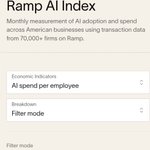
Again, Ramp AI index is very cool and fun to search.
Top 1% employee token spend at large tech companies exceeds 100k now! Jealous!!!


"The people have ye served and the people's superstition — not the truth! — all ye famous wise ones!"
