

EMBER app coming to mobile 2H26. AI empowered trading built by pros for retail and instutional traders. Free Newsletter on Substack.
Not Financial Advice
Joined March 2020
- Tweets13.8K
- Following148
- Followers3K
- Likes11.1K




Hacks are long term bullish AI. Short term bearish. Only way to fight Ai swarms is with AI swarms. We should be hearing about frontier @OpenAI and @AnthropicAI offering cyber security swarms to capitalize on the news.

This is what people who think this is dot com don't understand. And it really doesn't matter but is a simple IQ test-
1. There is literally no similarity between now and dot com. None. Economy is different. The businesses are different. The kind of inflation we have is different. It is not a case of idiots saying "oh this time is different" -like you can't even find a meaningful similarity. People like DY keep sharing stupid fake news stories about the AI build already being overdone and token costs dropping being an issue but this data is so fkn easy to find and none of it supports this fake news bs. Just lazy DD. Rental rates rose yet again this week - literally IMPOSSIBLE if there was a lack of demand. It's so fkn simple.
2. Because of these differences if you are waiting for an AI blow up before the pivot you're completely clueless. The economic data clearly shows that labor will break before AI. Even with the market panic selling there has been 0 reflexivity in AI fundamentals. It's very simple- the entire economy will bust before AI does. The pivot will come before then. And it's also why the market rotation is actually bullish and not bearish.
3. Top? 20/20 midterm elections had a post rally. One year later all had markets higher. So statistically upside is favored here- even if there is a quick sell off event in the short term (~3mo). And the big secular bear market people are looking for likely comes in a different form that people aren't expecting later - cause MARKETS DO LEARN AND ADJUST. 2000 wasn't that long ago. Everyone remembers it. Events rhyme not repeat. Know the differences to actually know the catalyst.

What gold does next has already been determined by today's dovish hold. It's worse than Arthur Burns in the 1970s, who at least raised rates for two years to fight the second wave of inflation. Once the AI bubble bursts, the Fed will lose any chance to hike. Today was likely the last chance to do it. Gold takes off in negative real rates.


This is the kind of thing that only out of touch techies could think is insightful. To everyone else it's profoundly stupid. And rightly so.

NoBellTrading retweeted

"the only economist you should ever trust is the trader"
@Josh_NBT
@WOLF_Terminal
In rapidly growing markets you shouldn't have a scarcity mindset about competition. Share of the pie is meaningless when the pie is still rapidly growing. Applies to both AI and self driving right now. @edels0n
X bulls complain in comments when something only runs 50% and not 100%.
But X bears when they make 2% -
Agreed. But to be fair, the comment he is responding to is pretty stupid.
Wtf is "true value"?
Fundamental value? Stocks only align with fundamentals temporarily once or twice over any decade ever.
And the tech to know the book value of any given stock at any given time has been around since the 2010's. That's not how you should be using AI for edge. You don't need AI to do that.

NoBellTrading retweeted

BREAKING: Hackers target the US Federal Election Commission, knocking its electronic filing system offline just 1 week before the midterm elections. — Reuters
NoBellTrading retweeted
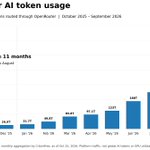
It's not a terrible thesis but it's not really supported by the data. Even when we look at the flattening in spend - actual usage is still rising. Which doesn't imply an overall slowdown. Could just as easily imply Jevons is kicking in as it does with most tech. Which we can see in the September recovery in spend and suggested in the Oct numbers as well.


People are having trouble following the logic in my posts so let me explain
1) top AI spenders are spending less on AI
2) even if overall AI token usage is going up, spend is not going up in line. Their spend = AI related revenue
3) LLMs becoming more efficient = less revenue for more usage
4) the amount companies spent and continue to spend on AI capex is fixed and expects certain amount of revenue to pay it back
5) even with LLMs getting cheaper, and usage going up, companies are spending less because they are cost-conscious and must spend on tokens responsibly. Recent trend shows reigning in costs. Also, note that this is during the "VC subsidized" era of AI compute. Meaning if the real pricing was passed through, companies would be using a lot less as they could not afford/justify the bill.
You can be bullish AI token usage but skeptical on the sustainability of the capex given the expected revenue. It isn't economical. Trillions spent on capex, todays use cases will not pay it back for some time. Revenue from top 1% is already declining, and Ant ARR slower than est which lines up. People will mention open source models, but fail to understand those are even cheaper options which means even less revenue generated in the ecosystem.
Also, much of the top 1% spenders are early stage start ups that require even more VC funding to keep going and burn the cash. If money dries up, people are underestimating the near term impacts on AI compute demand. You can extend this one step further to the frontier labs who are driving a ton of the overall compute demand for internal model development (which does not have tangible ROI to justify/foot the bill). These companies are not able to fund this tens of billions of dollars of spend themselves. This again requires tons of external capital. What happens if that capital is also fleeting? This is also where all the S&P earnings growth is coming from (AI infra, $MU, $NVDA) - aka contagion and earnings could roll over.
The capital is key. It's not infinite. It's not being paid back fast enough to replenish spend. The true demand is being subsidized. The top users are already showing declining spend. This has a big air pocket until the next wave of demand hits (like physical AI). If you can't fund the model training at frontiers, or start ups can't raise as much, we could possibly go from compute constrained to supply glut. Big risk, and you're talking trillions in capex + leverage in the ecosystem. And again the potentially profitable AI revenue from profitable companies is already being optimized for spend (lowering costs).
Cause AI demand is definitely slowing down so much. Keep in mind - this is only what open router can check. Actual growth is much larger.

It's not a terrible thesis but it's not really supported by the data. Even when we look at the flattening in spend - actual usage is still rising. Which doesn't imply an overall slowdown. Could just as easily imply Jevons is kicking in as it does with most tech. Which we can see in the September recovery in spend and suggested in the Oct numbers as well.
People are having trouble following the logic in my posts so let me explain
1) top AI spenders are spending less on AI
2) even if overall AI token usage is going up, spend is not going up in line. Their spend = AI related revenue
3) LLMs becoming more efficient = less revenue for more usage
4) the amount companies spent and continue to spend on AI capex is fixed and expects certain amount of revenue to pay it back
5) even with LLMs getting cheaper, and usage going up, companies are spending less because they are cost-conscious and must spend on tokens responsibly. Recent trend shows reigning in costs. Also, note that this is during the "VC subsidized" era of AI compute. Meaning if the real pricing was passed through, companies would be using a lot less as they could not afford/justify the bill.
You can be bullish AI token usage but skeptical on the sustainability of the capex given the expected revenue. It isn't economical. Trillions spent on capex, todays use cases will not pay it back for some time. Revenue from top 1% is already declining, and Ant ARR slower than est which lines up. People will mention open source models, but fail to understand those are even cheaper options which means even less revenue generated in the ecosystem.
Also, much of the top 1% spenders are early stage start ups that require even more VC funding to keep going and burn the cash. If money dries up, people are underestimating the near term impacts on AI compute demand. You can extend this one step further to the frontier labs who are driving a ton of the overall compute demand for internal model development (which does not have tangible ROI to justify/foot the bill). These companies are not able to fund this tens of billions of dollars of spend themselves. This again requires tons of external capital. What happens if that capital is also fleeting? This is also where all the S&P earnings growth is coming from (AI infra, $MU, $NVDA) - aka contagion and earnings could roll over.
The capital is key. It's not infinite. It's not being paid back fast enough to replenish spend. The true demand is being subsidized. The top users are already showing declining spend. This has a big air pocket until the next wave of demand hits (like physical AI). If you can't fund the model training at frontiers, or start ups can't raise as much, we could possibly go from compute constrained to supply glut. Big risk, and you're talking trillions in capex + leverage in the ecosystem. And again the potentially profitable AI revenue from profitable companies is already being optimized for spend (lowering costs).
big two weeks ahead of us. rate decision this week and big tech earnings. Then midterms next week. boy oh boy. volatility should be JUICY.
We have yet to watch this (we will) but the data clearly shows labor breaks before AI goes to zero. Which means pivot in rates comes before the fundamentals do. Which aligns with our thesis that the last bull phase is ahead and not behind. And it likely ends in a global financial crisis. The data below is from our EMBER app.


HOW @citrini SEES THINGS RIGHT NOW:
AI can design drugs like scorpion antivenom largely on its own (he did it with @claudeai) but the new bottlenecks here are monkeys/testing (rather than compute).
The reflexive risk in financing the AI buildout is REAL.
^it's not 2023 anymore & cash flows can't fund the whole thing so buildout is dependent on financial conditions whose tightening affects fundamentals.
The trade from AI Drug Discovery is to be LONG EXPERIMENTS rather than long the IP itself. Citrini actually thinks the value of early stage assets is going to GO DOWN. The stock he mentions is Charles River (a preclinical testing company that has monkeys is in a shortage that Citrini expects to get more extreme). More names in the piece. $CRL
ENJOY.
Apple
podcasts.apple.com/us/podcas…
Spotify
open.spotify.com/episode/405…
YouTube
youtube.com/watch?v=rzQhjayC…
CITRINI'S PIECE, "Citrini Therapeutics
We Wanted to Use Claude to Create a New Drug. Here’s What Happened.":
citriniresearch.com/p/citrin…
Anthropic's Technical Blog Post, "How Claude designed protein binders against scorpion neurotoxins":
anthropic.com/research/claud…