

Open-source AI for healthcare. 2,000+ Apache-2.0 clinical models. 600+ MLX and 700+ ONNX variants. Built for local and on-device AI. Free, forever.
Joined August 2025
- Tweets2.4K
- Following12
- Followers8.3K
- Likes4.6K




Pinned Tweet
OpenMed 3.0 is out: Patient Journey.
One synthetic patient, five systems: a clinic note, hospital FHIR, an outside clinic's HL7, a lab CSV, a retina DICOM report. They disagree.
3.0 links every fact to its exact source, keeps the conflict open and amends without erasing.

How 3.1 handles overlays, curves, icons and embedded documents:
github.com/maziyarpanahi/ope…
Repo, a star helps others find it:
github.com/maziyarpanahi/ope…
Synthetic phantom and names. The header pass does not OCR the main image; it was declared clean.


Docs for the summary leakage guard:
github.com/maziyarpanahi/ope…
Repo, a star helps others find it:
github.com/maziyarpanahi/ope…
Synthetic names and IDs, scripted summaries. The guard checks what de-identification found and reports counts and a digest, never the value.
Mid-read, you ask out loud: "Compare L4-L5 with L3-L4, and show L4 from the side."
SpineLab Voice measures both discs and turns the 3D spine to match. Fix a landmark, ask again, and it re-measures from your fix.
Liquid AI's LFM3-Audio-2B hears the request and calls the tools.
Engine: @liquidai's LFM3-Audio-2B, from the new LFM3 family. It takes the whole audio clip, no transcript, and emits native tool calls. 6.6 s of speech in, tool calls and explanation out in 2.97 s, locally on a Mac Studio.
huggingface.co/LiquidAI/LFM3…


Miss the pulmonary edema in a discharge note and the problem list is wrong.
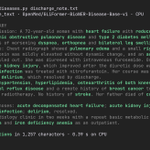
Same synthetic note, same threshold: the original GLiFormer base found 19 disease mentions. Our fine-tune found 26, adding pulmonary edema, a pleural effusion and delirium twice.
Plus three symptoms.

Both models run through the OpenMed SDK at threshold 0.5; the fine-tune's default is 0.7. One note, not a benchmark: the NCBI Disease test results are in the card.
huggingface.co/OpenMed/GLiFo…
Coding, cohort search and problem lists all start by finding every disease a note mentions.
New open model: GLiFormer BioNER Disease Base. It returns each disease mention with exact character offsets: 26 in this synthetic discharge note, 0.39 s on CPU.
huggingface.co/OpenMed/GLiFo…


Release notes and the 3.0 to 3.1 migration guide:
github.com/maziyarpanahi/ope…
The repo, a star helps others find it:
github.com/maziyarpanahi/ope…
Synthetic order, in-memory chart, no FHIR server. Every outcome on the card comes from openmed 3.1.0. Apache 2.0.

93 PRs from 8 contributors went into 3.1. Thank you @BelalWho, @pardeepshergill and, on GitHub, kokokoXUY, janithcd and first-time contributors Fire162, snowyukitty and wufangyong973.
Also new: NLI-checked briefs, governed FHIR writes, atomic OMOP, DICOM and multilingual fixes.
Shall we fine-tune Kimi K3.1 Pro for medical and clinical tasks? Should we make the best medical open frontier AI model? 🔥

Introducing Kimi K3.1 Pro: our most capable 3T-class open-weight model.
🔹 1M-token context, 2.8T total / 104B active params (MoE), Multimodal.
🔹 Full-project coding: games in Unreal, Unity & Godot.
🔹 Excels at parametric 3D modeling in Blender & CAD.
🔹 More reliable at finance work: Accurate modeling with hallucination down by 65%.
🔹 Matching the strongest proprietary models across coding, agentic and knowledge benchmarks.
Kimi K3.1 Pro and K3.1 Pro Highspeed (2–3× faster) are now live on Kimi.ai, Kimi Work, Kimi Code, and the Kimi API.
Open weights by Nov 4, 2026.
🔗 API: platform.kimi.ai
🔗 Tech blog: kimi.ai/blog/kimi-k3-1-pro

The access check in code: one boundary, two views.
A researcher asking for the identified view gets role_denied. The de-identified view answers without a subject id. Withdraw consent and the same clinician request comes back consent_withdrawn.

Docs: github.com/maziyarpanahi/ope…
Runs offline, no hosted policy service. Synthetic data.
