Outis (@Outisemoi) header
Outis (@Outisemoi) profile picture

ἀλλ᾽ ἴθι σιγῇ τοῖον, ἐγὼ δ᾽ ὁδὸν ἡγεμονεύσω, μηδέ τιν᾽ ἀνθρώπων προτιόσσεο μηδ᾽ ἐρέεινε. Ὀδύσσεια - VII.30-1 https://nitter.cf/t.co/eVrJ0ZGJYW

Joined March 2023
Photo by Outis (@Outisemoi)Photo by Outis (@Outisemoi)Photo by Outis (@Outisemoi)Photo by Outis (@Outisemoi)Photo by Outis (@Outisemoi)Photo by Outis (@Outisemoi)Photo by Outis (@Outisemoi)Photo by Outis (@Outisemoi)Photo by Outis (@Outisemoi)Photo by Outis (@Outisemoi)
"-Zeus-, the King and Father Himself,... the great, wise, ancient artificer of my race,... sitting beneath the rule of no one (ὑπ’ ἀρχὰ δ’ οὗτινος)… there is no one seated above Him whose power He reveres (οὗτινος ἄνοθεν ἡμένον σέβει κράτη)." Aeschylus - Supp. 590-9
The Nature of the Gods Faced with the too immediate question of whether the Gods exist, there is a humbler and, at the same time, more radical question when contemplating what has been transmitted by Aeschylus, Empedocles, or Syrianus.
2
46
1
267
25,683
You know it's late when your brain starts formulating sentences in two languages, with transliterated Greek thrown into the mix...
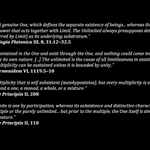
The henads do not “participate” in the One; they are the One coincidentalmente cada una (suggenés/sumphyomenoi), insofar as each is one (In Parmenides 1048). It is not an external entity that subsumes them. XIII
1
1
27
787
Outis retweeted
Replying to @goatofthousand
I understand the argument. However, a distinction must be drawn between a cause (aition) and a principle (arche), as emphasized by Damascius (De principiis I.152). I
1
2
10
323
If might were the sole criterion of justice, a powerful tyrant could enact laws that undermine his own power, just as a strong majority could impose its will against reason, thereby collapsing the distinction between justice and injustice. There is a stronger form of Justice.
3
29
559
Available as of 3 minutes ago! The Art of Divine Madness: Plato’s Phaedrus, Ecstatic Experience, and Inspiration with Susan Leybourne. The Ladder: Journeys in Platonic Mysticism Episode 53. Substack Link: palinode.substack.com/p/the-…
1
2
2
179
One of my favourite passages on diaphaneity and refraction, but also on pure motion [κίνησις καθαρά], elegantly opened with a Homeric paraphrase [Iliad VI.138], in which the simple divine life, “of ease” [ῥεῖα], is curiously set against the manifold “hostility” [ὀδύσσομαι]🧵
plotinus here champions the holographic polycentricity of all things, and hence the radical, absolute multiplicity and individuality of the gods.
2
6
22
796
It is worth sharing here part of what Plotinus goes on to say in this passage: “And each one is established (βέβηκε δὲ ἕκαστος), not upon a foreign land, as it were, but each one is in that in which is what it itself is (ἔστιν ἑκάστωι ἐν ὧι ἐστιν αὐτὸ ὅ ἐστι); ... II
1
4
156
... and it contemplates that from which it is, as though proceeding towards the higher (οἷον πρὸς τὸ ἄνω ἰόντι τὸ ὅθεν ἐστί), and it is not the case that it itself is one thing and its place another.” _
2
92
It does not constitute an entity, since each entity is a determinate object that presupposes unity in order to be; nor is it the highest member of a supreme genus, for the One transcends all categorical classification, making the genera possible without belonging to any of them.
The principle of unity is not a supreme entity. The One is simply the principle that makes anything one. I
1
4
2
35
1,035
The term "unit" here in this previous thread refers not to an integral unit or one [henás], but to any unified, synthetic unity [henómenon].
1
10
177
Outis retweeted
_
1
4
9
293
The principle of unity is not a supreme entity. The One is simply the principle that makes anything one. I
Replying to @ulfcytel
1. The Neoplatonist asserts that all existence ultimately derives from the One. 2. This assertion introduces a metaphysical entity whose existence is not established through the assertion itself. 3. An explanation cannot serve as its own proof without circular reasoning. 4/4 (v2)
5
7
2
77
3,845
Rejecting a single necessary principle does not remove this necessity either. The point is not that every explanation must end in a supreme entity, but that no account can dispense with unity while retaining distinct things. X
1
17
323
Even the claim that unity is primitive concedes the reality of what the principle names. Any coherent account of plurality necessarily presupposes unity, whether it acknowledges this explicitly or not. _
1
17
354