

@PatRubenFitz
Account based inUnited States
About this account
- Account based in
- United States
- Connected via
- United States App Store
Account-level information from X, not a live location or the device used for a specific post.
PostDoc @penneconomics @Penn_Exchange | PhD @MasonEconomics | Economic History, Political Economy, and Economic Growth
Joined March 2018
- Tweets287
- Following983
- Followers827
- Likes8.3K






Patrick Fitzsimmons retweeted

BREAKING NEWS
The Royal Swedish Academy of Sciences has decided to award the 2026 Sveriges Riksbank Prize in Economic Sciences in Memory of Alfred Nobel to Robert E. Hall and Michael Woodford “for microeconomic foundations of macroeconomic stabilisation.”
#NobelPrize

Had a great time working with WIP to get this article summary of my work out. Great group with interesting articles!

I had not realised before that the Bronze Age Collapse was literally *caused* by iron.
Bronze age powers like the Egyptians, Hittites and Babylonians used bronze weapons, made by combining copper and tin. Tin was so scarce that only the richest and most powerful groups could access it and the bronze weapons it allowed. (Tin was so rare that it was being transported from Cornwall to the Middle East more than 1000 years BC.) The scarcity of tin gave these empires a near-monopoly on violence.
Iron weapons are not actually any better than bronze ones – they're not stronger or easier to work with, as I'd assumed. They're just much, much easier to mass produce once you have bloomeries, which are the first furnaces that were hot enough to melt iron in a way that made them useable for weapons.
Bloomeries meant that iron ore, which was widespread, could be used to make weapons anywhere. That led to warlords, bandits and city-states rising in a massive decentralization of military power, which the Bronze Age empires were unable to resist.
After the invention of the bloomery, skeletons show a measurable increase in weapon-inflicted injuries. 'Destruction layers' with bones and signs of burning have been found from this time at archaeological sites including Troy. Ancient writers – including Herodotus, Ovid, and the writers of the Old Testament – believed the invention of iron had unleashed a new age of violence.
New at Works in Progress, WEAPONS OF MASS DECENTRALIZATION: how iron itself brought about the Bronze Age Collapse. And what technologies could do the same today?
worksinprogress.co/issue/wea…

Patrick Fitzsimmons retweeted

ANNOUNCEMENT: Michael Kremer appointed as World Bank Group Chief Economist and Senior Vice President for Development Economics. bit.ly/4cQg0zT

Patrick Fitzsimmons retweeted

Forthcoming in the AER: "The Dawn of Civilization Metal Trade and the Rise of Hierarchy" by Matthias Fluckiger, Mario Larch, Markus Ludwig, and Luigi Pascali. aeaweb.org/articles?id=10.12…

Patrick Fitzsimmons retweeted

New CEPR Discussion Paper - DP21792
Salt Wars
@desireedesierto @UFNews, @PatRubenFitz @Penn @penneconomics, @MarkKoyama @UFNews
ow.ly/kppC50ZuEUV
#CEPR_EH #EconTwitter

Patrick Fitzsimmons retweeted

Since I am working on a new paper on demographics and growth (big surprise!), I have just reread Michael Kremer’s “Population Growth and Technological Change: One Million B.C. to 1990.”
I read it as an undergraduate. I read it again as a graduate student preparing for my growth prelim in Minnesota. And I read it years later, when I taught growth theory to undergraduates at Penn, where I even put together slides that I still use regularly for my economic history course.
And yet, however often I go back to it, I am still amazed at how elegant the paper and its argument are. As Italo Calvino once remarked:
“Every rereading of a classic is as much a voyage of discovery as the first reading.”
(Perché leggere i classici, 1981)
Kremer’s paper is exactly that. Oh, how I wish I could write papers like it!
By the way, read Calvino’s essay as well. In English here:
whumspring2010.wordpress.com…

Patrick Fitzsimmons retweeted

🧵1/ The half-life of a grudge. Britain crushed the 1857 revolt (Sepoy Rebellion) in northern India with mass reprisals centered on Lucknow. For decades after, districts closer to that violence vaccinated their children less against smallpox and the effect faded almost exactly as the generation that lived through 1857 died off.

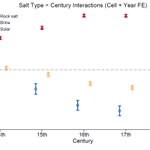
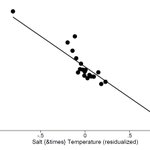
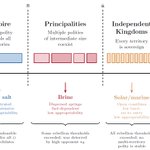
Why did some parts of medieval Europe consolidate into big states, while others were fragmented into hundreds of small polities for centuries? Our (@desireedesierto, @MarkKoyama, and I) new paper argues part of the answer is salt, and specifically how it was extracted.
Our proposed mechanism: conflict. Cold periods with more brine salt bring more civil wars/rebellions and fewer wars of annexation against that polity. Cold periods with more rock salt bring the opposite. Appropriability decides which side of state-building salt lands on.
Tilly's logic applies when resources are appropriable. But the bellicist logic reverses for resources that are costly to appropriate. Paper: papers.ssrn.com/sol3/papers.…
Patrick Fitzsimmons retweeted

Ever wonder why Europe is fragmented in some places but consolidated in others? It's got a lot to do with SALT!
New paper with @PatRubenFitz and @MarkKoyama
papers.ssrn.com/sol3/papers.…
Patrick Fitzsimmons retweeted

Using ancient DNA data to measure migration over the past 10,000 years shows that human mobility followed climate corridors and migration acted as adaptation to climate change, from Peter Huybers, Marco Tabellini, @ctaylor463, and Francesco Toti nber.org/papers/w35371
