

CEO & Co-founder @NOETIK_AI Using AI to actually solve cancer.
San Francisco, CA
Joined February 2011
- Tweets4.4K
- Following2.8K
- Followers7.6K
- Likes21.2K






Pinned Tweet
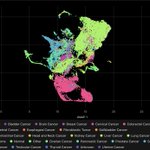
1/ Spatial transcriptomics is among the richest view of human biology that we have: 18,963 genes mapped at subcellular resolution.
It's also almost never collected outside of research settings.
So we trained a foundation model to generate it from a clinical H&E image alone.
Meet TARIO-2. 🧵
noetik.blog/p/tario-2-a-whol…

Ron Alfa retweeted

Our latest @MenloVentures healthcare AI report is out: healthcare AI is on fire. We've never seen technology adoption like this. Maybe we can finally start making real progress on access, cost and outcomes!

Healthcare is now AI’s biggest vertical market.
Spend grew 2.5x to $3.7B this year, more than double legal ($1.8B) and more than legal and finance combined.
It started in paperwork: scribing and billing. Now it’s moving into drug discovery, patient engagement and clinical decision support. Clinical copilots alone grew 5.5x to $550M.
Our 2026 State of AI in Healthcare report from @grgyap, @jpsanday, @CroomBeatty, @hu_j, @derekgxiao and @sabrinarlu: mnlo.vc/2026-healthcare-ai-r…

Nice piece from @LongmireMD on opportunities for AI to increase clinical trial efficiency. This, and making them fail less, is the unlock for therapeutics abundance.


Ron Alfa retweeted

Dream bigger. @elonmusk showing most do not push the boundaries of perceived reality hard enough and remain limited by small ambitions perceived as insurmountable barriers.

Of course, we agree… @NOETIK_ai the most curing-cancer-pilled ai research team in the industry.

Yes, if we were serious about curing cancer, we would have done many things to speed it up. Proof that this is possible without AGI God: China is now ahead of US in cancer therapeutics, while being a backwater just 10 years ago. There is so much left on the table.
Out of all applications of AGI, curing cancer is among the ones where the juice is the least juicy compared to the squeeze. That doesn't mean AGI wouldn't help. It's just that we can build
good specialised models for biology and also, data and human experimentation remain bottlenecks that we have to solve.
Justifying the need for AGI God (as opposed to specialised models) for curing cancer isn't a very good argument.
"Drug development isn’t rocket science, its actually much harder." 🔥

Convincingly negative result here. IL6 looks almost the same. Not often 2 of the most anticipated targets in CV go down at once. There will be lots of Monday morning quarterbacking these bets but it’s why we do the studies and they were reasoned bets, uncertain outcomes despite genetics and biomarkers with asymmetric value if positive. Drug development isn’t rocket science, its actually much harder.
In the near term, beyond LDL optimization (looks like real benefit), Incretin therapy in obesity now the one big idea left on the board to reduce CVD death and disability at scale. Surmount MMO is coming! clinicaltrials.gov/study/NCT…
Pelacarsen and Cardiovascular Outcomes in Patients with High Lipoprotein(a) | New England Journal of Medicine nejm.org/doi/full/10.1056/NE…
While we see very clear scaling laws with our models getting better with more human data and compute - we already have strong results predicting drug response on a diversity of patient cohorts, tumors and mechanisms.
This is the beginning of an inflection for making better medicines.
4
41
2,468
Ron Alfa retweeted

in April, we published a launch essay for @tacitlabsco
that outlined a thesis for frontier AI research in biology -
1. if we want models to be useful for curing disease, we must evaluate them on tasks with roughly that shape and complexity. optimize directly on the thing you care about - i.e. discovering & developing a drug
2. we should aim to model the biotech (process, reasoning, decision-making), rather than the underlying biology. biology is an empirical science - develop better empirical methods rather than treating it as an analytical domain
3. the most difficult part of all of this will be verification of those empirical methods with signal that actually matters (does the proposed drug actually work in a human?). biological time is a tough wall to run up against (most expensive forward-pass of all time). figuring out how to turn scientific problems into learning problems is a first-class research problem
4. if we believe (1) and (2), and we do a bunch of good work and figure out some clever solutions to (3) then we unlock increasingly agentic discovery/development, with the logical extreme being this concept of the "zero-person biotech", which is now (somehow) percolating in mainstream discourse
5. (4) has extremely exciting implications for the overall economics and practicalities of how we develop novel therapeutics (broadening viable aperture to rare disease, n-of-1 trials; new mechanisms of distribution) all of which are net positive for the world. much to be optimistic on here
discovering and developing a drug is one of the most complex and long-horizon tasks in the broad spectrum of human endeavors. inarguably one of the most important and high-impact research directions in AI today


We ran a pipeline in a person team at Recursion in 2021 to start the oncology work. Pre-LLM we could execute quickly outsourcing at scale - the models will make this much more efficient. But the game changer was scaled biological insights from the platform, this is still the gap.

Missed the live session? Don't worry, there's a recording.
youtube.com/watch?v=xZQ8Bn27…
