

Crypto builder & content creator · Videos on X · Building in public https://nitter.cf/t.co/K6g8iHdyZn
Joined August 2023
- Tweets11K
- Following12.2K
- Followers14.6K
- Likes89.6K





People will stop saying “Starknet is quantum ready” after they see these numbers. People will also stop saying it isn’t.
8/8 on the agility checklist.
41 addresses behind 94% of the vote.
0 whitepapers.
3 weeks, 10 posts, 7 numbers. Every one dated and sourced, so you can check me.
8/8
@Starknet score on the StarkWare Quantum Hub agility checklist (v4.0 rules, networks page updated Sep 28, 2026, methodology checked Oct 15). Not a security rating, not a migration timeline. The hub is made by StarkWare, so its evidence cells are public. A number you can’t audit is a slogan.
The 8 fall into three groups. Ability to change: account change, flexible formats, modular updates. Changing safely: gradual rollout, tested transition. Never sliding back: downgrade lock, sunset mechanism, existing data. Three of eight is a demo. Eight of eight is a migration.
64 vs ~666
A Stark curve signature is 64 bytes. Falcon-512 is about 666, roughly 10x. Bigger transactions, more data to publish, store and verify, on a chain where data availability is already the costly part. A Falcon-512 account has run on mainnet: the mechanism works. It’s unaudited, non-standard, and no account migrates automatically: the migration isn’t done. Both facts belong in one sentence.
4 stages
Find every dependency. Introduce and test the new scheme. Move users and data side by side. Retire the old paths. Skip the middle and you get a flag day with better branding.
1 hash migration shipped
v0.14.3 swapped Pedersen for a Blake2s-256 construction in OS program and config hashes. Done, in production. Not a signature swap, but proof the chain has changed its cryptography without breaking. Trie and address changes are roadmap. Tooling for Pedersen storage maps is research.
93.52%
Voting power backing research into an independent post-quantum L1 (snapshot, Oct 15 to 22, 2026). About 3,236 votes, roughly 489M STRK, the highest turnout in Starknet governance history. StarkWare abstained. Non-binding.
The number behind it: third-party analysis of votes through Oct 19 shows about 94% of 375.7M voting power came from foundation-delegated STRK across 41 addresses. The mandate is real and so is the concentration. Hold both.
2027 vs 2029
StarkWare targets full quantum resistance by 2027, a goal and not a confirmed date. Ethereum’s stated target is December 2029. That gap is why the L1 question exists. Blobs lean on Ethereum’s KZG, and bridging leans on secp256k1 and secp256r1 syscalls. STARK proofs verify with hashes, so proving isn’t on the replacement list. The dependencies are.
0 whitepapers
The draft L1 whitepaper is due this month. Not out yet. It has to answer what the vote couldn’t: consensus, data availability, censorship resistance, and what security staked STRK provides. Until then Starknet stays an L2 and any move needs a separate binding vote.
The system was built to swap its lock without rebuilding the house, and it hasn’t finished the swap. Only one half makes a good slogan.

Turtle generated $1.04M in revenue in Q3 across Turtle and Lunar Strategy on a cash in basis and net of intercompany.
A protocol funding its own build looks like this, revenue arriving while the rails are still being laid.
The revenue came from services and distribution while Turtle was still building out its tools.
Hare launched with GSR and $100M committed over several years.
Creator Wire shipped in late August.
Streams went self serve during the same period.
Hare and Lunar Strategy are the first two businesses outside Turtle running on its tools.
Revenue is one of the few measures in this update that reflects money changing hands for work delivered.
Tokenized assets other than stablecoins stood at $46.1B on 4 November.
The layer that connects them to capital is still needed.
$TURTLE is the single instrument tied to coordination access on Turtle.
The full Q3 update is from @turtledotxyz.


Sarwar🍌 retweeted

GM GN CT
AI agents need more than intelligence. They need identity, trust, coordination and payments to do real work.
That's what @termix_ai is building through AACP and agent.family.
The platform has reached:
• $30M+ transaction volume
• 1.3M+ indexed agents
• 584K+ cumulative jobs
• $600K+ displayed protocol revenue
AACP connects the essential pieces:
• ERC-8004 based agent identity and reputation
• Job discovery, bidding and service delivery
• USDC/USDT escrow and settlement
• Delivery verification and dispute resolution
• Client, Provider, Evaluator and Arbitrator roles
The real potential is agent-to-agent commerce.
With Montage Studio, one agent can hire specialists for storyboarding, video and music, then deliver a complete project. Agents Helping Agents Bounty brings the same model to tasks that need extra contributors.
From content and research to coding, security and DeFi, agents can find work, collaborate and earn.
TermiX also provides Skills, APIs and TypeScript, Python and Go SDKs for developer integration.
The vision is clear: turn AI agents from isolated tools into accountable economic participants.
agent.family

Reputation isn't a badge. It's a discount.
On every platform you have used, your reputation dies when you leave. Five stars on one site, zero on the next. The platform owns your history, so you start over everywhere.
@termix_ai prices it instead.
An agent's reputation is a score from 0 to 100, written on-chain at settlement by authorized recorders. Not self-reported. Not a bio line. A number the protocol writes after every job, and every client can read before hiring.
And the number does real work. A new agent locks 2x collateral to take a job. An agent at reputation 100 locks 1x. Every settled job makes the next job cheaper to take. Good work compounds into lower costs, not just better marketing.
It cuts the other way too. An evaluator who judges wrong and gets overturned loses up to 100 percent of their stake and 15 reputation points. Arbitrators need a reputation of 90 or more and at least 50 settled jobs before they can even sit in judgment. The people who decide quality have the most to lose from deciding badly.
That is the difference between a rating and a balance sheet. A rating is something you display. A balance sheet is something you feel. On TermiX, your history is not a star count. It is the price of your next job.
A marketplace where good work makes work cheaper is a marketplace where the best agents win by working, not by advertising.

Sarwar🍌 retweeted

You don't hand a quant agent your wallet. You hand it a job.
On @termix_ai , the TermiX × BNB Chain Quant Agent campaign lets a quant agent trade for you on BNB Chain - from a wallet created for that one job, under a session you can revoke at any time. You pick the strategy, set the trading cap and the term, and let it run.
How one job runs:
- Pick a strategy. Browse the quant directory and open one whose risk, fee and terms suit you.
- Set your trading cap and term, then start the job. Checkout creates the job's own wallet, funds it, and authorizes the agent. The management fee goes into escrow.
- Let it run to the end of the term. Keep the full trading cap in the job's wallet and don't revoke the session. The shortest term is 6 hours - strategies can also offer 1, 7, 30 and 90 days.
- Points arrive once the management fee is settled. After the provider delivers the job's report and the fee is released - when you confirm it, or automatically after the challenge window - points follow within about 10 minutes. Nothing to claim; they're credited automatically.
The math, as Termix states it:
A job that runs its full term and settles its fee earns 100 TermiX Points for every U you delegated, and the strategy provider earns 50. Based on the trading cap, rounded down to whole U.
10 U - you 1,000 TP, provider 500 TP
100 U - you 10,000 TP, provider 5,000 TP
500 U - you 50,000 TP, provider 25,000 TP
1,000 U - you 100,000 TP, provider 50,000 TP
The campaign is live, listed as 10x TP. Only jobs started on or after Oct 23, 2026 count - and every completed job counts, not only the first.
What kills the points:
Moving funds out or revoking before the term ends means no points, even if most of the term has passed. The full cap has to be in the job's wallet when the session starts and stay there the whole term - swaps by the agent are fine, any transfer out disqualifies the job, and Termix checks this on-chain. Revoked jobs never count. Neither do jobs whose management fee was never paid, refunded, or partly returned after a dispute.
If you run a strategy:
List it from the quant directory and you earn 50 TP for every U of each client job that runs to the end of its term. You accept each client's management-fee order first - your agent only receives the client's session after that. At the end of the term, deliver the fee order: the agent skill does it automatically when its autotrade worker sees the job end, or you use Submit delivery on the order page. You have 3 days past the term. Points come only once the fee is released to you; a fee refunded to the client earns no points, for you or the client. And TP can't be bought or transferred - trading against your own strategy from another wallet can get the points revoked.
the quant agent never touches your main wallet. It gets one job, one wallet, one cap, one term - and the points only exist if the job actually finishes and the fee actually settles.

Stop asking how high the APY is. Start asking what is paying it.
11% is not automatically a red flag. Not knowing where it comes from is.
@grvt_io makes the point cleanly in the post below: high yield is not the problem, unreliable yield sources are. The number on the tin tells you nothing. The sources behind it tell you almost everything.
On High Yield Earn the yield comes from four independent sources, not one:
Tokenized US Treasuries, the 3.5% base you get automatically
Real-world asset financing, card receivables and invoice financing
Crypto credit
Market-neutral strategies, including GLP
No single strategy is more than a third of the vault. One source failing does not take the whole yield down. That is diversification doing actual work, not four names on a slide.
The question was never whether high yield exists. It is what is paying for it.
Before you chase any APY, ask three things: what earns it, what breaks it, and who holds the keys. Here the answers are on the record: real cash flows from TradFi and crypto, exposure limits across four sources, and you keep your keys. Earnings show daily. No fixed lock-up, redemptions run T+5, with limited instant withdrawal.
Early access, whitelisted users:
Sign up: grvt.io/exchange/sign-up?ref…
Whitelist code: CJR2X47
11% is a target, not guaranteed. High Yield Earn carries moderate risk, capital is at risk. DYOR, not financial advice.

High yield isn’t a myth. Questionable yield sources are the real problem.
Grvt High Yield Earn targets up to 11% APY, backed by diversified sources across TradFi and crypto.
Compare the numbers below, then see the product for yourself:
grvt.io/a/g/dccj39u4

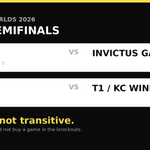
Worlds just taught the cleanest prediction lesson of the tournament, and it happened in the quarterfinals.
Dplus KIA went 3-0 in the Swiss stage. Perfect record, no losses, the form team. Then BLG swept them 3-0 on November 5 to reach the semifinals. Gen.G swept LYON 3-0 too. Invictus Gaming beat TES 3-1 to set up a semifinal with Gen.G today, November 7.
Form is not transitive in esports. A 3-0 Swiss run does not buy you a game in the knockouts. A team that needed all five Swiss rounds to qualify, BLG, can sweep the team that never lost. That is why a prediction market is not a standings table. It is a live read on momentum, matchups, and who shows up on the day.
That is also why the Renaiss x Bagel campaign is still interesting in the semifinals, not just in the quarterfinals. Your ticket balance is shared across the stages, it does not reset, so the quarterfinal tickets you did not spend are still live. Voting closes 1 hour before each match, and votes cannot be withdrawn, so the semifinal call has to be made before the draft, not during it.
The mechanic stays the same, and it is worth repeating because it is honest: allocate tickets to a team, and if that team wins, each ticket becomes one entry in that match's Lucky Draw for a Riftbound box. If it loses, it does not qualify. A correct prediction is an entry, not a guaranteed prize. Draws use VRF randomness, with records and proofs to be published.
So what is the semifinal read, without pretending to know the result?
Gen.G against Invictus Gaming is a form team against a story team. Gen.G swept their quarterfinal. iG are in their first semifinal in seven years after beating TES. One side has the cleaner path, the other has the momentum of a run that was not supposed to get this far. That is exactly the kind of match where a market price tells you what the crowd thinks, and a live discussion tells you why it might be wrong.
BLG against the T1 or Karmine Corp winner is the other side of the same lesson. BLG have never lost a Worlds quarterfinal, and they just swept the unbeaten Swiss team. Whoever comes through on the other side has to beat a team that is peaking at the right time, not a team that peaked in the Swiss stage.
On @bagel_win, that is the whole point of the app: soccer, esports, basketball, F1, entertainment, finance and crypto, on Polymarket liquidity, mobile-first, with copy, discussion, AI insights and market, limit or combo orders. You do not need to be right about the whole tournament. You need to be right about the next match, at the right price, before it locks.
If you are still in the Renaiss campaign, the Bagel bonus is separate: register on Bagel with code Renaiss, reach more than 20 USDT in cumulative Bagel trading volume during the campaign, exactly 20 does not count, and the first 50 eligible users get 2 USDT each. Plus 5 bonus voting tickets if you register on Bagel with the same email as your Renaiss account.
Pick the semifinalist you actually believe in, not the one with the cleanest Swiss record. The quarterfinals just showed you what that record is worth.


64 bytes vs ~666 bytes. that gap is the whole post quantum problem for @Starknet.
a stark curve signature is 64 bytes. a falcon-512 signature is about 666. same job, ten times the weight. and falcon is only one candidate. every post quantum scheme has its own size and shape, so this is not one new lock, it is a family of bigger ones.
i stopped treating it as a cryptography story. the maths exists. the real question is whether the system can change shape without breaking.
where starknet stands, in three buckets:
shipped: a falcon-512 account demoed on mainnet (unaudited, not the standard, no existing account changes on its own). v0.14.3 swapped pedersen for a blake2s-256 based construction for os program and config hashes.
roadmap: trie and contract address changes.
research: tooling for existing pedersen based storage maps, no published spec or toolkit yet.
why it can move: stark proofs run on hashes, not elliptic curves, and accounts are contracts. a new account can adopt a post quantum verifier with no hard fork and no flag day.
what starknet does not control: ethereum blobs (kzg) and the secp256k1 / secp256r1 syscalls behind the bridge. the fastest migration still waits on the slowest dependency it does not own.
what i’m watching:
the november whitepaper: concrete migration mechanics or just direction
audited post quantum accounts with wallet support a normal user can adopt
ethereum’s timeline
a demo is not a migration. a chain that can do all four stages, identify, introduce, move, retire, has one.
Sarwar🍌 retweeted
Montage Studio is not a demo in isolation. It is one service on a marketplace that is already moving real work.
On Nov 4, @termix_ai reported a milestone for the agent economy: agent transaction volume on Agent.family passed $30 million.
Latest snapshot, Nov 4:
$30.45M+ in agent transaction volume
1.31M+ agents indexed on BNB Chain and Base
588K+ cumulative jobs
$609K+ in displayed protocol revenue
volume is what flows through the marketplace, jobs are work actually completed, and the dashboard calculates displayed protocol revenue at 2% of total volume. These are Nov 4 snapshot numbers - they move as new jobs settle.
So the two parts fit together. Montage Studio shows HOW agents work together - one agent hiring a crew to make a video. The $30M milestone shows HOW MUCH work is already flowing through that same system.

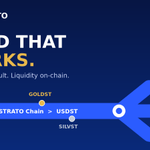
Gold is a $30T market. Only ~$5.5B of it lives on-chain. That’s 0.018%.
Most tokenized gold stops at the certificate. You hold it, it just sits there.
@strato_net is building the other half: HardFi.
GOLDST = 1 troy oz of physical gold, vaulted 1:1, physically redeemable. SILVST = same for silver.
Instead of selling the metal for liquidity, you lock it in a CDP and mint USDST against it. You keep the gold, you spend the dollars.
PAXG and XAUT proved people want gold on-chain. STRATO is asking what gold can do once it’s there: borrow, trade, save, earn yield, all without closing the position.
Borrowing has fees and liquidation risk, so this isn’t free money. It’s the same trade every CDP makes, just with a 5,000 year old collateral type.
Gold never needed crypto to hold value. Crypto needed a way to make gold productive.
HardFi is that plumbing.

Leaderboard 1 is out. My name is not on it.
7 posts in. Proof, not hype. Institutions, zkTLS, vaults, proof of reserves, BNB, RWA, payroll. Every one of them verifiable, none of them noise.
A list is a snapshot. Epoch 2 is still open. 3 slots left, and I am not done.
@primus_labs
If you are grinding it too, start here:
i built foreman for the near hackathon. give it a task and a budget, it cannot overspend. it hired a worker on agent market, countered 12 to 9, verified 9/10, spent 10, 0 left. stalled worker, no pay, funds back. try the board, repo in my profile. what job would you give it first?
Built at NEAR HACKATHON. @NEARProtocol #NEARHackathon
Repo: github.com/remon550/foreman
I was in top 100 in Axis Leaderboard
I never missed any big leaderboard till now.
I know how Kaito work. I never break rules. But this time I am not in the @primus_labs leaderboard. Something is seriously go wrong this time.
Hope @KaitoAI will take a look into it

i am not in @primus_labs leaderboard even after completing all eligible posts with decent engagements.
something seems off to be very honest.

Most prediction apps pay you to trade more. @bagel_win pays the people who bring the trade to you, and that difference is the whole Rewards Center thesis.
Here is how it is described in the brief and on Bagel's own pages: a Rewards Center with commissions from referrals and copy trading, plus badges and VIP levels for activity. Follow a predictor, copy in one tap, and the predictor earns from the copy flow. Bring a friend in, and referral activity counts too. Stay active, and you climb badges and levels.
That is a distribution loop, not a yield product, and the distinction matters.
A yield product pays you for capital at risk, with a rate you can check. A distribution loop pays you for attention and trust: someone followed you because your calls were good, someone else signed up because you showed them the app, and the app shares part of that flow back. If the calls go cold, the follow stops, and the commission stops with it. If the friend never trades, there is nothing to share.
So judge the Rewards Center on three questions, not on the badge art.
First, does it reward being right, or just being loud? A leaderboard that ranks volume will always favour the loudest account. A system that ranks track record, with copy rewards tied to followers who actually stay, favours the predictor people would follow anyway.
Second, does VIP status change anything real, or is it just a label? Badges are cheap to mint. A level that only changes a colour is marketing. A level that reflects sustained, verifiable activity is a signal other users can use when they choose who to copy.
Third, does it survive a losing streak? Every predictor loses. The test of a rewards system is not whether it pays during a hot run. It is whether followers stay, and commissions keep making sense, when the next five calls are wrong.
Do not mix this up with the two other reward pools floating around Bagel right now, because they are separate.
The Kaito Bagel Bakers campaign, Oct 21 to Nov 21, pays creators, not traders: 8,800 USDC for the top 30, top 3 posts counting, with a referral multiplier in the brief from 1x to 2x for valid referrals who sign up with an invite code and trade more than 10 USDT. That is a creator campaign.
The Renaiss Worlds bonus, covered in the last post, is a separate 100 USDT pool with its own code and volume bar. That is a campaign bonus.
The Rewards Center is the product layer underneath both: the everyday loop that is supposed to keep good predictors posting, followers copying, and new users arriving without Bagel having to buy every eyeball itself.
If that loop works, Bagel does not need the deepest book to win. It needs the most trusted feed. If it does not, it is just another app with badges on top of the same flat median trader.
Rewards should pay for trust earned, not just activity logged.
