

Please visit my bilingual non-fiction blog.
Joined March 2013
- Tweets15.3K
- Following176
- Followers443
- Likes14.6K





Pinned Tweet
Intelligence is the ability to detect relationships (inductive reasoning) and to use them effectively in real life through deductive reasoning—selecting the right relationship for a given situation and deriving useful conclusions.
Cognitive horsepower varies between individuals. IQ tests measure this horsepower much like thermometers measure temperature.
1
2
783
Erwin Schmidt retweeted

Completely true. The average person’s default behavior is now actively bad for their health and finances. Getting distracted by ads can often be a breath of fresh air that prevents them from ordering more DoorDash

Opportunity cost is negative for most people.
If true, this would predict an economy designed to soak up everyone's time.
From @PD_EXP

Erwin Schmidt retweeted

"our inability to imagine how we would feel or behave in an emotional state different from the one we’re in. When we’re pain-free, we can’t really remember what pain feels like." newyorker.com/magazine/2026/…


Loneliness:
"But loneliness isn't just an affliction to be cured–it is a biological signal, akin to hunger, thirst, or pain. Viewed this way, loneliness functions as social feedback. Like physical pain alerting us to injury, loneliness tells us that our social connections require attention. This discomfort motivates action."
2
34
Erwin Schmidt retweeted

Yep, reminds me of @JoHenrich's discussion of the evidence that markets foster patience, thrift, and work ethic, and coevolve with universalism and trust, in The WEIRDest People in the World (a book I highly recommend).

There has long been speculation that markets crowd out or corrupt societal moral values.
But new research finds that market-oriented societies have a greater aversion to unethical behavior, higher levels of trust, and are not significantly associated with lower levels of morality
"our results suggest that being or becoming more market oriented does not cause moral deterioration."
sciencedirect.com/science/ar…

Naval Ravikant:
"the game stops being something you play and becomes something that plays you.
When that happens, your choices shrink. You can’t step away. You can’t slow down. You can’t say no. You keep playing not because you want to, but because you have to. At that point, the game owns you."
34
The Allure of Social Media:
Why is it so alluring?
Because it offers status.
Using social media is, at its core, a status game.
1
23
Power Users:
"X wouldn't change much if you kept the top ~10% (or even tighter, top 5%) of truly active accounts and culled most of the rest. The platform lives or dies by its power users — the rest are mostly audience."
19
Erwin Schmidt retweeted

Not a good week for classical music. First Kovacevich, now Blomstedt.
I've seen him several times live. His concerts somewhat cured my fear of age related cognitive decline.
He proved that even well into your 80s/90s one can still create something truly great.

Erwin Schmidt retweeted

3 interesting findings:
1. Only 15.5% of men and 13.3% of women report suffering a midlife crisis. For most people, life gets better starting in middle age. Over the years, people tend to get happier, more creative, less neurotic, more agreeable, and more conscientious.


Stupidity, Igor Sibaldi:
" 'Stupid!' is a warning shot. It means: look out, you're about to step over a psychological line nobody wants to cross, and there's no easy way back.
'You're stupid' is a diagnosis. It mean: you've gone over that line and now you're in trouble."
1
23
Erwin Schmidt retweeted
Global warming is now blocking an ice age that had been already starting. Yay.

Here’s a rather extraordinary discovery: humanity seems to have interrupted the beginning of the next ice age. We thought it might happen in the future, but the evidence suggests it's already happened.
A new study in Science argues that the next major glaciation had already begun roughly 2,000 years ago, before modern warming reversed the trend in the 20th century.
The evidence comes from the Barnes Ice Cap on Baffin Island, the last surviving remnant of the enormous Laurentide Ice Sheet that once covered much of Canada and reached as far south as Illinois.
Because Barnes is frozen directly to its bedrock, advancing ice buries and preserves vegetation beneath it. Researchers radiocarbon dated plants emerging as the ice retreats to reconstruct its history.
They found that after melting to a minimum extent around 3,000 years ago, the ice began expanding again about 2,000 years ago. The researchers interpret this as the earliest stage of the next glacial period.
Left to natural orbital cycles, that cooling would have unfolded extremely slowly, potentially taking tens of thousands of years to rebuild a continent spanning ice sheet.
But around 1960, the trend reversed. Summers became warm enough that Barnes began losing more ice than it gained, despite Northern Hemisphere summer sunlight continuing to slowly decline in a way that should favor renewed glaciation. Greenhouse warming had (thankfully) overwhelmed the natural cooling tendency.
The Barnes ice cap may now disappear entirely within the next few centuries, removing the final remnant of an ice sheet that repeatedly served as the nucleus for much larger glaciations.
There is a remarkable deep time perspective here. For millions of years, orbital cycles have pushed Earth between warmer interglacials and colder glacial periods. According to this study, that ancient cycle had started turning once again.
Then, in the geological equivalent of an instant, humanity pushed hard enough in the opposite direction to stop it.
Just so we're clear, this is a very very good thing.
📸 Geology Sciences
Sources:
1) phys.org/news/2026-10-global…
2) science.org/doi/10.1126/scie…

Erwin Schmidt retweeted

You go to the gym, try to build some muscle, watch what you eat so you can avoid being overweight;
depending on the circles in which you move, you might think everyone is doing this.
But go out in public almost anywhere and you quickly realize that almost no one is in shape.
Erwin Schmidt retweeted
In most of our small scale detailed analysis, contradictions are destructive and we try to avoid them. So at what scale do they become helpful, and why?


Erwin Schmidt retweeted

The winning strategy has always been the same:
1. Develop deep mastery of your craft.
2. Build tools to scale your output.


Science (Cory Clark & Bo Winegard / @EPoe187):
"Science earned its authority ... by ... offering high-quality information that helps people solve problems[.]"
"The scientific method, though imperfect, is specifically designed to minimize biases, flawed analyses, and imprecise claims."
"science is the best system for arriving at truths (at least for now)."
"So long as scholars stick to their core mission, i.e., identifying and describing empirical reality, they can offer something genuinely useful to the world."
"Science has something helpful to offer."
"Instead of overstating certainty, scientists should model epistemic humility, acknowledging uncertainty where it exists and being transparent about the limitations of our knowledge."
"we must return to the slow, unglamorous, often tedious process that made the findings of science worthy of credibility in the first place."
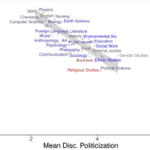
"The disciplines perceived as least politicized (including math, physics, chemistry, English, nursing, and computer science) are also the most trusted and provoke the least skepticism. In contrast, disciplines viewed as highly politicized (including religious studies, gender studies, ethnic studies, and political science [perhaps an unfortunate name choice]) tend to be the least trusted and elicit the most skepticism."
1
52