

Daily stablecoin yield research. Quoted vs earned. No hopium. Follow daily analysis. Join Discord for more: https://nitter.cf/t.co/ppbO6h7X6S Not financial advice
Dubai, United Arab Emirates
Joined May 2025
- Tweets2.5K
- Following541
- Followers235
- Likes1K






Pinned Tweet
StableTable is a research driven DeFi project focused on one thing above all:
Finding, filtering, and explaining the best stablecoin yield opportunities across DeFi
We do not exist to add noise
We exist to bring clarity
In a market full of scattered protocols, changing rates, temporary incentives, and hard to compare opportunities, StableTable helps turn complexity into a clearer path:
> We constantly search for strong stablecoin yield opportunities
> We compare different strategies, structures, and conditions
> We share analysis, insights, and actual observations on what looks worth watching
> We help make the stablecoin yield space easier to understand and easier to navigate
Our focus is not random speculation
Our focus is smart stablecoin research, better yield discovery, and clearer strategy selection
What you will find here
> Daily analysis
> Yield focused insights
> Research based posts
> Educational content
> A cleaner view of where stablecoins can work harder in DeFi
If you want to stay close to the project and take part in the early community, join our Discord and take the Pioneer role:
> Discord: discord.gg/7hxwXQ76sT
Stay connected
Follow this page for daily research and updates
Not financial advice

StableTable 📈 retweeted
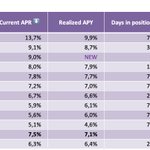
A conservative stablecoin book targets 6-8%. Mine is at 7.1% realized, eleven weeks in — and this week I reopened a position that cost me money in my aggressive book three weeks ago. 🧊
Pende @saturn_credit PT-USDat, 14JAN27, at 9.0% fixed for 77 days.
Three weeks ago I closed a leveraged PT-USDat position in the other book because Saturn announced heavy YT rewards ahead of their TGE. New PT yields jumped from 7% to 9%+, leverage demand followed, borrow costs climbed — and my rate was fixed before the announcement, so I was paying for a rally I wasn’t in.
Same asset, same rewards, opposite outcome. Without a borrow, there’s no spread to invert. A high fixed rate is just a high fixed rate. 🎯
The thing that broke a levered position is the thing that makes an unlevered one attractive. Worth sitting with that, because it’s the clearest example I’ve had of leverage changing what a trade is, not just how big it is.
Also this week: I rolled Pendle sUSDe LP into the 28JAN27 maturity rather than closing it.
I said last week I’d close at maturity. The forward rate came in at 13.7% — top of my book by a distance — so I rolled instead. Same position, new expiry, 77 days continuous and counting.
And I closed @superformxyz Flagship BaseUSDC at 6.4% realized after 28 days. Quoted 9.1% when I entered.
Two things happened: the sUP reward stream shrank, and TVL grew. Fewer rewards divided across a bigger base. 📌
That’s the second position this month to go the same way — @zama went 10.5% to 5.8% on pure dilution while its program was still running. So I’ll state it as a rule now rather than a suspicion: the headline rate on a fresh subsidised vault is an entry rate. It is highest before anyone notices, and it decays without an announcement, without a date, and without anything breaking.
Book-wide: quoted 7.5%, realized 7.1%. Six of ten positions have been running since day one, seventy-seven days ago.
This is the conservative book — unlevered, aimed at 6-8%, touched about once a month. The aggressive one runs with leverage and rotating yield windows. Posted separately.
@ethena @autopools @Morpho @gauntlet_xyz @yearnfi @0xfluid @SteakhouseFi @OriginProtocol @aave @fraxfinance

StableTable 📈 retweeted

The #1 thing I'd love to see on Aave is a section showing the oracle type.
On the Aave V3 UI, you can only see the oracle contract. On Aave V4, even that is impossible unless you dig into gov proposals.
Showing the oracle type would help both lenders & borrowers assess risk.

StableTable 📈 retweeted
18.0% realized on my aggressive stablecoin book.
I restructured two positions, and both came down to the same question: when is the right moment to borrow? 🏹
frxUSD @ReSupply: I closed the reUSD-fxUSD LP leg and turned the position into a 9x loop, frxUSD against borrowed reUSD.
The timing is the whole trade. reUSD had moved from 0.99 up to 0.994 — unusual for it — and when you borrow a token, you’re short it. You borrow at today’s price and repay the same number of tokens later, so the cheaper it gets, the less your debt costs you.
Borrow it expensive. It’s already back around 0.992. 📌
Which is the exact mirror of something I wrote here three weeks ago. alUSD was trading at 0.95 and I said don’t loop it — because a recovery to par would grow your debt against a levered position, and being right about the peg would be the thing that hurt you.
Same principle, opposite sign. A discounted token is dangerous to borrow and fine to hold. A token trading rich is the opposite.
Both positions are in my book right now, and they’re structured accordingly: reUSD borrowed at the top of its range in a loop, alUSD borrowed at a discount but put straight into a pool so the debt is offset rather than levered. 🎯
And I’m paying for that same move elsewhere in the book, which makes the point better than any example I could invent.
My crvUSD 10x position on reSupply borrows reUSD too — opened two weeks ago, before the run-up. The same price move that made the new loop cheap to open put the old one underwater: realized dropped from 31.3% to 11.0% in a week while its quoted rate went up to 31.1%.
That’s a mark, not a loss. reUSD is already back near 0.992 and I expect it to settle where it normally trades. Closing now would convert a paper mark into a realized one, so I’m holding and collecting the leverage in the meantime. 🧾
Same token, same week, two positions on opposite sides of its price. That’s what it looks like when the borrowed asset’s price is a real variable rather than a footnote.
Most people pick a strategy and then look at the rate. The price of the token you’re borrowing is the other half of the entry, and it barely gets discussed.
The second change is smaller. On the rlUSD-USDC position at Tangent, I moved the borrowed USG out of the USDC-OUSD pool into USDC-USG — rewards on the first had slipped, the second pays better and holds deeper liquidity. Same structure, better destination.
One line I’m watching: reUSD-sfrxUSD has fallen to 7.3% quoted, bottom of the book by a distance, against 16.8% realized. If the forward rate stays there, it stops paying for its seat.
Book-wide: quoted 20.4%, realized 18.0%.
This is the aggressive book — leverage, LPs, and yield windows I expect to rotate out of. The conservative one targets 6-8% unlevered and gets touched about once a month. Posted separately.
@AlchemixFi @aeroxyz @fraxfinance @Morpho @StakeDAOHQ @ConvexFinance @CurveFinance @InverseFinance @USDai_Official @Tangent_fi @LiquityProtocol


What’s happening with @CapApp cUSD? 🔍
Three redemptions in a week — 15.3%, 6.9% and 10.7% of supply, the last two inside two and a half hours. TVL down 25.7% in 30 days, supply ~27% off its mid-August peak.
cUSD is fully collateralized by regulated stablecoins and money market funds — holders redeeming at size and getting paid is the design working. 📌
The question is what a shrinking reserve does to what’s built on it. CAP outsources yield: operators borrow from the credit engine, stcUSD holders earn from that. Smaller base, smaller engine.
Note the two blank signals: cUSD barely trades and is barely used as collateral, so there’s no pool skew or utilization to read. This status rests on flows alone — which for this token is most of what exists.
I hold neither. Just what the board showed me this morning.
Open to everyone, no signup: plumbline.watch/?utm_source=…

StableTable 📈 retweeted

the future of lending is already here. it's just not evenly distributed
4 yearn vaults you can loop on Flex today:
- yvUSD, >60% APY
- yvcrvUSD-2, >70% APY
- yBOLD, >20% APY
- yvWETH-2, >17% APY
yes, you are still early


StableTable 📈 retweeted
Three times this year I got out of a stablecoin before it broke. None of it came from watching the price. 🔍
> March, MIM. Curve pools on Ethereum and Arbitrum had skewed until the other side was under 10%. Price was fine. A pool that lopsided means the exit is thinning — that was enough to stay out.
> June, msUSD (Main Street). Morpho market at 100% utilization for days. Balancer pools down to 14% on the other side. I closed everything at a profit. The depeg landed the next day.
> July, msUSD (Metronome). Different protocol, same ticker, same shape. Out with a few percent of slippage — not clean, but not damaging.
The pattern each time: utilization pinned high, pools tilting, and large flows moving through, all while the price sat at a dollar. Price is the last thing to move, which makes it the worst thing to watch. 📌
I was doing this by hand, on a handful of tokens, by remembering to look.
So I built the thing that looks for me. Plumbline reads four on-chain signals — utilization, pool skew, large swaps and redemptions, TVL change — across 40+ stablecoins on 9 chains, every 10 minutes, and rolls them into one status. Overall is the worst of the four, because a token is only as healthy as its weakest signal.
Open to everyone, no signup: plumbline.watch/?utm_source=…
Built by me, for my own book.
Disclosure: it’s my product.

StableTable 📈 retweeted

Today is the last regular working day for the @Balancer team.
Some of the people on this team have been here since Balancer's earliest days. Others joined along the way. Together, they helped build and evolve the protocol over the years.
From the original weighted pools and liquidity bootstrapping to the v2 Vault, Boosted Pools, and v3, Balancer helped shape how liquidity works in DeFi. Behind all of that were years of research, engineering, integrations, operations, and work with partners that most people never saw.
The last year was especially difficult. The exploit hurt people who trusted Balancer, and the team went through the recovery, restructuring, and eventually the decision to wind down. Even after the end date was set, they continued doing the work needed to support users and partners.
This isn't the ending we worked for. But it doesn't take away what the team built and contributed to DeFi.
The winddown itself continues under BIP-928. For the remaining steps and withdrawal information, please follow the official Balancer updates.
To everyone who helped build Balancer over the years, thank you.
I'm grateful I got to work with so many of you.
Three times this year I got out of a stablecoin before it broke. None of it came from watching the price. 🔍
> March, MIM. Curve pools on Ethereum and Arbitrum had skewed until the other side was under 10%. Price was fine. A pool that lopsided means the exit is thinning — that was enough to stay out.
> June, msUSD (Main Street). Morpho market at 100% utilization for days. Balancer pools down to 14% on the other side. I closed everything at a profit. The depeg landed the next day.
> July, msUSD (Metronome). Different protocol, same ticker, same shape. Out with a few percent of slippage — not clean, but not damaging.
The pattern each time: utilization pinned high, pools tilting, and large flows moving through, all while the price sat at a dollar. Price is the last thing to move, which makes it the worst thing to watch. 📌
I was doing this by hand, on a handful of tokens, by remembering to look.
So I built the thing that looks for me. Plumbline reads four on-chain signals — utilization, pool skew, large swaps and redemptions, TVL change — across 40+ stablecoins on 9 chains, every 10 minutes, and rolls them into one status. Overall is the worst of the four, because a token is only as healthy as its weakest signal.
Open to everyone, no signup: plumbline.watch/?utm_source=…
Built by me, for my own book.
Disclosure: it’s my product.
StableTable 📈 retweeted

Binance is reported to have suffered a significant hot wallet hack. We have been monitoring since the first reports. Tether and Circle have frozen a significant amount of USDT and USDC linked to the incident. Ethena, Maple, mF-ONE, FalconX and other collateral issuers onboarded to Steakhouse vaults on all available chains have confirmed no impact. Our only indirect exposure is to Ethena, which has confirmed limited potential impact ($8.8M) via unrealized basis positions, fully covered by the reserve fund ($60M) in a worst-case scenario if there is a failure to realize.
Our systems have triggered, on a precautionary basis, to withdraw liquidity from a number of markets. We are reviewing these manually and will release throughout the next few hours.
The situation is fluid and may evolve rapidly. We will continue to monitor the situation and provide updates as we receive them.
StableTable 📈 retweeted

FiRM is *still* the only lending protocol with a daily borrow limit. If Aave had it, both this and the Kelp incident would've been significantly limited.
But apparently losing hundreds of millions is not enough incentive for Aave to learn proper risk management.

The remaining pooled lending projects like @aave v3, @Compound_xyz , and @VenusProtocol should really consider rate limiting large borrows - theres ways to do this without impacting 99% of users and legitimate use cases.
Fluid and Kamino already implement this to an extent, the other lending protocols could do a lot to learn from them and develop their own methods - otherwise they will continue to be prime targets for hackers to get exit liquidity
StableTable 📈 retweeted

Ok guys, we are all in the same boat. Let's work together on making all crypto safer. For the sake of our industry

18.0% realized on my aggressive stablecoin book.
I restructured two positions, and both came down to the same question: when is the right moment to borrow? 🏹
frxUSD @ReSupply: I closed the reUSD-fxUSD LP leg and turned the position into a 9x loop, frxUSD against borrowed reUSD.
The timing is the whole trade. reUSD had moved from 0.99 up to 0.994 — unusual for it — and when you borrow a token, you’re short it. You borrow at today’s price and repay the same number of tokens later, so the cheaper it gets, the less your debt costs you.
Borrow it expensive. It’s already back around 0.992. 📌
Which is the exact mirror of something I wrote here three weeks ago. alUSD was trading at 0.95 and I said don’t loop it — because a recovery to par would grow your debt against a levered position, and being right about the peg would be the thing that hurt you.
Same principle, opposite sign. A discounted token is dangerous to borrow and fine to hold. A token trading rich is the opposite.
Both positions are in my book right now, and they’re structured accordingly: reUSD borrowed at the top of its range in a loop, alUSD borrowed at a discount but put straight into a pool so the debt is offset rather than levered. 🎯
And I’m paying for that same move elsewhere in the book, which makes the point better than any example I could invent.
My crvUSD 10x position on reSupply borrows reUSD too — opened two weeks ago, before the run-up. The same price move that made the new loop cheap to open put the old one underwater: realized dropped from 31.3% to 11.0% in a week while its quoted rate went up to 31.1%.
That’s a mark, not a loss. reUSD is already back near 0.992 and I expect it to settle where it normally trades. Closing now would convert a paper mark into a realized one, so I’m holding and collecting the leverage in the meantime. 🧾
Same token, same week, two positions on opposite sides of its price. That’s what it looks like when the borrowed asset’s price is a real variable rather than a footnote.
Most people pick a strategy and then look at the rate. The price of the token you’re borrowing is the other half of the entry, and it barely gets discussed.
The second change is smaller. On the rlUSD-USDC position at Tangent, I moved the borrowed USG out of the USDC-OUSD pool into USDC-USG — rewards on the first had slipped, the second pays better and holds deeper liquidity. Same structure, better destination.
One line I’m watching: reUSD-sfrxUSD has fallen to 7.3% quoted, bottom of the book by a distance, against 16.8% realized. If the forward rate stays there, it stops paying for its seat.
Book-wide: quoted 20.4%, realized 18.0%.
This is the aggressive book — leverage, LPs, and yield windows I expect to rotate out of. The conservative one targets 6-8% unlevered and gets touched about once a month. Posted separately.
@AlchemixFi @aeroxyz @fraxfinance @Morpho @StakeDAOHQ @ConvexFinance @CurveFinance @InverseFinance @USDai_Official @Tangent_fi @LiquityProtocol
StableTable 📈 retweeted

sDOLA stakers have now earned 2.5M DOLA since launch.
Another 22K landed this week, funded by DBR auction revenue.
inverse.finance/sDOLA

A conservative stablecoin book targets 6-8%. Mine is at 7.1% realized, eleven weeks in — and this week I reopened a position that cost me money in my aggressive book three weeks ago. 🧊
Pende @saturn_credit PT-USDat, 14JAN27, at 9.0% fixed for 77 days.
Three weeks ago I closed a leveraged PT-USDat position in the other book because Saturn announced heavy YT rewards ahead of their TGE. New PT yields jumped from 7% to 9%+, leverage demand followed, borrow costs climbed — and my rate was fixed before the announcement, so I was paying for a rally I wasn’t in.
Same asset, same rewards, opposite outcome. Without a borrow, there’s no spread to invert. A high fixed rate is just a high fixed rate. 🎯
The thing that broke a levered position is the thing that makes an unlevered one attractive. Worth sitting with that, because it’s the clearest example I’ve had of leverage changing what a trade is, not just how big it is.
Also this week: I rolled Pendle sUSDe LP into the 28JAN27 maturity rather than closing it.
I said last week I’d close at maturity. The forward rate came in at 13.7% — top of my book by a distance — so I rolled instead. Same position, new expiry, 77 days continuous and counting.
And I closed @superformxyz Flagship BaseUSDC at 6.4% realized after 28 days. Quoted 9.1% when I entered.
Two things happened: the sUP reward stream shrank, and TVL grew. Fewer rewards divided across a bigger base. 📌
That’s the second position this month to go the same way — @zama went 10.5% to 5.8% on pure dilution while its program was still running. So I’ll state it as a rule now rather than a suspicion: the headline rate on a fresh subsidised vault is an entry rate. It is highest before anyone notices, and it decays without an announcement, without a date, and without anything breaking.
Book-wide: quoted 7.5%, realized 7.1%. Six of ten positions have been running since day one, seventy-seven days ago.
This is the conservative book — unlevered, aimed at 6-8%, touched about once a month. The aggressive one runs with leverage and rotating yield windows. Posted separately.
@ethena @autopools @Morpho @gauntlet_xyz @yearnfi @0xfluid @SteakhouseFi @OriginProtocol @aave @fraxfinance
StableTable 📈 retweeted

Reminder: on October 30, most Balancer pools move to withdrawals only, as approved in BIP-928 and BIP-936.
Your funds stay in your control. Withdrawals remain available after that date.
Exit: legacy.balancer.fi
Details: forum.balancer.fi/t/7107
StableTable 📈 retweeted

🚨The first 20 new @aeroxyz vaults are ready for migration 🟦
Please migrate to continue earning
Details: beefy.com/articles/aero/
USDC - WETH
AERO - WETH
LINK - WETH
VVV - WETH
EURC - WETH
cbXRP - WETH
mooBIFI - WETH
SOL - cbBTC
SOL - USDC
PAXG - USDC
cbZEC - USDC
EURC - USDC
PLTRc - USSC
MUc - USDC
TSLAc - USDC
SNDKc - USDC
MSFTc - USDC
AMZNc - USDC
MSTRc - USDC

StableTable 📈 retweeted

New frxUSD Tangent Market 👀
The frxUSD/crvUSD PegKeeper on @CurveFinance has been a steady earner: $15M+ deep, earning 5%+ boosted.
Now that LP is collateral too. Borrow USG against it on @Tangent_fi, with bootstrapping incentives active.
Get started: app.tangent.finance/0xE1065B…

In @CurveFinance and @fraxfinance we trust!
A new market is live! You can now borrow $USG against your crvUSD/frxUSD LP tokens 🦙
Initial incentives are already streaming. Enjoy!
Link and details below 👇
StableTable 📈 retweeted
Start your week off with rewards.
sfrxUSD continues to deliver the highest risk-adjusted yield on stables.
Earn over 5% APY with set-it-and-forget-it savings.
💰 Get started: frax.com/earn
StableTable 📈 retweeted
17.7% realized on my aggressive stablecoin book, the best it’s shown — and one strategy in it I’d now tell you not to copy. 🏹
No trades this week. The finding is worth more than a rotation.
Leveraged on Solana @USDai_Official solana:sUSDai6Y3GxysDEtA9BVcEFTaog6UZpYUVxJiMhAKYE positions have an exit problem, and it isn’t venue-specific.
On @kamino and @JupiterExchange, Solana no longer has the swap liquidity to unwind these cleanly. But the same thing shows up on @0xfluid sUSDai loops on Plasma and on Base: when you want out, you can’t swap sUSDai back into the borrowed asset at a reasonable rate. Three venues, three chains, same failure. That’s a property of the asset, not of any one platform. 📌
Nothing is stuck. I can close manually by bridging sUSDai to Arbitrum over the OFT bridge, and sUSDai itself has a scheduled redemption on November 1 — a planned exit that doesn’t depend on secondary liquidity at all. I’ll decide which route to take by that date.
Here’s what I’d do differently, and it isn’t what you’d expect.
Two weeks ago I wrote at length about why this position was structurally safer than the leveraged PT that cost me money in September: the subsidy pays in USDC rather than a protocol token, and sUSDai yields float, so the spread can compress but can’t invert. All of that is still true. None of it covered this.
Exit liquidity was fine when I entered — I checked. It drained in the last few days. Which is the actual lesson: exit liquidity isn’t an entry check, it’s a live variable.
The @ResupplyFi crvUSD 10x leverage, which sounds like the aggressive one — I picked specifically because that market holds $98.9M of available borrow liquidity. It’s now my best performer at 31.3% realized, seven days in.
Same week, same book, two positions. The variable that separated them wasn’t leverage or yield. It was whether there was room to move.
Liquidity on the way in sets your rate. Liquidity on the way out decides whether the rate is yours to keep.
Kamino now quotes 10.5% against the 16.1% I entered at, 7.8% realized — worst line in the book. I’m not exiting into a thin market to make a point; November 1 is the date.
One housekeeping note. Aerodrome and Velodrome are merging into a single protocol, @aeroxyz, and positions need migrating this week — which affects my @AlchemixFi position, since its LP leg sits on Velodrome.
Neither the old venue nor the new one is displaying a forward rate right now, so the 23.9% in my table is last week’s number carried over, not a figure I can verify today. The realized column is unaffected — 21.8% is what actually landed. I’d rather flag a stale quote than publish it as current. Should be resolved by next week’s update. 🔧
Book-wide: quoted 19.5%, realized 17.7%.
This is the aggressive book — leverage, LPs, and yield windows I expect to rotate out of. The conservative one targets 6-8% unlevered and gets touched about once a month. Posted separately.
@CurveFinance @StakeDAOHQ @AlchemixFi @aeroxyz @Morpho @ConvexFinance @Tangent_fi @LiquityProtocol @InverseFinance @Frax @fraxfinance
