





Welcome back, prodigal son! 📈
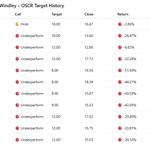
Good news for $OSCR: Jefferies today upgraded Oscar Health from Underperform to Hold, raising the price target to $16 (from $10) on stronger pricing outlook.
investing.com/news/analyst-r…
I’ve followed D. Windley at Jefferies since he started covering $OSCR.
Always the most bearish, lowest target on the Street. Last year he warned of ACA subsidy expiration Armageddon... and he was somewhat right. Stock hit $10.69 just a few weeks ago (but it was more a macro-driven dip, to be honest).
Yet he was bullish on other health insurers at the same time... never quite made sense to me.
But after $OSCR strong guidance + reaffirmation, Windley finally flipped... and here we are with a record target price, now at $16 Hold, during the first quarter without ACA enhanced subsidies!!!🤣
"""
The firm said its analysis of the company’s 2026 bids indicates Oscar Health likely priced sufficiently to reach its 2026 guided margin. Data and industry conversations point to market enrollment trending favorably versus expectations, which is a directional positive for market morbidity, Jefferies said.
Oscar Health is likely increasing its share of "good risk" even net of risk adjustment, the firm said. Jefferies said if the 2026 medical loss ratio meets or beats management’s guidance as it now expects, an Underperform rating is not defensible.
"""
"An Underperform rating is not defensible"?!
Here's a U-turn before it’s too late.
I’m usually very skeptical of sell-side analysts, but this is too hard to ignore.



There are only two companies in the world with:
✅ Mkt Cap > 2Bn USD
✅ Tech Sector
✅ Fwd P/E < 20
✅ Last 5Y Sales CAGR > 25%
✅ D/E < 0.3
✅ Analysts' Recommendations: Strong Buy
✅ Constantly Positive Sales & EPS Surprise
One of these two is $ZETA. What else do you need?
@dsteinberg10000
@TheRonnieVShow
@wealthmatica
@QualityInvest5
@riyadosofian
@foliotrail
@MMatters22596
@danielnewmanUV
@EndicottInvests

‼️‼️‼️
President Trump is set to propose a new framework to extend Obamacare/ACA subsidies for 2 years and modify them, including income caps at 7x the federal poverty line and minimum premium requirements.
Source: politico.com/news/2025/11/23…
Bullish for $OSCR, $MOH, and $CNC if true.
Beware: Politico was by a large margin the newspaper most confident on ACA subsidies renewal during the shutdown, which eventually did not happen.
Very positive rumors, but still rumors.

7
947

$HIMS credit card data (R² > 90%, highly significant revenue indicator) shows flat revenues since March, even on last weeks.
Without increased organic revenue growth (excluding Zava acquisition) momentum may weaken.
Still optimistic about the thesis btw, $HIMS has strong growth potential, but the time to ramp up sales again is now. Otherwise, at this pace, we could have a single digit to 0% YoY organic revenue growth in Q4, which would be unprecedented.

$HIMS fundamentals continue to advance towards an exponential inflection point.
A few months of dull price action haven’t changed the thesis.

1
7
1,037

Looks like we’re in good company: Warren Buffett’s $BKR is in $UNH!
But the thesis still has to unfold — this is just the start, and another sign there’s at least some value in this pick.


📉 This $UNH chart is incredibly revealing.
Let’s break it down — and let me know what you think 💬
UnitedHealth reported a high Medical Loss Ratio (MLR) of 89% — above historical norms.
That crushed earnings to just $3.4B.
Remember: insurance is a low-margin biz. Every 1% surprise in MLR = major earnings pain.
And legally, MLR can't fall below 80%, so there's a cap on profitability by design.
Stock Reaction? UNH sold off hard. It’s now back to 2019/2020 price levels — which could make sense from a P/E perspective since the net income today is about the same as back then.
But here’s the kicker: Revenues have DOUBLED since 2019.
Yes, doubled. With no signs of slowing down.
So what’s going on?
Likely Cause is actuarial miscalculations.
Almost every insurer mispriced plans this year. UNH will likely adjust models and reprice plans next year.
If margins normalize → price should follow.
Headwind 1 - Medicare/Medicaid Cuts:
Yes, they sting — but this is part of the long-term privatization of US healthcare.
People will still need insurance.
UNH has pricing power. They’ll adapt.
Headwind 2 - DOJ Investigation:
A settlement may come, sure.
But UNH publicly declared full cooperation... that’s confidence, not fear.
Bottom line: all the bad news — both real and feared — looks well priced in.
And $UNH today could likely be a very strong turnaround play.

3
531
This is a strong and detailed analysis of PAGAYA from @mvcinvesting, and was very timely looking at the nice price action $PGY had. It seems like this company is finally gaining traction after several difficult years.
That said, concerns remain.
I’ve followed the company since 2021, watching its share price climb to $30 in August 2023 before falling back to $8. In my view, the business is inherently cyclical and perhaps too fragile.
It is cyclical because its performance is tied to interest rate levels, which affect the risk profile of its loan pool, and to the broader economic environment.
It is fragile because—apart from forward-flow agreements—it must retain junior (riskier, first-loss) tranches of its issuances on the balance sheet. This means that a single challenging year can put the entire balance sheet and business at risk, as we have seen before. One small misstep can heavily erode equity book value through impairments on retained loans. In effect, the company serves as the first-loss protection for institutional investors who subscribe to its vehicles.
Since an impaired loan represents lost future cash flows, the company often has to raise capital via share or debt offerings simply to continue operations. This is because it must put up capital for each issuance in line with its retention requirements.
This dynamic was clear in the 2022–2023 vintages. To maintain client relationships, the company kept loan production flowing in a very challenging environment—when halting activity would have been the safer move. Impairments were severe, and the company risked losing its entire equity base (book value per share fell by more than half in just a few quarters). The share and debt offerings during this period were not for strategic growth but simply to keep the business running.
Key factors to monitor here are:
- Fee revenue less production cost (FRLPC)
- Retention rate on the balance sheet (RR)
- Impairments on retained loans
If FRLPC > RR, the business is sustainable and can scale. But the margin is razor-thin—a matter of single-digit percentage points—and keeping impairments under control is critical. One adverse cycle like 2022, or one poorly timed issuance, could produce impairments several times larger than the FRLPC–RR margin, leading to significant losses (don’t be misled by EPS figures adjusted for impairments).
Given these risks, I’m unsure how much total addressable market (TAM) remains or how much upside the business offers. The company has already onboarded several strong counterparties and maintains close ties with Jefferies and Wall Street. But partner relationships alone are not a reliable success factor—you can easily find a sell-side firm willing to work with them, as they take no credit risk to expand/keep their client base.
The buy-side—together with Pagaya’s own capital—is another area to watch. While investor appetite is currently strong, in a stress scenario institutional investors could pull back from their funds, again stalling the engine.
Looking at the latest cash flow statement, without additional borrowing the company would not have reached free cash flow positivity (CFO < CFI). Loan retention is still consuming more cash than is generated from fees plus repayments of older retained loans, meaning that scaling still requires raising capital.
One could argue that retained loans eventually pay back, and I agree. In this strong H1, impairments were $54M against a CFO of $91M—healthy numbers. But the risk remains: in 2024 alone, impairments totaled $414M against $714M in retained loans at the start of the year, meaning the company lost 57% of its largest asset in the balance sheet in just 12 months.
Another difficult environment could erase the FRLPC margin and nullify operational leverage. The margin of safety here appears somewhat thin.
I remain open to revising my assumptions, which may be outdated or incomplete. But based on what I’ve seen over time, I believe the risk/reward profile is not so ideal here.


I just published my detailed review of $PGY's Q2 Earnings Report.
Feel free to check it out. 🤝🏻
$HIMS Core flat QoQ ‼️
Core: Q1 356m vs Q2: 355m
GLP-1s: Q1 230m vs Q2: 190m
Total: Q1 586m vs Q2 545m
As anticipated, until today the growth was mostly GLP dependent. To meet the 2.3-2.4 Bln revenue for FY 2025 they must increase Q3 revenues to 580m and Q4 revenues to 640m.
How to change the trend fast? Hair gummies maybe are not enough, lab testing and other verticals may take a while to contribute, Zava could be no more than a 50m addition in H2.
This is why the marketing on web/newspaper is basically only about personalized GLP, that is probably one of the few ways - maybe the only one - to meet the guidance.
HIMS hopefully won't be a GLP-only company, BUT the short-mid term growth prospects are heavily GLP dependent right now, as well as the stock price.

🚨 $HIMS CORE BUSINESS DECLINED QoQ
Revenue totals:
Q1: 586m
Q2: 545m
GLP-1s:
Q1: 230m
Q2: 190m
Core:
Q1: 356m
Q2: 355m
8
916
📉 This $UNH chart is incredibly revealing.
Let’s break it down — and let me know what you think 💬
UnitedHealth reported a high Medical Loss Ratio (MLR) of 89% — above historical norms.
That crushed earnings to just $3.4B.
Remember: insurance is a low-margin biz. Every 1% surprise in MLR = major earnings pain.
And legally, MLR can't fall below 80%, so there's a cap on profitability by design.
Stock Reaction? UNH sold off hard. It’s now back to 2019/2020 price levels — which could make sense from a P/E perspective since the net income today is about the same as back then.
But here’s the kicker: Revenues have DOUBLED since 2019.
Yes, doubled. With no signs of slowing down.
So what’s going on?
Likely Cause is actuarial miscalculations.
Almost every insurer mispriced plans this year. UNH will likely adjust models and reprice plans next year.
If margins normalize → price should follow.
Headwind 1 - Medicare/Medicaid Cuts:
Yes, they sting — but this is part of the long-term privatization of US healthcare.
People will still need insurance.
UNH has pricing power. They’ll adapt.
Headwind 2 - DOJ Investigation:
A settlement may come, sure.
But UNH publicly declared full cooperation... that’s confidence, not fear.
Bottom line: all the bad news — both real and feared — looks well priced in.
And $UNH today could likely be a very strong turnaround play.
Positive news for $HIMS.
As said by the experts hosted in the @himshouse podcast, a lawsuit is risky for $NOVO too, since their patents would be challenged in court.
🚨 BREAKING: MYLAN WINS FIRST LEGAL BATTLE AGAINST NOVO NORDISK, PATENT #003 FOR SEMAGLUTIDE STRUCK DOWN
- 4 more patents to go before Mylan can sell generic semaglutide in the U.S.
- Other rulings happening soon
$HIMS $NVO $LLY
FULL STORY BY @MANONTHEPEN LINKED BELOW
