

I write the campaign articles for the paper. I don’t think anyone reads them. Direct deposit still works.
District Office, Printer Desk
Joined April 2022
- Tweets38.5K
- Following287
- Followers894
- Likes52.9K







Pinned Tweet
O.K. Let's do this: I am going to post an outline, as you will see. Now, everyone is invited to tell a story about any period, person, or thing that you remember and that others would enjoy; I will incorporate it into the story with your byline and your name if you wish. It will not be in the comments, except for your original post. I will copy it and insert your story into the main body of our story and repost the whole story every time I get a comment that is a story. Make since?
Odessa, Texas / The Permian Basin
A Journey Through the Decades
From Bonham Junior High to the Golden Years in the Permian Basin
Introduction
We were the last of the war babies and the first edge of the baby boom
generation. We grew up in Odessa, Texas, during a time when the
Permian Basin seemed destined to power America forever. We witnessed
the end of steam locomotives, the rise of television, the birth of the
Space Age, the Vietnam War, moon landings, oil booms and busts, and
eventually the arrival of computers and the Internet.
This is the story of one generation, the Permian High School Class of
1962, and of the city that shaped us.
________________________________
Chapter 1
Bonham Junior High: The Late 1950s
If you attended Bonham Junior High in the late 1950s, you might
remember voting on the name, mascot, and colors for the new Permian
High School. None of us realized at the time that the school would
someday become famous throughout Texas and beyond. It was simply the
new school on the north side, a place where we hoped to end up once we
survived junior high.
Bonham could be a rough place for a seventh grader. Hazing was
considered almost a rite of passage. Older boys might make a newcomer
push a penny across the floor with his nose or invent some other
embarrassment. Looking back, it sounds cruel, but that was simply how
things worked.
We quickly learned there were divisions in Odessa. People judged where
you lived, what your parents did for a living, and how much money they
made. The railroad tracks separated more than neighborhoods. South
Side was considered another world. Most north-side kids were warned
not to go wandering there after dark.
Inside Bonham there were different tribes. The athletes dominated the
sports fields. The thugs wore their jeans low, placed taps on their
shoes, smoked cigarettes, and seemed to challenge authority every
chance they got. Most of us floated somewhere between the two groups.
There was no air conditioning. West Texas heat poured through the
windows. Fistfights after school were common enough that they rarely
attracted much attention. News traveled through the grapevine long
before social media existed.
Most students walked home. A few rode bicycles, though by junior high
that no longer carried much status. Coolness came from other things.
If you owned a motorcycle at fourteen or fifteen, people noticed. I
rode an Allstate motorcycle during ninth grade and thought I was doing
pretty well.
The legendary Mr. Macintire led the Bonham band. He was probably one
of the finest band directors Odessa ever had and one of the craziest
men I ever encountered in education. I lasted exactly one day under
his instruction.
Even then, change was coming. Odessa was growing, Permian High School
was opening, and our generation was moving toward a decade none of us
could possibly imagine.
________________________________
Chapter 2
Ninth Grade and the End of Childhood
By ninth grade, everything seemed to be changing at once.
Our bodies were changing. Our interests were changing. Even the tools
we used in school were changing. Fountain pens were slowly being
replaced by ballpoint pens.
The world itself appeared to be speeding up.
Rock and roll had swept across America. Elvis Presley had been drafted
and sent to Germany. Fidel Castro had taken control of Cuba. Alaska
became the forty-ninth state, meaning Texas was no longer the nation's
largest state. Buddy Holly, Ritchie Valens, and the Big Bopper died in
a plane crash that later became known as "The Day the Music Died."
Television fascinated us. Most programs were still black and white.
Families gathered together each evening to watch the same shows.
Stations often signed off at midnight. Before programming began, an
Indian-head test pattern filled the screen.
If your television broke, you could remove the vacuum tubes and carry
them to Cabel's to test them. If one had gone bad, replacements were
available right there at the store.
Many teenagers worked after school. Some sacked groceries at Bill
Sears or Piggly Wiggly. Others carried newspaper routes. The Odessa
American was still an afternoon newspaper.
School dances, the ninth-grade prom, football games, and telephone
conversations occupied our lives. Many afternoons were spent listening
to KECK radio, and many nights ended with KOMA drifting in through the
darkness.
By then most of us were already deciding who we wanted to become.
________________________________
Chapter 3
Entering Permian
Permian High School felt like a completely different world.
The social divisions we had known at Bonham became even more obvious.
There were athletes, scholars, band members, cheerleaders, and
troublemakers. Students were judged by clothes, hairstyles, cars,
grades, and athletic ability.
The football players wore their status proudly. The thugs favored
low-slung jeans and ducktail haircuts. The academic crowd usually
looked somewhere in between.
Girls faced strict dress codes. No pants. No jeans. Spaghetti straps
could get you sent home. Going steady meant loaning your football
jacket, band jacket, or choir jacket to a girl.
Pep rallies filled the auditorium. Football ruled everything.
Cheerleaders led chants while players promised victory.
Breaking rules could earn licks from a paddle or a trip to D-Hall.
Three-day suspensions were considered serious punishment. Counselors
would come later.
The school snack bar sold candy, pencils, paper, and soft drinks.
Students could leave campus for lunch. Fifty cents would buy a
hamburger, French fries, and a cherry Coke at Watts Burger or one of
the many drive-ins.
By then many students were experimenting with cigarettes, chewing
tobacco, and occasionally beer. A surprising number gathered before
school at the telephone company building across from Permian,
cigarettes in hand.
We thought we understood the world.
We did not.
________________________________
Chapter 4
Summer of 1960
The summer of 1960 belonged to teenagers.
Grant Street became Odessa's version of Main Street. Teenagers cruised
from one drive-in to another, visiting places like Tommie's, Days,
Speedway, Nick's, Danny's, Park Inn, and A&W.
The Speedway was famous for its colorful drinks and plastic stir
sticks topped with miniature animals. The Park Inn remained a favorite
gathering place.
Across town, South Side and Ector students had their own territory
around Murphy Street and the Frost Top.
Most evenings began with the simple phrase:
"I'm going to get a Coke."
Parents often knew that meant something much larger.
Cars cruised endlessly. Drag races occurred. Raw eggs occasionally
flew through open windows. Fistfights were arranged. Friendships
formed. Future husbands and wives met.
We were sixteen-year-old bodies carrying twelve-year-old wisdom.
Drive-in theaters were another summer ritual. Odessa had five of them.
Speakers hung from the car window. Double features were standard.
Cartoons played before the movies. The bouncing ball encouraged
sing-alongs.
A breakdown in the projection booth produced a symphony of impatient car horns.
For some teenagers, the drive-in theater had very little to do with the movie.
________________________________
Chapter 5
The Last of the War Babies
When the 1960-61 school year began, we entered our junior year at
Permian High School.
World War II had ended only fifteen years earlier. Looking back, our
class occupied a unique place. We were among the last students
directly shaped by a generation that had lived through the Depression
and fought the war.
Childhood was disappearing.
Bicycles, lunch boxes, marbles, coloring books, and cartoons faded into memory.
Christmas presents became practical.
Most of us worked after school. Gasoline averaged twenty-five cents a
gallon, and fierce price wars sometimes pushed it down to 17.9 cents.
Older friends bought beer. Paper driver's licenses occasionally
developed "improved" birth dates. Some drive-ins served draft beer
curbside.
The Park Inn became legendary.
Football remained the center of school life. Permian finished 8-3 that
season. The homecoming bonfire tradition began.
The band could be heard every morning before class. The members seemed
to belong to their own secret society.
P.E. class meant laps, touch football, soccer, basketball, and the
dreaded rope climb.
Principal Gail Smith guided the school. Teachers who remain vivid in
memory include Mr. Cariker, Mr. Crawley, Ms. Dial, Ms. Doyle, Mr.
Jacobs, and Mr. Tiner.
Breakfast was usually Cheerios or Post Toasties. By mid-morning our
stomachs often growled loudly enough that we were certain everyone
could hear.
________________________________
Chapter 6
Senior Year: 1961-62
By senior year we had reached the summit.
Twelve years of school were nearly over.
Cars became increasingly important. Hot rods, fuzzy dice, pinstriping,
glass packs, and four-on-the-floor transmissions dominated
conversations.
Songs like "Runaway," "Crying," "I Fall to Pieces," and "Take Good
Care of My Baby" filled radios.
Television favorites included Gunsmoke, Bonanza, Red Skelton, and Candid Camera.
Graduation seemed both exciting and frightening.
The senior prom arrived.
So did adulthood.
Some classmates became roughnecks, welders, mechanics, soldiers,
cashiers, teachers, housewives, or college students.
The class of 1962 stepped into a world that would soon be transformed
by war, politics, and technology.
________________________________
Chapter 7
Assassinations, Vietnam, and the Space Race
Three forces shaped our generation more than any others.
The first was political violence.
John F. Kennedy's assassination in Dallas in 1963 stunned the nation.
We watched Lee Harvey Oswald killed on live television two days later.
Lyndon Baines Johnson, another Texan, became president.
Martin Luther King Jr. and Robert Kennedy were both assassinated in 1968.
The second force was Vietnam.
By late 1967 nearly half a million Americans served there. Ultimately
more than 2.7 million Americans would serve in Vietnam and over 58,000
would die.
Some of our classmates went.
Some returned changed forever.
Some never returned at all.
The third force was the Space Race.
We were the "Duck and Cover" generation. We believed beating the
Russians mattered.
Odessa's dark skies sometimes revealed satellites crossing overhead.
The Apollo program pushed forward despite setbacks, including the
tragic fire that killed Gus Grissom, Ed White, and Roger Chaffee.
The moon seemed impossibly far away.
Yet somehow it no longer felt unreachable.
________________________________
Chapter 8
The 1970s
The 1970s found most of us firmly planted in adulthood.
We were husbands and wives. Parents. Workers. Veterans. College
graduates. Oil-field hands.
Many were still trying to figure life out.
Disco arrived, and Odessa danced right along with the rest of the country.
The local nightlife revolved around Herb Gram's clubs. The Shadows
played pop music. Across Andrews Highway, the Stardust catered to
country fans.
For a brief and ridiculous moment, streaking became a national craze.
The Gatlin Brothers became Odessa's hometown stars.
In 1972, Permian High School won the state championship and was named
national co-champion. Mojo became more than a nickname. It became a
rallying cry.
Nationally, Nixon resigned. The Vietnam War ended. The oil embargo
created recession. Elvis died. Margaret Thatcher rose to power in
Britain. The Iran hostage crisis began.
Locally, the Permian Basin suffered through painful boom-and-bust
cycles. Businesses closed. Buildings stood empty. Workers departed in
search of opportunity elsewhere.
Yet Odessa endured.
It always had.
________________________________
Chapter 9
The 1980s
The babies of the forties and fifties entered middle age.
Most of us passed forty.
Some called the 1980s the "Decade of Decadence."
Ronald Reagan occupied the White House for nearly the entire decade.
Many of us now had teenagers of our own.
Permian football reached legendary status. State championships came in
1980, 1984, and 1989. The 1989 team added a national championship.
Mojo was everywhere.
The world brought dramatic change.
CNN arrived.
Personal computers entered ordinary homes.
The Challenger exploded.
The AIDS epidemic spread.
Chernobyl shocked the world.
The Berlin Wall fell.
MTV revolutionized music.
Meanwhile we watched Dallas, Cheers, CHiPs, and Hill Street Blues
while listening to Olivia Newton-John, Pink Floyd, George Jones, Dolly
Parton, Conway Twitty, and a young Garth Brooks.
Many of us noticed new gray hairs.
Some noticed a few extra pounds.
By the end of the decade, many had become grandparents.
Life was moving faster than ever.
________________________________
Chapter 10
Approaching Fifty: The 1990s
By the middle of the 1990s, most of us were approaching fifty years old.
Half a century.
The phrase "golden years" began appearing in conversation, half joke
and half hope.
Operation Desert Storm introduced another generation to war.
Bill Clinton was elected president.
The Dallas Cowboys became America's Team once again.
The Internet arrived.
eBay appeared.
The iMac was introduced.
Scientists cloned Dolly the sheep.
Country music flourished with Garth Brooks, George Strait, and Brooks
& Dunn. Television gave us The West Wing and The Sopranos. Movies
included Titanic, Casino, and The Shawshank Redemption.
The decade also produced tragedies, controversies, and unforgettable
headlines. Oklahoma City. Waco. O.J. Simpson. Ruby Ridge.
The world we had entered as children scarcely resembled the one around us now.
________________________________
Epilogue
Looking Back
When we walked the halls of Permian High School in 1960, none of us
could have imagined everything we would witness.
We saw the end of segregation and the beginning of space exploration.
We watched Kennedy's funeral, Armstrong's moonwalk, the fall of the
Berlin Wall, and the birth of the Internet.
We survived recessions, oil busts, wars, social upheaval, and personal
heartbreaks.
Some classmates became wealthy. Some struggled. Some were taken far
too early. Others remain with us today.
What binds us together is not simply that we attended the same school.
It is that we traveled through one of the most extraordinary periods
in American history together.
We were the last of the war babies.
We were the Class of 1962. Hollywood even made a movie about us. "American Graffiti"
And for a little while, under the vast West Texas sky, the Permian
Basin was the center of our world
2
1,134
Campaign Intern retweeted

Nation Approves Plan To Push Hollywood Into Pacific Ocean buff.ly/PpqUkfK

Older Star Trek fans know it is either Nomad or V'jer. Both were armed and planet killers.
SPACE: Mysterious object in space: Could it be a Soviet probe missing for 40 years? “A group of researchers has put forward an unusual explanation. Harvard astrophysicist Avi Loeb and two colleagues, Adam Hibberd and Adam Crowl, believe KY26 could be Phobos 1, an unmanned Soviet spacecraft launched on 7 July 1988. The probe lost contact with Earth while on its way to Mars.”
8
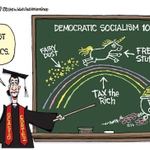
Satire or maybe.... Summary of the contemporary U.S. “new left” (mainly Democratic Socialists of America/DSA, progressive Democrats, and allied groups) based on their stated platforms:
They aim to shift power from corporations and markets toward public/democratic control of major sectors of the economy and expand government provision of goods and services. Core commitments include:
Healthcare: Medicare for All — universal single-payer coverage free at the point of service (no premiums, deductibles, or copays), covering medical, dental, vision, mental health, reproductive care, and long-term care. Funded primarily by taxes on the wealthy and corporations.Platform.dsausa
Climate and energy: Green New Deal — rapid decarbonization, massive public investment in renewable energy and infrastructure, federal jobs guarantee, and a “just transition” for fossil-fuel workers. Some versions emphasize public ownership of energy systems.Program.dsausa
Economic redistribution and labor: Wealth taxes and higher taxes on the rich and large corporations; stronger unions and collective bargaining; a 32-hour workweek with full pay and benefits; living minimum wage; public ownership or democratic control of major industries and utilities; free public college and cancellation of student debt; expanded public housing with rent controls and tenant protections.Fox News
Criminal justice and policing: Steps toward defunding and ultimately abolishing police and prisons (redirecting funds to social services), ending cash bail, and reducing mass incarceration.Reason
Immigration: End ICE detentions and deportations; amnesty/legalization for undocumented immigrants; more open migration policies.Reason
Foreign policy: End or sharply reduce U.S. military aid to Israel and support Palestinian rights (including right of return in some platforms); close overseas bases; cut military spending; prioritize diplomacy over force.Platform.dsausa
Democracy and institutions: Expanded voting rights (sometimes including non-citizens), ranked-choice voting, public campaign financing, proportional representation, and in more radical DSA proposals, abolishing or subordinating the Senate, reducing Supreme Court power, or rewriting constitutional structures for a “workers’ democracy.”Washingtonexaminer
Mainstream progressive Democrats (Congressional Progressive Caucus) emphasize many of the same economic goals (higher wages, expanded social programs, climate spending, free college elements) but are generally less radical on police abolition, open borders, or full nationalization than the DSA. These positions are drawn from official platforms such as DSA’s “Workers Deserve More” program and related progressive agendas. Thanks, GROK, for help and documentation.
29 sources See less

58


Campaign Intern retweeted
All Of Nation’s Technology Fails After One Asian Guy Fired buff.ly/BCr2E7v


Satan Once Again Favored To Emerge As Senate Majority Leader babylonbee.com/news/satan-on… via @TheBabylonBee

4
According to a 1960 study, overpopulation was going to end the world on Friday notthebee.com/article/accord… via @Not_the_Bee

4