

Public Power for the Nation's Capital IG: @wepowerdc Email: [email protected] #DCStatehood
Piscataway land/Washington, DC
Joined April 2020
- Tweets1.3K
- Following547
- Followers977
- Likes1K





We Power DC retweeted

We have seen the villain. Now is the opportunity to break its monopoly grip on power

We Power DC retweeted

Why should Congressional Democrats investigate corporate America if their mandate is to deliver real economic change? Because investigations are a key catalyst for securing reform and legislation. For much of the last century, Congress used to be the main institutional player working to secure an economy that serves working people. A key tool was oversight. Lawmakers routinely investigated complex markets and major corporations, identifying problems and exposing wrongdoing. A major goal of these investigations was to learn what was driving certain problems and figure out how to fix them.
After Democrats took back the House during the first Trump administration in 2019, I joined the House Judiciary Committee as a staffer on the Antitrust Subcommittee. Under the terrific leadership of @RepJerryNadler and then-Rep @davidcicilline, we pursued an 18-month investigation into Amazon, Apple, Facebook, and Google, securing key evidence of how their business practices were undermining competition and harming people, setting the basis for both lawsuits and proposed legislation.
A few lessons from that experience:
1. The quality of legislative oversight depends on the staff and the support of top members to confront power. Committee and Subcommittee Chairs that are focused on getting answers and unafraid to take on powerful corporate interests will make the difference between oversight that doesn’t surrender to their evasion tactics and oversight that aims low or flames out.
Even a relatively small number of dogged, talented lawyers ready to dive in can make a big impact. In the 1930s a single congressional lawyer, Ferdinand Pecora, helped reshape our entire banking system by subpoenaing records and interrogating top financiers, including J.P Morgan. The investigation exposed self-dealing, market manipulation, and tax avoidance, and laid the groundwork for foundational New Deal legislation, including the Glass-Steagall Act and the Securities Exchange Act.
2. Eliminating bottlenecks to moving investigations forward is key. For example, the House should make sure that Subcommittee Chairs can issue subpoenas rather than needing the sign-off of the full Committee or its Chair. A credible threat of sending subpoenas is critical for credible oversight.
3. Ensuring that members can develop the muscle to effectively interrogate CEOs requires investing in real preparation. In the lead up to the hearing with Bezos, Pichai, Cook, and Zuckerberg, the Antitrust Subcommittee spent months reviewing millions of documents collected from the firms, interviewing affected parties, briefing members on key evidence, and conducting practice hearings. Members came into the hearing deeply informed and able to rebut and call out CEO dissembling. The result was some of the most effective member questioning of executives we’ve seen in decades. @TheProspect wrote up a great overview: prospect.org/2020/07/30/triu…
4. For decades, institutional capacity in Congress has been extremely weak. Much of this traces back to the Gingrich Revolution, which was effectively the 1995 DOGE-ing of Congress. Republican leadership fired over 600 professional staffers, eliminated the Office of Technology Assessment, and gutted research capacity. None of that capacity was ever meaningfully restored.
As a result, members have way fewer resources to develop serious expertise or go deep on a new topic. Members should start rebuilding that capacity so the institution can fully play its Article I role, where Congress can again do serious policy development and legislating and serve as a real check on the executive and judicial branches.
5. AI markets should be high on the list of investigations. The business decisions of the major AI firms have huge public ramifications, yet the public is at a severe informational disadvantage when it comes to how these markets work and the choices these firms are making. A congressional investigation will help ensure future legislative action is based on a more complete view of what is going on rather than selective and partial corporate disclosures.

We Power DC retweeted

New post: I think folks are failing to grasp what a watershed election this was for the politics of monopoly utility companies.
Governors are the most important people to utility regulation in most states. The new ones ran on aggressive utility accountability platforms. 1/9

We Power DC retweeted
HUGE: Michigan officially banned companies with more than $250,000 in state government contracts, and the state's utility monopolies, from contributing to campaigns last night.
We Power DC retweeted
This initiative has passed: called by the AP. The fight will move to the courts but it is an unequivocal, bipartisan repudiation by voters of Michigan's two investor-owned utilities as toxic entities.


We Power DC retweeted
From scorching job sites to flooded factories to overcrowded hospitals, workers are some of the first to face the repercussions of climate change.
Join WPDC and Metro DC DSA for a conversation with local union reps & climate experts about what's at stake for local workers.

We Power DC retweeted

Duke Energy has been overcharging Indiana ratepayers for 565 days and counting.
On 4/16/2025, the IURC denied Duke's challenge of the final order in its rate case. Duke ignored the order and continues to charge ratepayers rates that are tens of millions higher than were approved


We Power DC retweeted
@robinsonmeyer made this joke verbally during our podcast so here it is in meme form.

We Power DC retweeted

⚡ NEW: A public renewable energy developer would deliver substantial economic and reliability benefits for New York City, including cost savings of at least $170 million per year. Read our research with @publicpowerny and @PubRenewables at the link below.

We Power DC retweeted
Watching, in real time, as sentiment toward investor-owned monopoly utilities becomes depolarized among elected Rs and Ds (and not in the good way for the utilities!) in real time is really quite something.
10/10, recommend.
We Power DC retweeted

Systemic failures, neglect and a tumultuous storm have impacted the Black-majority city of Gary, Indiana. Northern parts of the U.S. state have suffered a two-week blackout.
And now, the city is the proposed site of 8 new data centers.
According to a Bloomberg study, it’s estimated that people living near data centers pay 267% more for electricity than they did five years before – even though a third of the city lives below the poverty line.

We Power DC retweeted

Today I found out almost a million people are without power for nearly two weeks in Gary, Indiana. Only heard about it from my co worker who has family there. Nuts.

“We’re the Blackest city out here, so they don’t want to check on us.”
More than 20,000 residents in Gary, Indiana have been without power for almost two weeks after massive storms tore through the area, knocking down trees and power lines.
NIPSCO is the only energy provider in the area, and they reported more than a half a billion dollars in profit in the first half of 2026.
“We don’t pay, we get cut off. But when disaster happens, they want to charge us. They have billions of dollars, we’re working day-to-day.”
Gary residents are banding together to provide for each other amidst the blackouts, providing community meals and phone charging stations at community centers.
We Power DC retweeted
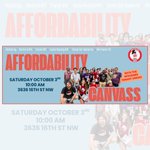
Let’s dive back into it! MDC DSA Working groups are coming together to base build around affordability issues for a canvass in NW.

We Power DC retweeted

A customer’s $200 monthly #electric bill means roughly $30 went to corporate profits.
Curious about how much #utilities are profiting from your bills? @EnergyandPolicy's utility profit calculator tells you.
energyandpolicy.org/utilityp…

We Power DC retweeted

SCOOP: Documents show that power companies and tech firms invested in the data center buildout have created a group to ‘educate’ and support friendly state regulators with big donations and secret retreats. Get the inside story from @evanhalper washingtonpost.com/business/…

We Power DC retweeted
We Power DC is partnering with Extinction Rebellion to co-host a wheatpasting session this August!
Please join us to hang up posters around the Mt. Pleasant neighborhood (starting at the Columbia Heights Metro station) at 1PM.

We Power DC retweeted

Also, call @DCOPC to see if we can be of assistance @ (202) 727-3071. Repost:

Our call center is currently experiencing an outage due to a third-party vendor issue. If you have an emergency, please call 911.
If you have a question about your bill, starting or stopping service, or any other non-emergency matter, please contact us on or after Monday, August 10th.
We appreciate your patience as we work to restore service as quickly as possible.
We Power DC retweeted

Battery-eligible New Jersey VPP program begins to take shape
Utility-owned storage could help mitigate grid congestion, a utility manager said at a July stakeholder meeting. Another said customer-centric program design is crucial to reducing attrition.
utilitydive.com/news/battery…

We Power DC retweeted

"Utilities do not write campaign checks out of generosity or civic duty. Their investments in political influence have to by law be in the interests of their shareholders. And that investment pays off when lawmakers block reforms that would lower bills, especially when that money comes from the utility’s excessive profits."
cardinalnews.org/2026/07/30/…


