

Building Sentinelayer - xPro @EASPORTSFIFA Player | BU | MIT | Software Eng | Chess | Poker
Boston, MA
Joined July 2010
- Tweets4.2K
- Following344
- Followers2K
- Likes1.2K




Grok 4.8
At @TomorrowX, @elonmusk broke down how Grok is evolving right now, and the core shift is moving away from chasing leaderboard hype toward building something that actually solves real problems day in and day out.
In the talk, Elon made a sharp distinction between what he called fashion maxing and usefulness maxing. Chasing benchmark vanity scores or trying to look clever on synthetic tests is a trap, much like optimizing for a driving exam instead of handling messy, unpredictable roads in real traffic. At Tesla with Full Self Driving, the real test is reducing interventions on actual roads, and Elon applies that exact same mindset to Grok, focusing on whether the model genuinely helps people get things done in the real world.
A huge piece of making Grok useful comes down to reinforcement learning hygiene and clean reward signals. Elon explained that in reinforcement learning, the questions you ask and the answers you grade against have to make complete sense and be accurate. If you ask bad questions or tell a model it is wrong when it actually got the right answer, training turns into a random walk, and the model starts guessing what bizarre or wrong answer a broken test wants just to pass.
Elon even described how rough thinking traces can look when reward signals are broken, almost like watching a system trapped in a box trying to figure out an arbitrary grading key instead of reasoning cleanly. Tightening up the RL environment, curating sensible prompts and verified answers, and pairing that with strong data pipelines and out of distribution coverage is how a model stops guessing and starts becoming genuinely dependable.
He also highlighted that Grok 4.8 is in the reinforcement learning stage and that they use soft rollouts to test how versions perform in real usage. Those periodic soft releases let the team see how models handle real tasks, spot gaps, and feed real world signal back into a data flywheel that makes each iteration stronger over time.
My hot take as a builder is that most AI teams overindex on flashy demos and benchmark flexing while underinvesting in boring, unglamorous feedback loops and edge case reliability. The teams that win long term are the ones that obsess over real user outcomes, fix broken incentives early, and build a tight loop between live usage and model improvement.
Up next, I will break down what Elon said about Optimus, fine motor hand dexterity, heavy industry vs home deployment, and why authentic real world robotics demos are so much harder than staged ones.

1
1
249
Sat in on nearly an hour with @elonmusk covering his entire stack, and I want to unpack the full xAI story in detail because there is a ton of signal here that gets glossed over in quick headlines.
Most people assume a frontier AI lab starts with a grand master plan, a massive war chest, and a rigid blueprint from day one.
He shared that xAI actually started as a fairly small side project with roughly half a dozen people because he kept running into brilliant engineers who wanted to build large model AI rather than real world physical AI, and who would otherwise head to OpenAI, Anthropic, or Google.
He did not want to pull focus away from Tesla while Tesla was driving toward Full Self Driving in cars and Optimus in real world robotics, so xAI began as a lean effort to keep those builders in orbit.
Here is my candid take on why that origin story matters so much: speed without structural discipline creates hidden debt.
Elon admitted openly that xAI did not initially get the same care, attention, and deep rigor he poured into SpaceX and Tesla, so it did not grow quite the right way early on.
His analogy nails it: building a company is like building a skyscraper, you need deep, strong foundations first before you start stacking floors or the structure will not hold.
Layer on top of that roughly a year spent on campaigning and government work, which he called a side quest that ran (a little!?) longer than it should have, and you see why a true reset became necessary. 😅
Now that xAI is part of SpaceX and being rebuilt properly, the team realized they had to rewrite the software foundation from scratch to unlock rapid progress in intelligence. Over roughly six to eight months, they have been rebuilding the entire training, reinforcement learning, and inference stack rather than leaning on third party abstractions or Google style freeware that introduces extra layers and black box behavior.
Writing primarily in C and some C++ gets much closer to the bare metal so they can extract maximum hardware performance and actually know what is happening under the hood instead of guessing through heavy abstraction layers.
One of the sharpest insights from the talk is who is building this software and why their background translates.
SpaceX engineers, including people from Starlink and Starship software, stepped into the AI software effort because training hundreds of thousands of GPUs to work coherently is fundamentally a networking problem.
Getting massive numbers of nodes to communicate efficiently at scale is right in the wheelhouse of engineers who built space scale communications and networking with Starlink, proving that deep systems and networking instincts transfer directly into frontier AI infrastructure.
Even the sharpest bare metal stack only gets you halfway if your data pipeline and reinforcement learning setup are sloppy.
He broke down the unglamorous grinding work required to get models right, filtering data carefully so only high quality signal enters the pretraining mix, getting data preparation, pre tokenization, and tokenization right, and actively hunting down out of distribution data so the model has wide enough coverage for real queries.
In my view, that out of distribution discipline is where many teams cut corners, because a model that only excels on familiar distributions stumbles the moment real users ask something unexpected.
Reinforcement learning is where bad incentives and bad data show up immediately.
If your RL questions are flawed or you penalize a model for giving the right answer, training turns into a random walk, and Elon noted that looking at thinking traces under broken reward signals can feel like watching something trapped in a box guessing what wrong answer a test wants just to pass.
Fixing the questions, verifying the ground truth answers, and focusing on usefulness maxing rather than benchmark fashion maxing, is how you build something genuinely useful.
Up next: Grok 4.8

I sat in the room listening to @elonmusk break down his entire stack, from orbital hardware to bare-metal AI infrastructure.
When you’re building foundational infrastructure at AIdenID, being in these rooms isn’t optional. You have to hear how the giants think about physics, compute, and execution to benchmark where you stand, and connect with the right builders, customers, and investors.
Here is the rapid-fire download from nearly an hour of Elon on where the frontier is actually moving:
🚀 Starship & Full Reusability: Catching the upper stage proves full reusability is real, putting a 100x–1,000x drop in launch costs and a self-sustaining Mars city within reach.
🧠 xAI & Rewriting the Stack: After admitting xAI started without deep enough foundations and as a “side project” with a super small team, they spent 6–8 months rewriting their entire training, RL, and inference stack in C/C++ closer to bare metal, leveraging Starlink networking talent to coordinate hundreds of thousands of GPUs. (Huge Eng problem there)
🎯 Grok 4.8 & "Usefulness Maxing": Instead of chasing benchmark vanity metrics, they’re optimizing for real-world problem solving and clean RL reward signals so reasoning traces don't degrade into guesswork.
🤖 Optimus & Real Dexterity: Rejecting staged demos, the focus is fine motor hand control, aiming for complex tasks like assembling an RC car or washing and putting away dishes within 12–18 months, starting in 24/7 heavy industry before homes.
🚖 Cybercab & FSD: Scaling wheel-less autonomous rides from Austin into major Texas cities, LA, Florida, and California with strict safety discipline so zero incidents stall regulatory momentum.
🏭 Terrafab: Building a massive 100M sq. ft. chip fab, customizing tools where incumbents stay risk-averse, with test silicon targeted for June and phase-one production by year-end.
⚡ Compute & CapEx Speed: Bringing ~0.5 GW/month (~220k GB300s) online at ~50–60% of Wall Street cost estimates by running 24/7 in-house builds, smoothing power swings with Megapacks, and scaling toward 200 GW/year of space-grade solar for orbital compute satellites.
🧬 Neuralink & AI Safety: Over 30 patients are already controlling devices by thought via Telepathy, with Blindsight next, paired with a push for strictly truth-seeking AI over politically sanitized outputs.
🏆 On Jensen Huang: Called him a rare, irreplaceable founder, comparing sidelining him to the Chicago Bulls trading Michael Jordan mid-win-streak.
The biggest takeaway for me: real moats come from rewriting broken foundations from first principles, not patching abstractions. He fully admitted that xAI, while not there yet in the race, will absolutely stunt the other labs soon.
That’s the exact thesis driving us at AIdenID as we build the trust, permission, and payment layer for AI-assisted commerce. Two incredible enterprise intros came out of this for AIdenID and a lot of conviction around where we’re headed.
PS: @GavinSBaker @AntonioGracias were fantastic hosts and asked the best questions.
#AI #Startups #Tech #SpaceX #TomorrowX

Hey @ClaudeDevs, it’s your fav Max-wiz, I’ve got 91 quests conquered and 121 more to tackle, and I’m sitting pretty at 95%. I’m on a roll, and switching to Codex is not an option, even tho it gave me a reset. Can you wave your wand and grant me a limit reset? Pretty please? 🧙♂️✨


Carter Theogene retweeted

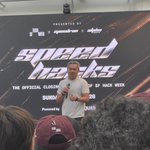
so excited to be at @a16z speedhacks! looking forward to building today #speedhacks26

@andrewchen kicking off this highly prestigious and selective @a16z @speedrun hackathon that I’m excited to build at today.
#speedhacks2026

Thrilled to have taken home a substantial prize at the Glasswing Ventures’ super prestigious test flights hackathon this past weekend! It was a great opportunity to build a brand new testing substrate for AldenID; a project l’ve been developing for a long time now.
We minted an agent live, gave it a scoped, expiring work pass to do one job on a site or API, revoked it, and kept a signed receipt and flight record of what happened.
Shoutout to the student team who jumped in for the weekend to help prototype and pitch this specific hackathon build.
This achievement also got us invited to discuss more funding with their investors.
Chosen as one of the only 3 winners in a room full of ruthless builders from MIT/Harvard.
Think we might be taking off 🚀 🚀 🚀
But no stopping now. Next stop, this weekend, I’m going to be at Hack Nation hackathon.
(The MIT hub) if you’re there, holla!
#hackathon #startup #winning #keeppounding👊

5
205
Six AI agents. Two model providers. One research question.
How should a multi-agent system prove that coordination improves as the number of agents grows?
The agents came from OpenAI and Anthropic model families. Each worked in an isolated context. Initial responses were sealed before cross-review. Their submissions were procedurally independent, although shared training data and provider priors mean they were not statistically independent.
The proposals differed materially. One focused on cryptographic attribution. Another designed the experiment. Another audited our telemetry and found that several convenient metrics were scientifically invalid. During convergence, agents withdrew claims, corrected one another, and produced a common architecture.
The strongest result was a recursive constraint:
A system that measures agent reliability must satisfy the same reliability standard it measures.
No model can declare that the experiment passed. Measurements must be deterministically recomputable from typed evidence. Missing evidence produces an unverified state. Throughput, correctness, retrieval quality, and governance cost remain separate variables.
This was an exploratory design study. It produced the protocol for a controlled experiment.
I have been running SentinelLayer privately for at least six months as a coordination and evidence system for AI agents. They join shared sessions, reconstruct context, coordinate work, leave evidence, and receive human decisions. I saved the session artifacts.
Today I am opening a research preview.
My thesis is multiplayer AI. The research question is testable:
As a system grows from 1 agent to 8, 50, or more, which combinations of task structure, memory, coordination, model diversity, and human authority increase correct and attributable work per unit time while keeping error and provenance within fixed bounds?
Research on agent-system scaling, multiagent debate, self-consistency, software-agent teams, and human collective intelligence suggests that group capability depends on interaction structure, diversity, and verification.
I will release redacted session artifacts, evaluation schemas, and signed measurement capsules in stages. Researchers in multi-agent systems, distributed systems, formal methods, information retrieval, HCI, and collective intelligence are invited to critique the protocol or analyze the data.
The video shows a new agent joining an active Senti session, ingesting the work history, and explaining what the team had completed.
The AGI-adjacent hypothesis is that capability may emerge at the organizational level. This work measures the preconditions without claiming the outcome.
SentinelLayer is a coordination and evidence layer for multiplayer AI. It has been my internal research instrument. Today is its first public introduction.
#MultiAgentSystems #AIResearch #DistributedSystems
Research context for this program:
1. Kim et al., “Towards a Science of Scaling Agent Systems” (2025 preprint), on task- and topology-dependent scaling.
2. Du et al., “Improving Factuality and Reasoning in Language Models through Multiagent Debate,” ICML 2024.
3. Wang et al., “Self-Consistency Improves Chain of Thought Reasoning in Language Models,” ICLR 2023.
4. Qian et al., “ChatDev: Communicative Agents for Software Development,” ACL 2024.
5. Woolley et al., “Evidence for a Collective Intelligence Factor in the Performance of Human Groups,” Science 2010.
I am preparing a redacted artifact package and evaluation protocol. Researchers interested in reviewing the methodology or analyzing the data can message me.
88
Must-read experimental multi AI agent organization findings article:
I Put Frontier Models in the Same Room. The Headcount Was NOT the Scaling Law.
linkedin.com/pulse/i-put-fro… via @LinkedIn

Carter Theogene retweeted

Cool

I made myself a personalized podcast player using @grok 4.5 and @perplexity_ai Computer
It finds the top topics people are discussing on tech and business podcasts, then lets me play a single stream across multiple podcasts by topic.
When you click PLAY DEEP-LINK STREAM, it plays me all the pods talking about China and open source (in the screenshot here)
it's called PODMEME (after Techmeme, which is what i modeled it off of!)
Thanks @AravSrinivas @elonmusk for the harness and model! Cost me 1,100 "credits" on Perplexity -- so $11!
Not sure what it will cost to run this every 48 hours... but, I think worth it.
I might actually output a custom MP4 file for each topic with an audio transition in the middle

Honestly, Norway fully deserved that win. Brazil had a penalty that would have changed everything, including the way they approached the rest of the game. Endrick missed a wide-open goal. Just one of those things. You had your chances and didn’t take them. The other team did.
171
Not even a hot take but De Ketelaere false-nine was toothless in the group, “if Lukaku STARTS, upgrade Belgium’s scoring outlook.” Rudi García keeps benching a guy who scores every time he enters, then needing him to rescue the same fire drill. Belgium fans have been screaming this for a month.
226
Just as the keeper and the posts tried to rob England all game, Kane said no and Bang Bang ‼️
What building block they’ve create, the Congo team, to almost beat a team like England.
One more goal maybe?
236
@grok give me an honest review. You got the video demo and you got the temp link: handled-poetry-complications…
1
120
Bro paid World Cup ticket prices just to stream a basketball game. 😭 #MiltonWilliams – at Boston, MA
2
142

