






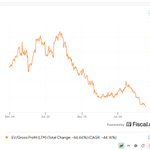
Looking at $AXON on a per-share basis, revenue per share has more than doubled since 2023.
- Revenue per share: 26% CAGR
- Share count growth: ~3.5% annualized
EPS per share has also grown, although not nearly as quickly. FCF per share leaves more to be desired, with recent investments in inventory and capacity contributing to the pressure.
For now, I think revenue per share growing this much faster than the share count is an encouraging signal.


In my previous post, I explained why $AXON SBC expense in dollars can be misleading when trying to understand the actual impact on shareholders.
Instead, I think we should also focus on actual share-count growth and potential future dilution.
The chart and table below summarize my research. Here are my main takeaways:
#1.
Axon's share count has grown approximately 3.5% annually 2023 through September 2026. This includes dilution from other sources as well. Not going to sugarcoat it, that's on the higher end compared with several other growth companies I've looked at, although TSLA, PLTR and CRWD were even higher.
#2.
That said, employee-related share issuance (dark green bars) has moderated since 2023.
#3.
Looking at the table on the right, Axon had approximately 5M outstanding equity awards at the end of 2025, representing roughly 6% potential ownership dilution if fully issued as new shares.
It isn't an estimate of exactly what's left today, but it gives us a general picture of the potential future dilution.
------
My takeaway is that Axon's SBC is indeed high. But after digging into actual share-count changes and outstanding awards, I find the dilution picture more manageable than the headline SBC expense initially suggested.
That's especially true when you consider that some of the potential future dilution could occur over multiple years rather than in a short period of time.
Furthermore, management has set a target of keeping annual dilution from SBC below 2.5% by 2028.
The important thing to watch is whether Axon can grow its business and value per share metrics fast enough to more than offset that dilution.
-----
Sources: Axon's 2025 10-K, Q3 2026 10-Q and FY2025 earnings release. FYI I did use AI to help analyze the filings and haven't independently verified every figure.

2
965
Another interesting insight from @HaydenCapital's quarterly letter was an explanation behind the increased volatility when it came to individual stocks compared with years past.
They explain a few reasons for this...
#1 Indexing
Passive funds hold more than active ones. An index fund buys a company because it's in the index, not because of anything specific about the business. This leads to a thinner trading float.
#2 The rise of pods and quants
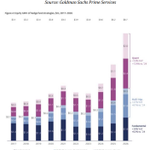
Equity gross exposure across hedge funds has nearly tripled, from $3.1 trillion in 2017 to $8.7 trillion in 2026. Quant exposure alone went from $1.1 trillion to $4.4 trillion, and is up 53% in the last year.
That leads to more short-term oriented actions. If a stock drops 5%, it's sold, regardless of the fundamentals when taking a longer-term view.
#3 Leverage
Goldman reporting that gross leverage across its prime brokerage book rose for a third straight year to a record high at the end of 2025. There's much more gross exposure across hedge funds which often utilize more short-term, leveraged capital. This results in much more extreme swings in either direction.
----
The result of all this is a much more fragile market with much less tolerance for any negative news. (Same goes on the way up as well, but it seems to be much more apparent on the way down.)
I end this with a couple of quotes from the letter:
"Nobody is asking whether the business is still worth owning. The question is whether the position is breaching a drawdown limit, and the only way to fix that is to sell, now. Layer leverage on top, and a modest disappointment becomes a forced liquidation."
"For a pod with a tight drawdown limit, a falling price is the risk, regardless of what’s happening to the business. As long as the stock exhibits negative price momentum, it’s uninvestable. An entire multi-trillion dollar industry has been built around that idea."

2
29
1,645

It is a pleasure to read these every quarter.
Moreso cause I hold both these companies and will take whatever additional conviction I can get 🥲
Source: content.haydencapital.com/Ha…
6
968
It is a pleasure to read these every quarter. Moreso cause I hold both these companies and will take whatever additional conviction I can get 🥲
Source: content.haydencapital.com/Ha…
1
35
In my previous post, I explained why $AXON SBC expense in dollars can be misleading when trying to understand the actual impact on shareholders.
Instead, I think we should also focus on actual share-count growth and potential future dilution.
The chart and table below summarize my research. Here are my main takeaways:
#1.
Axon's share count has grown approximately 3.5% annually 2023 through September 2026. This includes dilution from other sources as well. Not going to sugarcoat it, that's on the higher end compared with several other growth companies I've looked at, although TSLA, PLTR and CRWD were even higher.
#2.
That said, employee-related share issuance (dark green bars) has moderated since 2023.
#3.
Looking at the table on the right, Axon had approximately 5M outstanding equity awards at the end of 2025, representing roughly 6% potential ownership dilution if fully issued as new shares.
It isn't an estimate of exactly what's left today, but it gives us a general picture of the potential future dilution.
------
My takeaway is that Axon's SBC is indeed high. But after digging into actual share-count changes and outstanding awards, I find the dilution picture more manageable than the headline SBC expense initially suggested.
That's especially true when you consider that some of the potential future dilution could occur over multiple years rather than in a short period of time.
Furthermore, management has set a target of keeping annual dilution from SBC below 2.5% by 2028.
The important thing to watch is whether Axon can grow its business and value per share metrics fast enough to more than offset that dilution.
-----
Sources: Axon's 2025 10-K, Q3 2026 10-Q and FY2025 earnings release. FYI I did use AI to help analyze the filings and haven't independently verified every figure.
One of the biggest points of contention with $AXON is its stock-based compensation (SBC).
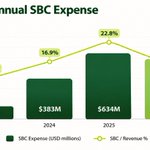
SBC went from $131M in 2023 to $634M in 2025, representing nearly 23% of revenue. That's a substantial amount, and it looks even more concerning if you look at operating profitability.
But after digging into Axon's SBC structure, I think looking at the dollar expense alone can be misleading.
In 2024, Axon introduced a massive performance-based stock award program for employees and its CEO.
The Employee XSP originally had 7 tranches, with 2 more added in 2026. Each tranche has operating targets, stock price targets, and minimum service requirements.
However there's an important accounting nuance:
Axon can recognize SBC expense once the operating targets are considered probable of achievement, even before the stock price targets are met or the shares have vested.
That expense is generally recognized over the expected service period, which can change as management updates its assumptions.
Axon even acknowledges in its 10-K that this accounting treatment can result in higher upfront expenses and volatility.
The first 3 Employee XSP tranches vested between June 2025 and June 2026.
My suspicion is that the large awards introduced in 2024, combined with rapid progress toward the earlier performance milestones, contributed to the sharp increase in SBC expense. However, expense could also have been recognized for later tranches that haven't vested yet.
Of course, I'm not implying SBC is free. The main takeaway is that looking at just timing and dollar amount doesn't accurately tell you the shareholder dilution that will ultimately occur.
That's why I think looking at actual share-count growth, newly granted awards, and potential future dilution gives us a more complete picture than SBC expense alone.
I'll be digging into those numbers in a future post.
🤖 Made with AI
One of my favorite accounts as of late.
Nothing like bullish confirmation bias to keep me in good spirits during this downturn 😬

SPX just had a 7 day losing streak with a total return of -9.31%
How did SPX do 1 week and 1 year after every other similar event in the history of the S&P 500?
Who else is already getting tired of nothing but bullish stats? Yeah, I figured.

2
19
3,186
Even $AXON management agrees shares are cheap.
They recently changed the terms of the Skydio acquisition to be funded by 90% cash (from 60%), reducing equity dilution.

Exactly why I was comfortable making $AXON a top 5 position very quickly.
I bought purely shares to hold for the long-run.
2
32
2,466
I remember a similar chart back during April 2025 liberation day. I posted on substack that I was buying into the fear.
Looks like it’s time again 🛍️


The $VIX increased 86% this week, its 4th biggest weekly spike ever.
What has happened in the past following the biggest $VIX spikes?
Stocks have tended to bounce back with above-average forward returns.
Does this always happen? No. There are no certainties in markets, only probabilities.

2
207
Exactly why I was comfortable making $AXON a top 5 position very quickly.
I bought purely shares to hold for the long-run.

$AXON now trades at its lowest valuation (forward basis; I believe the numbers because it's mission critical govt contracts) since 2022, during which time we experienced the "first or second fastest interest rate hiking cycle in American history," which concluded with the 2nd and 3rd largest bank failures in U.S. history. Scary.
This suggests that, today, we can buy an Axon that offers its highest return profile in four years while we assume the same level of risk.
Higher return, same level of risk: The ideal asymmetry when investing.


Guess $SE investors can’t take it too personally:
nitter.cf/mikezaccardi/status/21…

Emerging Markets fall to a 7.7 P/E with today's drop @yardeni $EEM
Lowest since the depths of the 2008-09 GFC

2
189
The 30%+ post-earnings reaction in $TMDX was well deserved.
But the number that impressed me most from Q3 wasn't the headline revenue growth of 41% YoY, it was the sequential 2% QoQ organic revenue growth.
That doesn't sound like much, but Q3 is a seasonally weaker quarter for transplant activity.
Deceased donor transplant volume actually declined by 6% during this time, yet TransMedics still managed to grow organically from Q2.
To me, that's a strong signal of continued market share gain.
There were also very encouraging updates on CHOPS, heart/lung trials, and international expansion that could drive growth in 2027.
I break it all down in the article below 👇
2
9
780

If you needed a sign the AI trade was over it’s when a SCHD account sells all their $SCHD and goes all in (+margin!) on $NBIS

Selling all my $SCHD and going 100% $NBIS on margin may have been the worst investment decision I’ve ever made…
I am stressed 24/7 and only have a 22% margin buffer left. 😳

1
1
302
But in all seriousness I feel for you @SCHDaccumulator. Everyone has to pay their tuition to the market and thankfully it’s not TOO much, relatively speaking of course. Hope it works out in the long run for you.
1
53