

Respiratori PT, MSc Col. N°12380, CFC Fisioteràpia en malalties cròniques; cardiovasculars, respiratòries i diabetis. Consorci Sanitari de l'Anoia.
Santa Coloma de Queralt
Joined October 2011
- Tweets2.3K
- Following1.2K
- Followers440
- Likes5.8K






Ramon Sureda retweeted

🧑⚕️Igualada acollirà una taula rodona per abordar els mites sobre la salut de les dones
anoiadiari.cat/noticia/16102…

Ramon Sureda retweeted

D'ahir. M'encanta la meva feina, gaudeixo a la consulta, no m'agrada la demagògia ni la queixa fàcil. Lluitaré per l'atenció primària, la que millora i salva vides, amb totes les meves forces, i tornaria a agafar aquesta especialitat. Però hi ha dies que estic molt cansada.

Ramon Sureda retweeted

🏫⚽ Back to school. Back to sport.
The right nutrition helps young athletes stay energized, focused, and ready to perform in the classroom and on the field.
👉 Swipe through for Aspetar’s essential nutrition tips to support a healthy and successful school year.


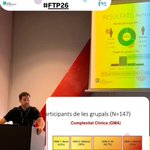
"Avaluació de l'impacte de la fisioteràpia en un Centre d'Atenció Primària i Comunitària" #FTP26

1
1
174
Ens diuen que tractem patologia musculoesquelètica de baixa complexitat, però la nostra realitat és clara: les dades ens diuen que la complexitat mitjana i alta hi predomina amb el 80,7% 📊🤯
Passarà el mateix a la resta de Catalunya? 🤔
#FTP26

62
Ramon Sureda retweeted

6/7 És desolador veure com es malbaraten milions d'euros en esdeveniments, visites o infraestructures mentre es regategen cèntims a la gent gran del nostre país. Aquells que han treballat tota la vida per aixecar aquesta societat avui són invisibles per a qui hauria de cuidar-los
Ramon Sureda retweeted

🦿 Com pot fer mal una part del cos que ja no hi és?
👉El dolor de membre fantasma afecta a més del 60% de les persones amputades. En aquest vídeo, Ferran Burdeus explica la seva experiència i l'especialista Cristina Ibarz n'explica l'abordatge terapèutic i les causes.
Ramon Sureda retweeted

+BÀSQUET: Azahara Fort, una referent
🏀 “El primer és la salut”
▶️ laxarxames.cat/basquet
Ramon Sureda retweeted

🔴 "La gastronomia d'hospital ens tocarà a tots i t'enganxa en un moment d'extrema vulnerabilitat"
La xef Maria Nicolau (@MAlbercocs) ha encès les xarxes amb la foto d'un menú d'hospital i defensa obrir un debat per millorar-los
#TotEsMou3Cat
▶ 3cat.cat/totesmou
Ramon Sureda retweeted

🍏 El CAP Igualada Nord porta a les escoles recursos innovadors per consolidar bons hàbits de vida 👉 f.mtr.cool/lctmthqdxc
➡️ Els dos recursos han estat desenvolupats amb el suport de l’empresa igualadina Cubus Games

Ramon Sureda retweeted

Chronic musculoskeletal (MSK) pain affects 1.7 billion people globally and costs hundreds of billions annually.
Exercise helps ✅
⚠️but: evidence base is too imprecise to implement it well
What do 🤔
➡️Editorial in @BMJOpenSEM
bmjopensem.bmj.com/content/1…
By Nitin Arora 🙏👏

Ramon Sureda retweeted

Senator Prof. Mario Monti: "¿Por qué hablamos de responsabilidad política? Porque el comportamiento de los gobiernos nacionales consiste en trasladar las recomendaciones de sus informes a sus realidades"
#CongresoCEDE

Ramon Sureda retweeted

Tu hijo se cae jugando al futbol. Pierde un diente. Te entra PÁNICO. 😱
Lo que hagas en los PRÓXIMOS 15 MINUTOS puede significar que tenga su diente de por vida o que lo pierda para siempre.
¿Sabes qué hacer? Te lo cuento 🧵

Ramon Sureda retweeted

‘The Student Physiotherapist’s companion’ @StuartPorter 👀
Lovely publication with some great case studies and learning points 👏👏
Nice to see a couple of chapters from @UoNPhysio @UoN_SHS via @RogerKerry1 and yours truly.
#Physiotherapy #PhysicalTherapy #Vascular #BookChapter


Ramon Sureda retweeted

𝗣𝗿𝗲𝗽𝗮𝗿𝗶𝗻𝗴 𝗧𝗿𝗮𝗶𝗻𝗲𝗲𝘀 𝗳𝗼𝗿 𝗖𝗹𝗶𝗻𝗶𝗰𝗮𝗹 𝗨𝗻𝗰𝗲𝗿𝘁𝗮𝗶𝗻𝘁𝘆
Uncertainty is ubiquitous in medical practice yet is often viewed as a regrettable phenomenon to be tolerated or eradicated. To prepare trainees for practice, teachers need to reframe uncertainty as a central feature of how clinical problems are understood and managed.
Clinicians may go to great lengths to reduce uncertainty, often perceiving it as a threat or source of stress. Multiple cultural forces in medicine reinforce this tendency. Physicians receive extensive training in the biomedical sciences, which are grounded in fixed characterizations and clear classifications. Early medical training comprises case-based discussions and standardized tests that use logical causal pathways to arrive at singular correct answers. Clinical training and practice perpetuate this orientation, with peers, teachers, and patients often reacting negatively to uncertainty or equating it with incompetence. Structural elements in the workplace, such as the electronic medical record and billing platforms, require unambiguous characterizations of illnesses or treatments, even when clinical problems remain ill-defined.
An aversion to uncertainty can induce subconscious efforts to hide, suppress, or minimize it during daily clinical work. Yet uncertainty cannot be eradicated from clinical practice, even as its frontier shifts with advances in technology and treatments. This unyielding reality requires teachers to frame uncertainty not as an undesirable by-product of clinical reasoning but rather as a central feature of it.
A new review focuses on the ways in which clinicians recognize and manage in-the-moment experiences of uncertainty in practice and provides practical strategies that teachers can use to help trainees build confidence in managing uncertainty.
Read the Review Article “Educational Strategies to Prepare Trainees for Clinical Uncertainty,” the latest in the Medical Education series, by Jonathan S. Ilgen, MD, PhD, and Gurpreet Dhaliwal, MD, from @UW, @UCSF, and @SFVAMC: nej.md/43xKSQX

ALT Medical Education Educational Strategies to Prepare Trainees for Clinical Uncertainty Illustrations of medical students during moments of clinical uncertainty
Ramon Sureda retweeted
Beyond The Labrum ... Anterior Shoulder Stability In Elite Athletes
✍️ – Written By Eui Hwan Cho, Hyung Jun Koo, And Sae Hoon Kim, Republic Of Korea
------
Shoulder instability is a common and challenging condition in sports medicine, particularly among professional athletes due to the shoulder joint’s wide range of motion and limited natural stability. Most cases involve traumatic anterior dislocation, where the humeral head slips forward—typically caused by forced abduction and external rotation. Without treatment, young athletes are prone to recurrent instability, affecting performance and career longevity, leading many to opt for early surgical stabilization.
Traditionally linked to Bankart lesions (labrum detachment), current understanding highlights the need to also address glenoid bone lossand Hill-Sachs lesions, as these increase the risk of recurrence. Studies show high failure rates when such bony defects are not corrected. Modern management therefore emphasizes comprehensive, individualized evaluation and treatment of both soft-tissue and bone injuries to achieve stable and functional outcomes for elite athletes.
Mechanism Of Injury in Elite Athletes
Anterior shoulder instability in elite athletes results from either acute trauma or repetitive microtrauma.
Acute injuries typically occur when the arm is forcibly abducted and externally rotated, leading to anterior dislocation—common in contact and overhead sports like rugby, football, or volleyball—and often associated with Bankart and Hill-Sachslesions.
Repetitive microtrauma, seen in sports like tennis, gymnastics, and swimming, gradually stretches the capsule and weakens stabilizing structures, especially in athletes with generalized laxity. Overall, the shoulder is most vulnerable to dislocation when externally rotated and abducted, whether from a single impact or accumulated stress.
Pathology and Injury Patterns
- Anterior shoulder instability often involves both soft-tissue and bony injuries beyond the classic Bankart lesion. Common associated patterns include glenoid bone loss (bony Bankart) and Hill-Sachs defects, which frequently occur together (“bipolar” lesions). Significant bone loss (>20% of glenoid width) or a large, engaging Hill-Sachs greatly increases the risk of recurrence.
- The glenoid track concept helps classify these lesions as on-track (stable) or off-track (unstable), guiding treatment.
- On-track lesions → managed with arthroscopic Bankart repair.
- Off-track or large bone-loss cases → need augmentation such as remplissage or Latarjet procedures.
- Other injury types include ALPSA (medially displaced Bankart), HAGL (ligament avulsion), and SLAP tears, which may coexist but rarely improve stability when repaired alongside a Bankart.
Clinical Evaluation and Imaging
Evaluating anterior shoulder instability in elite athletes requires a detailed history, focused examination, and appropriate imaging. Key history points include prior dislocations and the injury mechanism—often forceful abduction with external rotation. Physical exams assess motion, strength, and instability using tests like Apprehension, Relocation, and Load-and-Shift, while also checking for generalized ligament laxity.
Initial X-rays (AP, Grashey, scapular Y, axillary, etc.) help identify fractures or bone defects such as Hill-Sachs or glenoid rim injuries. MRI—often with contrast—detects soft-tissue damage (Bankart, SLAP, HAGL, rotator cuff tears) once swelling subsides. CT scans, particularly 3D reconstructions, remain the gold standard for assessing glenoid bone loss and guiding surgical planning.
Effective management of anterior shoulder instability in elite athletes requires a comprehensive approach that addresses both soft-tissue and bony pathology. Treatment strategies must be tailored to the athlete’s sport, position, and season timing, ensuring long-term joint stability while optimizing athletic performance.
Read the full paper here: journal.aspetar.com/en/archi…


Ramon Sureda retweeted

😴 El son ens ajuda a restaurar el cos, reparar teixits i consolidar aprenentatges. Tot i això, moltes persones pateixen insomni, una dificultat per adormir-se o mantenir el son durant la nit.
🔗 En el següent article trobaràs consells per dormir millor: veuanoia.cat/recepta-bon-des…

Ramon Sureda retweeted

🏥➡️💪 1 in 3 older adults lose independence after hospital discharge.
But exercise might be the key to recovery.
Hot off @LancetLongevity press: A meta-analysis with BIG implications.
📝thelancet.com/journals/lanhl…
@TheLancet
