


Chris Farrington retweeted

congrats team! happy to have led your seed round!
super smart founders, big market, product market fit == millions in arr with large customers a few weeks after launch
80-90% usage rates across users
customers scale very quickly after pilot
lets goooo!

We raised $5M, led by @KearnyJackson with @petra and @a16z speedrun.
@verrainc is institutional memory for consulting firms: approved past work, put to use on the next engagement, in the firm's own cloud.
Forbes + Axios below.

Chris Farrington retweeted

We raised $5M, led by @KearnyJackson with @petra and @a16z speedrun.
@verrainc is institutional memory for consulting firms: approved past work, put to use on the next engagement, in the firm's own cloud.
Forbes + Axios below.
We raised 5M in seed funding to build the infrastructure that consulting teams run on. Today, we're happy to share the news with Forbes, Axios, and others.
A firm's expertise is its number one asset: the work its done and the situations its seen provide the competitive edge that attracts clients.
As everyone rushes to adopt AI tools, that expertise will still be what sets firms apart. That being said, the firms that can capture what they know, distill it, and put it in the hands of every consultant and every agent will win as clients begin to expect better work, faster.
We've faced so many amazing challenges as we've tackled this problem; from building cost effective infrastructure to ingest and make sense of millions of pages a week, to the governance around knowledge search, we've worked closely with our early customers to build a full stack platform around the consulting industry.
Today, our agents run for hours or even days at a time, reasoning over past engagements and live data rooms to deliver for clients.
I couldn't be more proud of the team and what we've accomplished thus far. Thank you to the entire team for your hard work!
And thank you to our investors, @sriramkri , @sunilchhaya , @lukas_linemayr, @AryVaidya and the @speedrun team for taking an early bet on us.
Excited for whats ahead!


Chris Farrington retweeted

If you still have your tech stack in your bio, you're probably gonna be unemployed in 6 months


Chris Farrington retweeted

Added something similar to our harness a couple days ago. Crazy how High EV this is

Lot of people asked about this. You can basically make your MCP self improving by doing this:
- Add a submit_feedback tool to your MCP
- Agent using your MCP will write detailed issue including proposed fix.
- Have it send to an internal Slack channel
- Have Claude in Slack channel and tag it to put up a PR when you agree w proposed change.

So many enterprises building internally have become obsessed with the idea of creating many specialized agents / agent marketplaces.
The differentiation comes down to system prompt and tool sets, thats it. 90% of the time a general agent with standardized tools for retrieving information and a sandbox to build in, with a general system prompt and skills, performs better and is easier to scale across use cases.
Specific and restrictive system prompts can actually hurt performance, especially as the models have become so good.
1
55
Used 6.2 astra for a whole 30 minutes before switching back to opus. I should probably use it for more things but the difference in usability was very noticeable
43
We did this a month ago with our own internal coding tool (a lot of infrastructure around and extensions to the frontier harnesses). Collaborative Word, Powerpoint, and Excel editing with full feature parity is in Verra!

How Phil built a collaborative Word editor with no human engineers.
Inspired by @russelljkaplan's story of how @cognition builds their Android app with just a swarm of Devins.

1
5
127
We built out our own internal coding tool @verrainc (extension of the frontier harnesses) and have been iterating on it over the past few months. Here are some of the things that I couldn't live without:
1
3
68
2. Projects - Most of our "chats" are no longer single agents. Instead, its an orchestrator and many persistent subagents. Based on your initial conversation and request, the orchestrator will spawn persistent workers to handle specific aspects of the request. These subagents communicate with eachother as well as with the orchestrator and persist indefinitely. If I come back to a chat a week later, those subagents still exist, each with rich context in the specific area its responsible for, and my orchestrator can delegate / ask questions. Ephemeral subagents are a waste imo - they gain great context on something specific, return a diluted answer back to the main agent, and all of that context is then lost.
This architecture has improved the quality and speed of our work.
1
3
32
3. Sentinel - Because our tool is so well integrated to our observability stack and our day to day work, we can have one of our "projects" on a cron job to check production infrastructure. Because this agent knows exactly what is being worked on, what was pushed, who did what, etc, when it sees issues in our deployments, it can immediately give tailored advice (which it sends to us in an email) and even attribute who should own the fix. It didn't take much effort to build, but because it is so well integrated with our day to day, its better than any SaaS product offering we've seen.
1
1
30
1) Over the past couple of months, we've realized how important deliverable generation is to our users. For consultants, that work happens almost entirely in Office files: Word, Powerpoint, and Excel.
Agents work with these files by generating code, but editing the raw XML directly is slow and inconsistent, and most prebuilt frameworks do not provide enough of a surface for the agent to be as proficient as a consultant.
So, we built an entire office suite from the ground up, giving our users an office native, in-app interface, and our agents the most extensive editing surface we've ever seen.
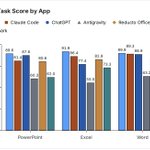
We benchmarked it on 95 consulting tasks against Claude Code, ChatGPT, Reducto Office, Genspark and Antigravity:
✅ Highest mean score in PowerPoint (89.5), Excel (91.9) and Word (89.9)
✅ Most consistent from run to run
✅ Faster bulk operations across Word, Powerpoint, and Excel when compared to the Office native desktop apps
The full write-up covers how we built the architecture, how co-editing with the agent works, and the benchmark. See below🧵

2) Every tool you have in an office desktop app is available to our agents. Because of that, we see the highest consistency across consulting tasks compared to all other harnesses.

1
2
58
