

Research scientist @valeoai | Teaching @Polytechnique @ENS_ULM | Alumni @upb1818 @Mines_Paris @Inria @ENS_ULM | Feedback: https://nitter.cf/t.co/MHAm0ClYvh
Paris, France
Joined November 2008
- Tweets10K
- Following1.4K
- Followers8.5K
- Likes19.4K






Pinned Tweet
The unreasonable magic of simplicity!
Meet DrivoR (Driving on Registers): our latest end2end autonomous driving model.
We teared down complex dependencies & modules from current models to
obtain a pure Transformer-based SOTA driving agent (NAVSIM v1 & v2, HUGSIM).
Find out more👇


Andrei Bursuc retweeted

I interviewed ~2 dozen researchers, engineers, research / engineer managers etc. asking them how they / their teams use coding agents in their work. Then I sprinkled it with my opinions and hot takes and wrote a substack post (link in the next tweet, I'd be delighted if you subscribe; of course, the post is free and any future post will be free too!) trying to triangulate the current reality of software engineering / industry research as opposed to what gets peddled on social media.
TL;DR (3. and 4. are the most important!):
1. Models, harnesses, workflows: don't bother with fancy workflows, they don't really work. Use stock Claude Code / Codex (or Copilot with Claude / GPT models if you are a Microsoft stan), perhaps with subagents in some very special cases. Write a design doc, then plan a change, then implement it, then merge. Wash, rinse, repeat. Don't get swayed by people online who are trying to sell you snake oil in the form of their new harness or workflow. None of this stuff works (in general).
2. Correctness/tests/reading or not reading code: it's OK not to read code if you do one of the following three things. a) One-off stuff / demos, which you need to work on exactly one input. b) Testable / verifiable stuff, e.g., GPU kernels. c) Stuff, where it's OK to be "directionally correct" (ML / data work / research code). In other cases, especially if you require any degree of maintainability / reliability or your code is customer-facing, reading code is still necessary. Reading tests and steering the model to write better tests is a good idea too. It's often good to use a different model to review the code that the other model wrote. Even if you approve the PRs without changing them, reading still helps for future more productive prompting.
3. Team dynamics: if we are not careful, agents can really undermine team dynamics. Two biggest problems are "slop infestation", where over time all PRs / emails / Slack messages end up being unreadable slop, and "overbuilding", where we are building and shipping useless stuff to get recognition or as a form of procrastination. Other, less severe but still important problems include: reduced communication, being secretive about ideas, decreased diversity of thinking, mode collapse of the ideas, trusting LLMs more than people.
4. Call for action: we really need to be careful with preserving team work and collaboration. We still need to "form packs to hunt mammoths", but with coding agents this becomes increasingly harder. Overall, many of the agents-induced problems stem in myopic short-term thinking of the sort "we have a couple of years left until our jobs are fully automated, so I can as well extract as much value as possible, everyone else be damned". While somewhat understandable, I think it’s important to resist these urges, if nothing else, for your own sanity’s sake.
[Full disclosure: until 2 months ago, I worked at OpenAI and my work directly contributed to Codex, I'm a big fan of coding agents and quite strongly AI-pilled, but there is little I hate more than fearmongering, gaslighting, lies and rage-bait that are ubiquitous in this space, unfortunately, hence spending time on all of this.]
Keeping the one-page rebuttals at #CVPR2027! Yeah!*
*still getting flashbacks from the never-ending scrolling on NeurIPS discussions this summer 😱

Submitting to #CVPR2027? Check out the author guidelines, including what's new this year.
cvpr.thecvf.com/Conferences/…
Happy to share that I’ve been elected an ELLIS Fellow!
Thanks to @gabrielpeyre and the ELLIS Unit Paris for the support, and to the @valeoai team and all the collaborators I’ve learned from over the years.
Congrats to all the new Fellows & Scholars!

📢 ELLIS expands with 𝟱 𝗻𝗲𝘄 𝗨𝗻𝗶𝘁𝘀 and appoints 𝟭𝟲𝟬 𝗻𝗲𝘄 𝗘𝗟𝗟𝗜𝗦 𝗙𝗲𝗹𝗹𝗼𝘄𝘀 𝗮𝗻𝗱 𝗦𝗰𝗵𝗼𝗹𝗮𝗿𝘀 through the 2025–2026 selection process
👉 New Units: ellis.eu/news/five-new-units…
👉 New Fellows & Scholars: ellis.eu/news/ellis-selects-…

ALT ELLIS expands with 𝟱 𝗻𝗲𝘄 𝗨𝗻𝗶𝘁𝘀 and appoints 𝟭𝟲𝟬 𝗻𝗲𝘄 𝗘𝗟𝗟𝗜𝗦 𝗙𝗲𝗹𝗹𝗼𝘄𝘀 𝗮𝗻𝗱 𝗦𝗰𝗵𝗼𝗹𝗮𝗿𝘀 through the 2025–2026 selection process
Andrei Bursuc retweeted

I've always believed that intelligence should come from simple, general building blocks that learn their own abstractions directly from raw data; in other words, the bitter lesson. I think we're finally seeing a real step towards AI that can learn from all data.
Language modeling on raw bytes is a microcosm of this ideal, and to me it's a central problem in AI: if we can't build LLMs that learn end-to-end from bytes, how will we handle the rest of the world's data that we understand even less?
Last year we introduced hierarchical networks (H-Nets) as a first step. Our new version finds up to 3-5x efficiency gains in controlled scaling law experiments, and at larger scale matches an open-source model trained on 11T tokens with ~10x less data and compute. The posts below walk through what we found and why we think it works.
Andrei Bursuc retweeted

We're excited to introduce AW-0: Agentic World Action Models! 🤖 (0/8)
The first World Action Model that plans in code, predicts the future, and controls the robot—all in one generative model.
AW-0 jointly generates:
🧠 Code - explicit skill calls, object arguments, and control flow
🎥 Future video - predictive visual dynamics
🦾 Robot actions - continuous motor control
All three are generated together through joint denoising, letting semantic plans directly shape both predicted futures and robot behavior, with:
🤝 Hybrid execution — generated programs can also run directly through perception and control APIs
⚡ Just 40 ms of additional inference latency over the base WAM on an RTX 5090
📚 Pretrained on ~3,000 hours of robot + human demonstrations
One model for planning, prediction, and execution.
🌐 Project: agentic-wam.github.io/
📄 Paper: arxiv.org/abs/2610.30136v1
💻 Code: github.com/ZhuoyangLiu2005/a…
🤗 Model: huggingface.co/miniFranka/ag…
🧵 How it works—and what we found ↓


Andrei Bursuc retweeted

I heard OpenAI are testing GPT-7 Astra inside vim so the agents can’t escape.
Andrei Bursuc retweeted

1/10 🔮 Can a world model learn to make its own future more predictable?*
In Latent-Foresight, we jointly learn a compact latent representation of visual foundation model (VFM) features and a generative dynamics model that predicts their future.
Here's how 👇
Andrei Bursuc retweeted

Tinker's new StableReinforce objective is Reinforce + Score Centering. Here's how I reverse-engineered it 🧵

Off-policy RL is difficult; runs can suddenly collapse because of async RL staleness or numerical mismatch.
StableReinforce is a new method on Tinker that keeps your RL runs stable, even when learning drifts from sampling.
tinker-docs.thinkingmachines…
Andrei Bursuc retweeted

With ReDi, @ThKouz, Nikos, and team, we showed the benefits of jointly modeling images and semantic features through diffusion.
Now, @MathiasOllu and Nikos bring this idea to continuous diffusion LMs, jointly denoising tokens and semantic clusters. Love this! 🔥

Andrei Bursuc retweeted

🚀Improve Continuous Diffusion LMs by making them denoise hierarchical token representations!
We introduce Hierarchical Continuous Diffusion LMs (H-CDLMs), which diffuse tokens *and* coarse semantic clusters jointly.
➡️ Better generations for less compute🧵

Andrei Bursuc retweeted

Hi all, I have a new result I'm excited to share. It turns out that *all existing implementations* of softmax and cross-entropy (that's JAX, PyTorch, textbooks, etc) have a subtle bug --- two bugs, actually. A simple rewrite fixes both, and eliminates "slingshots" when grokking:
Andrei Bursuc retweeted

Ever wondered what it’s like to learn robot autonomy @Stanford? Now you can.
Today, we’re opening up the robot autonomy teaching materials that my collaborators and I have been developing over the past several years—for anyone, anywhere, completely free.
At the heart of this effort is Principles of Robot Autonomy (PoRA), a textbook inspired by the Stanford robot autonomy course series I’ve been teaching since 2017.
Robot autonomy has evolved from a research discipline into a technology deployed in the real world. Building capable autonomous systems requires more than understanding individual algorithms: it requires understanding how perception, state estimation, planning, control, and learning work together in a complete autonomy stack.
That’s what we set out to teach with PoRA: bringing classical robotics and modern AI together in one coherent framework, grounded in both theory and practice.
Coming soon in print from Cambridge University Press, Principles of Robot Autonomy is also freely available online and comes with a comprehensive collection of open educational resources:
📖 Textbook, arxiv.org/abs/2608.03496 — Foundations of robot autonomy, from classical methods to modern AI-based approaches.
🎥 Video lectures, porabook.com/lectures/ Lectures from my Stanford courses on robot autonomy and on optimal and learning-based control.
💻 Interactive exercises, porabook.com/exercises/ — Hands-on Python implementations and Jupyter notebooks.
📝 Teaching materials, porabook.com/instructors/ — Lecture slides and resources for instructors.
🌐 Explore all PoRA resources, porabook.com/ — Including Ask the Book, an AI study assistant integrated throughout the textbook to answer questions, explain derivations, and connect ideas across chapters.
📣 Read the Stanford announcement: news.stanford.edu/stories/20…
Our goal is simple: to make high-quality education in robot autonomy accessible to students, researchers, engineers, educators, and anyone curious about how autonomous robotic systems work.
I believe that sharing knowledge is fundamental to the mission of a university. Autonomous robotics—and Physical AI more broadly—are among the defining technological frontiers of our time. We want to help more people understand these technologies, build with them, and advance the field.
A huge thank you to my co-authors, @DanieleGammelli, Joseph Lorenzetti, @katielulula, and @GioeleZardini, and to everyone who helped bring this project to life.
Explore the resources, use them in your own learning or teaching, and please share them with anyone who might find them useful!
#Robotics #PhysicalAI #ArtificialIntelligence #AutonomousSystems #Education
@Stanford @StanfordEng @StanfordAILab @StanfordHAI

Some things in computer science stay the same in the era of coding agents: it's still the "laziest" who thrive the most, i.e., the ones that find ways to do less manual work and rather delegate to the machines.
No need to baby-sit your training and hyper-parameters anymore: your agent can do it for you and way better

1/9 Current optimizers are static during training. What if the optimizer could think and react while the network trains?
We let an agent watch the training dynamics and rewrite the optimizer's source code as training goes: a reactive optimizer.
In every language and image setting we tried that has no tuned recipe, it matches or beats the best recipe one can one-shot, and it guards against loss spikes and overfitting by itself. In the near future, optimization decisions may belong to agents, not humans.
📝 xingjianbai.com/reactive-opt…
💻 Try it on your task: github.com/xingjian-bai/opal
🧵
Andrei Bursuc retweeted

Why are French university students lining up for lunch at 11am when the cafeteria opens at noon?
I took this picture on my way to work this morning because it is a good lesson in “shadow prices.”
In May, France extended €1 university meals to all students. Previously, those not eligible for assistance paid €3.30.
The result was not cheaper meals, but shortages.
Demand surged, and students now queue an hour or more in advance to secure their lunch. What they used to pay with money, they now pay with time.
And this is a lesson in shadow prices. It tells us that students are willing to sacrifice an additional hour to save €2.30, so they are implicitly valuing their time at €2.30 an hour or less.
That's awful. 11 am is one of the best times to study. You are alert, but not yet tired. Even if a fraction of them studied at this time, there could be more value than the one saved by the “cheaper” meal.
While the government did provide €50 million in additional funding for 2026, for a system serving more than 3 million higher-education students (about 8 cents per student per day), the problem illustrates something deeper about France.
Don't get me wrong. I love living here, and I work hard every day to contribute to this country. But too many French institutions operate as though people's time were free.
It is a system where enormous resources flow through the state, and simple transactions are replaced by forms, permissions, and waiting. People grow accustomed to this dependency, sometimes even demanding more of it.
The implicit message of the system is that your time is cheap, your initiative is unwelcome, and your ability to decide for yourself is something to be managed.
It is a sad situation because I genuinely believe France can be one of the best places in the world to live.
But people are tired. And I'm not talking about those who looted sporting goods stores and vandalized public buildings over the weekend. I'm talking about the butchers, bakers, and produce sellers I meet every week at the market. The small antique dealers who worry that a mob could destroy the little capital they have. I talked to many of them yesterday. They are scared and they know there is nothing for them to do other than hide.
A country that values its people should value their time.
Vive la France!

Well articulated post by @arthurmensch on why Europe should aim for frontier AI as well & be more optimistic.
Don't know if Europe will catch up with this immediate wave, but working towards ambitious aims will eventually lead to all sorts of cool stuff whether aimed or sidetrack

Andrei Bursuc retweeted

Today we’re releasing Muse Spark Open, the most capable US open-weight model to date.
Built for coding and agentic work, it excels at long-horizon tasks, complex software engineering, and multi-step reasoning.
Key Model Specs:
→ 816B total / 42B active parameters
→ 1M token context window
→ Natively multimodal across text, image, video, audio


Andrei Bursuc retweeted

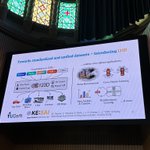
We are thrilled to announce that we have joined forces with @kesai_labs towards building generalist autonomous driving systems together.
We aim high and plan to release models and code to push forward research boundaries.
valeo.com/en/valeo-and-kesai…
