

Da Buccinasco .. Economist: @NYUfasecon, @nberpubs, @cepr_org, @EJ_RES. R NineT & Bonneville T100 (US). Olive and lemon trees. @Inter. FirstGen college.
New York, NY
Joined August 2015
- Tweets39.7K
- Following3.2K
- Followers22.5K
- Likes75.9K






alberto bisin retweeted

Come be a predoc working with me and James Robinson (Uchicago), for two years.
We work on economic history, political economy and AI
Please apply here: uchicago.wd5.myworkdayjobs.c…
#predoc @predoc_org
alberto bisin retweeted

Infamia eterna su questa maggioranza, se passa
Medici: via libera della Camera allo scudo penale e al reintegro dei no vax. Si spacca la maggioranza
ilsole24ore.com/art/medici-s…

The Bible is incoherent when viewed through the lens of modern science is another way of saying that modern science is incoherent … Galileo (and Brecht with him) is alone and sad in the garbage can of history and the sun’s busy running around the earth.

alberto bisin retweeted

I agree. But Keynes’ GT is intellectually incoherent when viewed through the lens of General Equilibrium theory … it has no intelligible answer to the question: When faced with persistent unemployment why don’t firms offer lower wages and why don’t unemployed workers accept those offers?
When the N. American Keynesians ... based in Cambridge Massachusetts … accepted Friedman’s argument that high unemployment is caused by a temporary deviation of wages and prices from their equilibrium levels … they gave up the Keynesian Baby with the Monetarist Bathwater.
The Cambridge England Keynesians resisted but they did not have a coherent explanation for the persistence of long-term unemployment as an equilibrium phenomenon that could answer the questions of the General Equilibrium theorists.
My entire body of work has been devoted to providing an answer to the question: How can high unemployment persist? that reconciles General Equilibrium Theory with the Keynesian proposition that Walrasian Equilibrium is one of many potential resting points of a dynamical system. The answer is what I call Keynesian Search Theory. static1.squarespace.com/stat…

alberto bisin retweeted

🇮🇹 Riguardo quanto detto da Vespa, mi permetto di rispondere io facendo vedere i “dati di fatto reali”. Questa figura mostra la spesa italiana in istruzione rispetto agli altri paesi sviluppati. Da 30 anni - in realtà molto di più - spendiamo molto meno della media (in % del PIL) e spendiamo quasi la metà di quanto spendono i migliori. E direi che i risultati si vedono, in tutte le categorie, giornalisti inclusi. Non ci facciamo, invece, grossi problemi a spendere molto più della media in pensioni (4pp in più della media), interessi sul debito (2pp in più della media) e compensi per gli 80enni, cioè in spese che per definizione sono il passato. Messa così, forse, hanno ragione i ragazzi.


Stasera durante la trasmissione di #PortaAPorta Bruno Vespa leggerà una nota in merito al confronto in studio con Sabrina Brizzola della scorsa settimana.
alberto bisin retweeted

La legge elettorale va verso la Corte costituzionale?
La Rete per un voto libero e uguale e la società civile hanno depositato oggi, in 25 tribunali italiani, i ricorsi contro il Truffarellum: una legge che limita la libertà di scelta degli elettori e ostacola l’ingresso di nuovi partiti.
Sosteniamo questi ricorsi e chiediamo firme digitali accessibili, meno barriere per le nuove forze politiche, preferenze vere e lo stop ai premi di maggioranza che alimentano la polarizzazione.


alberto bisin retweeted

L'Europa ha dimenticato come si cresce. John Cochrane fotografa con queste parole lo stallo del nostro continente. Economista della Hoover Institution e già docente all'Università di Chicago, è stato uno dei volti più attesi al Festival Internazionale dell'Economia. Noto con il soprannome “The Grumpy Economist”, l'economista scontroso, Cochrane analizza i rischi di stagnazione, debito sovrano e il boom dell'intelligenza artificiale. "L'Europa è piena di startup con grandi idee, ma vanno tutte nella Silicon Valley quando vogliono diventare grandi". Il Vecchio Continente, spiega, necessita un drastico cambio di rotta per ritrovare spinta e competitività.
L’intervista integrale di Fabrizio Goria è su La Stampa
#LaStampa
Affascinante lavoro ...

Il capitale civico collega l'eredità storica ai divari attuali. Infatti, i territori italiani con frequenti cambi di sovranità prima dell'Unità mostrano oggi una produttività del lavoro più bassa. Ne scrivono G. Cainelli, R. Ganau e N. Matsiuk
lavoce.info/archives/114655/…

alberto bisin retweeted

During the @festinteconomia I had the great opportunity to have a very long chat w/ @JohnHCochrane about AI, global debt, and several other funny things. You can find everything here lastampa.it/economia/2026/10… via @LaStampa @giubot @giapao

alberto bisin retweeted

Thanks a ton to everyone who engaged with this thread I made a few weeks ago, and especially to @jasonfurman for his wonderful and generous compliment.
Alex and I made this into a Substack (link below) as many of the topics echoed closely with what we were already thinking of writing about, and the current moment of the advances in AI and discussions surrounding it became a focal discussion point.
As I write this today, OpenAI has announced what it describes as major breakthroughs in mathematics, computer science, and physics such as the local smoothing and the Kakeya conjecture, that the Exponential Time Hypothesis is false, and the existence of quantum chromodynamics and completions of the standard model (h/t @AndrewCurran_).
As these technologies advance and refine the limit of what is possible, or what it means even to "understand" something, there is sure to be a reckoning among the most cognitively gifted on what this means for their sense of identity and craft.
I do not have any solutions or recommendations, in part because I am not qualified and also because the historical record we presented in the essay doesn't point to one. All it suggests is that disruption can be quite painful in the short term, with adjustment over time smoothing out the early upheaval.
I also do not know what these advances mean for many professions. On one hand, such technology in the hands of many can empower them to try what was never possible, but it might also create a fear of increasing disillusionment among those whose mastery of such techniques was core to their identity. We will just have to wait and see.
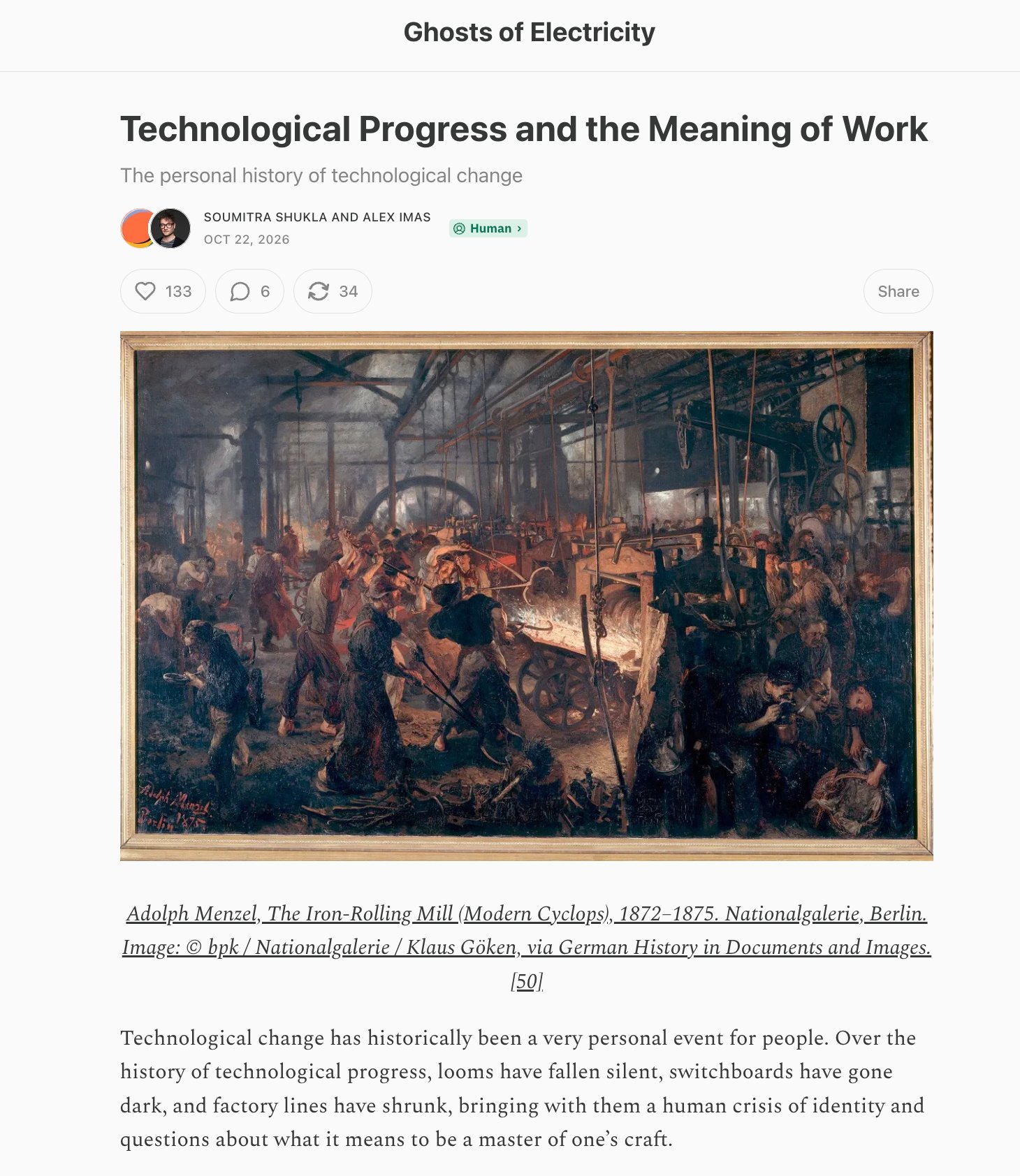

🧵1/10 Given the recent reactions of mathematicians over rapid advances in AI, I think it is important to remember that technological change has historically been a very personal event for people.
Over the history of technological progress, looms have fallen silent, switchboards have gone dark, and factory lines have shrunk bringing with them a human crisis of identity and what it means to be a master of one's craft.

alberto bisin retweeted

I loved You Can See Everything. Probably the best documentary I've ever seen. The only annoying part was the crowd laughing at the filmmaker’s spectrum-related traits and ways of relating to the other characters.
🙏🙏

Il congresso europeo di oncologia medica sta volgendo al termine. Torno con la consapevolezza che l’oncologia di precisione non è più il futuro, ma il presente. I progressi sono enormi e reali, e sono molto orgoglioso che il mio team stia contribuendo a questa impresa. #ESMO26


alberto bisin retweeted
🇮🇹 Questa sera ho avuto il piacere e l’onore di discutere del declino italiano al Festival dell’Economia di Torino in una cornice a dir poco meravigliosa, credo si intuisca dalla foto. A nome mio e di Guido (Ascari) ringrazio @monacelt e gli organizzatori per l’invito. Devo dire che ero un po’ in imbarazzo a parlare su un palco accanto a @Tboeri, un maestro per tutta la professione. E certamente vanno ringraziate tutte le persone che sono venute, erano talmente tante che abbiamo offerto il bis in una seconda ora di presentazione per poter accomodare tutti. Speriamo davvero vi sia piaciuto, io speriamo che me la (sono) cavata. 🙃
Grazie ancora a tutti!
P.S. Nella foto, 3 grandi economisti. E poi ci sono io! 😉

alberto bisin retweeted

Un solo grido un solo idioma: scapoma mantellini.it/2026/10/25/un-… via @mante

alberto bisin retweeted

Manca ormai meno di un anno alle elezioni politiche e, come ogni volta, si ripete lo stesso indegno spettacolo. Dice moltissimo sul livello della nostra classe dirigente e sulla qualità delle proposte dei partiti nazionali.
Il primo capitolo è la legge elettorale. Chi oggi non siede in Parlamento dovrà raccogliere tra 6.000 e 7.000 firme in ogni collegio, contro le 1.500-2.000 di prima. Si passa da 112.500-150.000 sottoscrizioni complessive a 450.000. Nessun altro Paese europeo pretende tanto per poter semplicemente stare sulla scheda. È un muro alzato da chi sta dentro per escludere chi sta fuori: una regola illiberale, che trasforma un diritto democratico in un privilegio riservato a chi è già nel Palazzo.
Il secondo capitolo è persino più avvilente. Mentre si alza il muro per gli altri, in Parlamento è iniziato il mercato delle vacche. Deputati e senatori lasciano i gruppi con cui sono stati eletti per formarne di nuovi, al solo scopo di sfruttare le esenzioni previste dalla legge. Non lo fanno per rappresentare meglio gli elettori, ma per aggirare le regole che loro stessi hanno scritto. Così qualcuno evita la raccolta firme. Ma soltanto qualcuno, non tutti.
Insieme, i due fenomeni disegnano un sistema chiaro. Chi resta dentro il perimetro deciso da chi gestisce il potere viene premiato con corsie preferenziali, deroghe e scorciatoie. Chi prova a costruire qualcosa fuori da quel perimetro è condannato in partenza: movimenti civici, liste nate dai territori, partiti emergenti, persone che fanno politica senza un apparato alle spalle.
Intanto, a ogni tornata, cresce il numero di italiani che restano a casa perché non si sentono rappresentati da nessuno. L'astensione è il primo partito del Paese. Invece di chiedersi perché, chi governa le regole del gioco restringe ancora di più l'offerta politica. Così diventa sempre più probabile che quegli elettori non trovino mai un motivo per tornare a votare.
Una democrazia sana non ha paura della concorrenza. Non teme chi nasce dal basso, chi porta idee nuove, chi sceglie per convinzione e non per appartenenza. Una democrazia che si chiude a riccio per proteggere chi è già seduto al tavolo è una finta democrazia.

Congrats guys, it’s a great privilege to be with Tom … but you know, we all know .. have fun

“Meet Wharton’s Newest Faculty”
youtube.com/shorts/Bq0hq1Fuq…
