

29. Data Scientist. London.
London, England
Joined June 2012
- Tweets1.2K
- Following189
- Followers121
- Likes35.2K



Arsam Kamran retweeted

When Israel bombed Al-Shifa Hospital, so many were making excuses saying, "Israel would never bomb a hospital"
Israel has since damaged or destroyed at least 94% of hosplitals in Gaza, 98% of schools & over 80% of civilian infrastructure.
It's a Genocide!

Arsam Kamran retweeted

Prices in the UK have absolutely lost the plot
£12 for fish and chips
Almost £2 per litre for fuel
£45 for a driving lesson
Over £2 for a bottle of pop
£20 for a takeaway for one person
£20 for a 15 minute taxi
Weekly food shop for one person £80
£100 a night for a "cheap" hotel
Rent prices through the roof
At this point we're just getting robbed.
Arsam Kamran retweeted

This was done by Israel.
Jewish colonial supremacists armed to the teeth by the USA and Germany.
An evil beyond comprehension.


Arsam Kamran retweeted

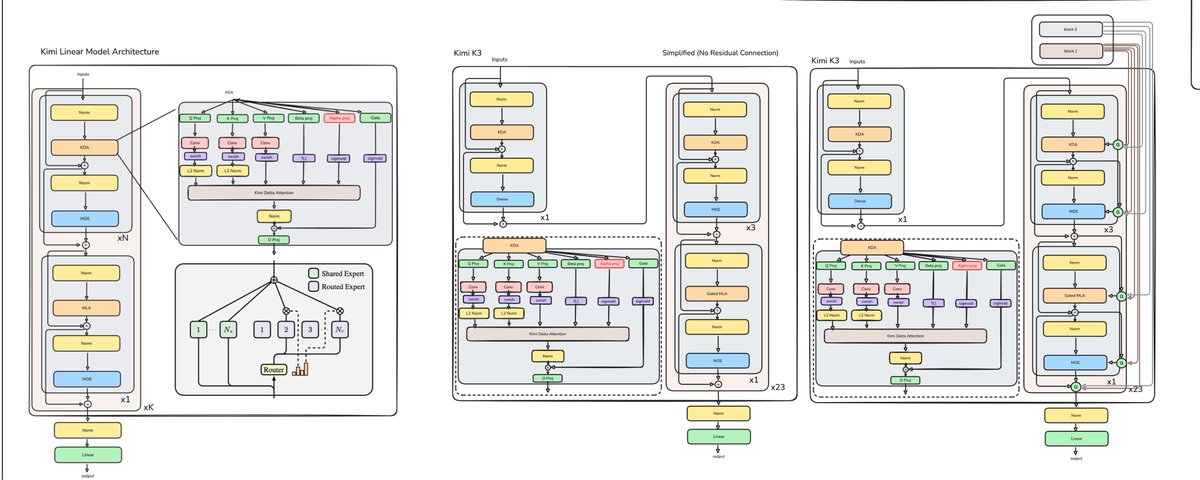
Everyone is staring at the 6B active parameters of Qwen3.8-Flash-Next. The more interesting number is the 51B nobody talks about.
Quick explainer, because this part of the architecture is genuinely clever.
A normal LLM has one embedding table. Token comes in, gets mapped to one vector, done. That table is small compared to the rest of the model and nobody thinks about it.
Flash-Next adds a second table. A massive one. On top of single tokens, it looks up short token sequences: the last 2-3 tokens as one unit. These are n-grams, and the model has learned representations for billions of them.
Why does that help? Because language is full of chunks that always mean the same thing. “As far as”, “def init”, “on the other hand”. A normal model has to reconstruct the meaning of these phrases from scratch through its layers, every single time. Flash-Next just looks them up. Memorization instead of computation.
That is a big part of how 6B active parameters compete with much larger models. The heavy lifting for common patterns was moved out of the transformer and into a dictionary.
And here is the thing: it really is just a dictionary. 51B parameters, but structurally nothing more than rows of numbers indexed by a hash of the token sequence. No matmuls, no gradients flowing through deep layers at inference. Fetch a few rows per token, add them in, done.
The related trick is called PLE, per-layer embeddings, where these lookups feed multiple layers instead of just the input. Same idea that shipped on phones with small on-device models. Now scaled up to 51B.
Why I care: a lookup table has completely different hardware requirements than weights. Weights must sit in fast memory because you multiply with them constantly. A dictionary where you touch a few KB out of 51GB per token? That can live on an SSD and be paged in on demand.
Which is exactly the angle that decides whether this model fits on 128GB unified memory machines. Working on that right now. More soon.




Arsam Kamran retweeted

Creator of Claude Code:
"Right now you still need to know how to code. In a year or two, it won't matter. I haven't edited a single line by hand since November."
In a 90-minute podcast, Boris Cherny breaks down the exact setup behind the tool now writing 4% of every public commit on GitHub.
More value than a $500 vibe-coding course.
Save this. In a year we'll know if he was right.

Anthropic CEO, Dario Amodei:
"Half of entry-level white-collar jobs could be gone in one to five years."
3 things he said on stage.
The third, Demis Hassabis wouldn't back.
One: inside Anthropic, engineers say "I don't write code anymore. The model does."
Two: the real trigger isn't jobs. It's AI that builds AI, and the loop may close this year.
Three: how soon superhuman AI actually lands. The clock Hassabis, sitting right next to him, refused.
Save it. Reread in 2028 and see who was right.

Arsam Kamran retweeted

I leave the UK for 4 days and inflation apparently hit like a truck while i was gone


Arsam Kamran retweeted

Just so everyone understands the accounting game in the AI/Cloud-space here is a very *simple* example:
1) Amazon “invests” $50B in OpenAI. Amazon records:
- Cash $50B
+ Investment Asset $50B
2) OpenAI uses $50B to buy AWS services. Amazon records:
+ Sales $50B
+ Cash $50B
Amazon is net $0 cash, but now has $50B in sales and $50B investment asset. Great deal! Thats why we see all the majors doing it, and at scale. It is a way to convert their dormant cash pile into revenue, which Wall Street loves.
Most ppl dont realize what is happening. The revenue of these large tech companies is increasing dependent on them being able to self-fund their own sales.

Today, we closed our latest funding round with $122 billion in committed capital at an $852B post-money valuation.
The fastest way to expand AI’s benefits is to put useful intelligence in people’s hands early and let access compound globally.
This funding gives us resources to lead at scale. openai.com/index/acceleratin…


