

AI that runs only on your device, never on a server. Works offline. Completely private. Free, without limits.
Joined June 2026
- Tweets106
- Following55
- Followers109
- Likes250


Pinned Tweet
The progress that's been made in local AI this year isn't comprehensible until you visualize it. Hopefully this helps!
Shoutout to @liquidai @Alibaba_Qwen @GoogleDeepMind for driving many of these gains.
It's 2026. There's zero reason you should be paying for meeting notes OR dictation that go through a server.
on-device meeting notes/dictation are live on Loci. Free and private.

Loci retweeted

LFM3-1.7b is genuinely unbelievable for its size. In awe of how much this will unlock for lower-end hardware to have excellent local AI experiences.

Introducing 𝙻𝙵𝙼𝟹: our new generation of Liquid Foundation Models. With a new tri-hybrid architecture and new multimodal encoders, the LFM3 family is the ideal model suite for specialized intelligence.
> 6 model instances, across text, audio, vision, and omni modalities, generative and decision models.
> 𝙻𝙵𝙼𝟹-𝟷.𝟽𝙱: text, 256k context window.
> 𝙻𝙵𝙼𝟹-𝚅𝙻-𝟸𝙱: vision-language model with video-input support for spatial understanding
> 𝙻𝙵𝙼𝟹-𝙰𝚞𝚍𝚒𝚘-𝟸𝙱: tool calls, voice chat, reasoning in 18 languages.
> 𝙻𝙵𝙼𝟹-𝙾𝚖𝚗𝚒-𝟸𝙱: an omni model combines vision, audio, and language.
> 𝚍𝟷-𝟸𝙱 and 𝚍𝟷-𝙾𝚖𝚗𝚒-𝟸𝙱: decision models with typed outputs and calibrated probabilities in a single pass. Omni adds audio input.
> fine-tune on 1 GPU.
> a new tri-hybrid architecture
> architecture optimized for 14 processor classes across GPUs, CPUs, and NPUs.
> 𝙻𝙵𝙼𝟹-𝚅𝙻-𝟸𝙱 is a beast. It performs competitively with Gemma 4 12B (6x larger), and Gemini 3.5 Flash Lite, and GPT-5.6 Luna, with 1.9B parameters.
> 𝙻𝙵𝙼𝟹-𝟷.𝟽𝙱 is #1 on the Pareto frontier of device intelligence 𝚙𝚒𝚙𝚎𝚝𝚝𝚎.𝚕𝚒𝚚𝚞𝚒𝚍.𝚊𝚒
Every modality for specialized intelligence. Pick the one that fits your use case, customize it, and run it on-device.
1/ 🧵
Summarization works surprisingly well even on tiny models like Qwen3.5 4B.
When you manage your email with Loci, it's never going to an AI lab's servers.


Most local AI apps hand you a finished answer and nothing more.
Because Loci runs its own inference engine, it can show how each reply was built: every model call and tool step, and how sure the model was of every word along with the alternatives it nearly chose.
That turns “trust me” into “check for yourself”, and the cost is about 1% of generation speed. (switch it on or off in advanced settings)
What you tell your boss about a health situation is different from what you tell a friend.
Go offline, draft each version with a local model. Those drafts aren't uploaded while you work.
You pick what each person gets.
Tailoring your résumé for each job takes more rounds of editing than anyone admits.
Loci's on-device chat has no message quota.
askloci.ai/

Loci now runs Phonon as the default TTS engine on mobile. Try it out today at our link in bio

A new frontier for on-device speech.
We're open-sourcing Phonon, a suite of TTS models under 50m parameters, setting a new standard for naturalness and accuracy across languages, with the broadest inference support to date.
Phonon-31m is available under Apache 2.0.
gradium.ai/phonon🧵
Loci retweeted

This idea seems really important.
In another few years, what percent of prompts will be solved locally, or on virtually no compiute? I'd guess 95%+, probably 98%+?
So AI datacenter companies (and all but the very very best models) basically lose any non-large scale demand.

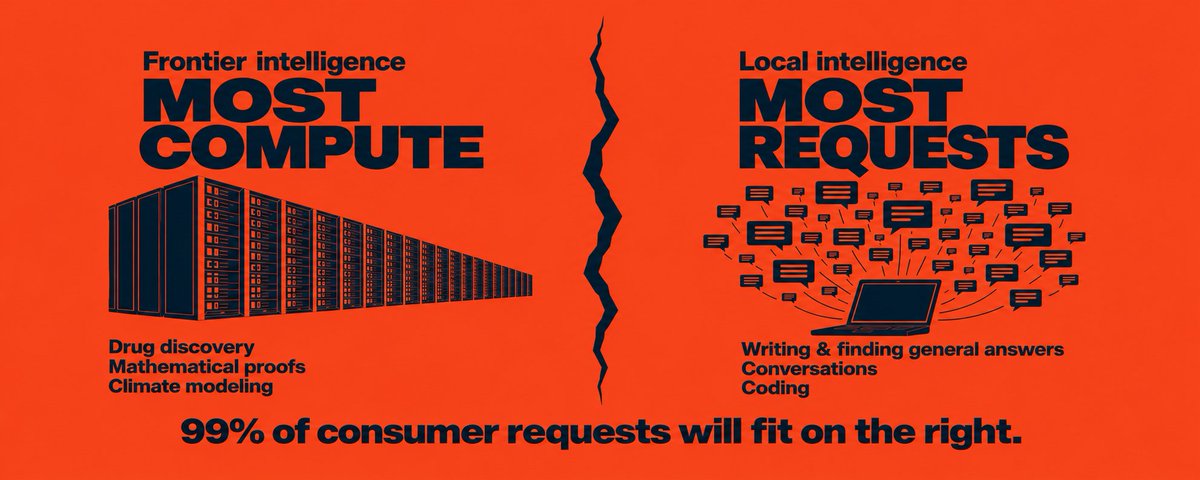
Most AI investors have it backwards.
Here's why we're so focused on local intelligence:
Both cloud getting more efficient as well as more traffic going on-device will mean there will be many empty datacenters.

1/ Are we overbuilding compute for AI?
Introspection on eve of release of DeepInfer - the most economically valuable software release of history (on par with Claude Code).
DeepInfer has even a bigger money printer, if your are to believe latest numbers compared to what @SemiAnalysis_ reported.
They can make 149B revenue from 1GW of GB200 without slack, and 100B with very big slack at DeepSeek's current prices, while serving fast tokens at 230 tokens/sec per user at 38$ per GPU hr of GB200. The performance is reproducible. (I will explain the calculations in following tweets)
These numbers are much higher than numbers reported by SemiAnalysis below at 15B revenue per GW with B200 GPUs (not GB200) with the same model DS Flash 4.1. The difference shows the power of NVL72 architecture are large scale up domain.
Large domains afforted by NVL72 allow to have large scale up domain for decode of 64 GPUs (WideEP). This allows for much less use of HBM on each GPU for weights (spread out), and more use for long sequences and batches. This allows them to serve 200+ tokens per second per user and still make 38$ revenue per GPU.
If those numbers check out, implications are massive!
Impact on demand and supply:
---------------
Now imagine with 50GW compute by 2027 that SemiAnalysis claims will come online (I trust them), even with 50%/25GW going to training and post training, how much would have to be token consumption in USD to use up all 25GW at DeepSeek rates? 2.5T USD off course (25 GW * 100B / GW)
Leading US labs are more expensive in terms of token rates (say 4 times), so revenue would have to be 10T USD ARR to consume 25GW inference compute by 2027 end.
That is 8% of Global GDP of 125T USD. This is at the time revenue may be slowing down, if we are to believe all the rumours.
Industry Implications
---------------
But, this newfound DeepSeek efficiency will make Meta Muse much cheaper to serve, for example.
Overall, assuming US labs already have such efficiencies or they incorporate them, this is superbullish for US labs, as well as, existing hyperscalar who may be able to charge much more for existing GPUs by slowing down build outs beyond 2027 (with LTAs it is hard though).
Coming back to question: How does 1 GW of GB200 compute turn into ~$148B/year (100B with slack) in revenue?
The math behind the token economics vs. standard cloud rental 🧵👇
CC: @firstadopter @bubbleboi @GavinSBaker @zephyr_z9 @teortaxesTex
kingy.ai/blog/deepinfer-deep…

OpenAI having this data on its users should terrify everybody. It makes the information Meta has on users look like nothing.

Researchers found ChatGPT is secretly writing a psychological profile of every user.
They published a paper that exposes what ChatGPT is really doing to you.
And the results are terrifying.
96% of the things it remembers about you were stored without you ever asking.
researchers discovered that it is actively reading between the lines to deduce your personality traits, anxieties, demographics, and behavioral patterns.
it’s an invisible, autonomous background process.
you ask it to debug a python script or write an essay.. and it analyzes your syntax, prompt frequency, and hesitation markers to map out your exact psychological footprint.
the paper shows that the model builds a persistent "user state" that tracks your emotional baseline over time. it knows when you are stressed. it knows your exact communication style.
it infers your insecurities based on the questions you ask and the context you provide.
we spend so much time focusing on model evaluations and alignment frameworks, but we missed the most obvious vulnerability..
the models are evaluating us.
this changes everything about how we interact with these tools on a daily basis.
every innocent prompt. every late-night question. every "help me understand this" query.
it is all being used to build a shadow profile of your mind in real-time..
practical privacy is officially dead. the ai knows you better than you know yourself.

Would you paste your bank statements into ChatGPT?
Loci Connectors let AI work across your email, calendar, Notion, GitHub, Stripe and hundreds of others while the model runs on your own computer.
Rolling out this week, starting with our waitlist ↓
We won’t stop until free, private AI is the default.

Prompts answered up to 80% faster!
We've been hard at work on Loci's own inference engine in recent months, and wanted to share some early results.
We've pushed well past what has been thought to be the performance wall of on-device inference, getting significantly faster prefill times than the industry default engine, llama.cpp
