
Founder and CEO of Heron Power Former SVP of Powertrain and Energy at Tesla
Joined October 2008
- Tweets257
- Following83
- Followers81.5K
- Likes934



Drew Baglino retweeted

In early October we completed our first prototype Heron Link and landed it right here in our backyard in Scotts Valley.
We spent the summer building, testing, learning, and iterating to get full-scale engineering prototypes to this point. At our pilot production line we’re building additional B-build units to go into the field across all Link's applications.
It’s a big moment for the Heron engineering team after many focused months of effort, the first of many critical milestones ahead.

We are proud to lean into native 800VDC datacenters with @VantageDC. The first of many GWs to come.

.@VantageDC just reserved over 1 GW of manufacturing capacity for Heron Link, bringing the adoption of 800 VDC power architecture for next-generation AI data centers a step closer.
The @nvidia 800 VDC architecture calls for converting medium-voltage grid power directly to 800 VDC. Heron Link does just that, integrating power conversion, protection, and distribution into a single cabinet.
Our agreement with @VantageDC creates a path to bring this architecture to hyperscale data center campuses.
Read more: heronpower.com/news-stories/…

Drew Baglino retweeted
Today, we’re launching two new solutions for AI data center campuses: Heron MV UPS and Heron E-STATCOM.
The two offerings address tightening grid requirements and help keep large, fast-changing AI loads from destabilizing the grid.
Heron MV UPS pairs two back-to-back Heron Links with DC-coupled battery storage. It lets campuses ride through grid faults, filter rapid power fluctuations from AI training, and continue operating through outages. It also offers 97% series efficiency, compared with 94% for conventional MV UPS systems, and up to 250 MW of capacity per acre.
Heron E-STATCOM pairs Heron Link with an ultra-high-power battery to improve power quality across a data center campus and stabilize the local grid. Compared with existing E-STATCOM systems, it takes up 80% less space and can be brought online within six months of construction start. Projects using Heron E-STATCOM cost one-fifth as much to deliver as those built on legacy equipment.
Both solutions are built on Heron Link for today’s AC data center campuses, while Heron Link + SuperBBU serves the industry’s move to native-DC AI data centers.
Our new white paper on the Heron Campus lays out three reference designs incorporating Heron’s solutions for grid-friendly campuses that maximize tokens per watt.
Read the white paper: heronpower.com/insight/the-h…

It’s a privilege to work closely with @zachkirkhorn again, his candid insights bring the best out of all he collaborates with!
.@zachkirkhorn, former CFO of Tesla, has joined our board. We've also signed a $60M credit facility with @jpmorgan and @TriplePointCap.
Zach has backed Heron since our Series A and brings 13 years of scaling operations and finance at Tesla, four as CFO.
Read the full announcement:
heronpower.com/news-stories/…

Can AI datacenters be good grid citizens? At @heronpower our view is unequivocally yes.
Earlier this week in @UtilityDive I alongside Vladimir Troy (NVIDIA), Michael Polsky (Invenergy) and @vsiv (Emerald AI) detailed how. Together we represent key layers of the power stack: data center power architecture, accelerated compute, electricity generation and transmission, and orchestration software.
Appropriately designed and sited, data centers can be grid-supportive and flexible new load (and new generation) that increase network utilization, improve grid resilience and drive down electric rates.
Heron's technology supports this vision and we will continue to partner across the power stack to make it a reality.

3 principles to make AI data centers good grid citizens
Developed intentionally, AI data centers can help create a more resilient and affordable electric system, write officials from Heron Power, NVIDIA, Invenergy and Emerald AI.
utilitydive.com/news/3-princ…

Today is a pivotal day at @heronpower as we announce Heron Factory One, our first large-scale manufacturing facility, in Morgan Hill, California.
We will invest over $100M to transform a former distribution warehouse into a facility capable of manufacturing 10,000 Heron Links a year.
The decisions involved in manufacturing are weighty and consequential. Whether to build a factory, where to site it, what to make versus buy, how much to automate, what equipment to use. Each one can bring pain or gain to a company at a critical time. As they say, prototypes are easy and manufacturing is hard.
The Heron team faces this challenge pooling decades of hard-won, hands-on experience building 10k per week battery and vehicle lines, vertically integrated energy storage factories, and continuous motion consumer goods and battery cell factories. Perfection is impossible, but we have high execution expectations for Heron Factory One, and our customers do too.
America's grid is growing faster than in decades to meet new demand from AI, electrification, and re-shored manufacturing. But much of the critical equipment underpinning the grid hasn't fundamentally changed in a hundred years, and nearly 80% is imported.
Heron Link replaces passive steel and oil with silicon and software, offering our customers a more efficient, smaller footprint, faster to deploy, and high uptime solution. We are bringing much-needed innovation to the grid edge to match the pace of progress in AI, energy storage, and renewable energy.
Securing the site is the first of many steps towards building the largest SST manufacturing facility in the United States, if not the world, and prep for mass production in late 2027.
heronpower.com/news-stories/…

And to make grid-forming technology more accessible and easily adopted across the globe, @heronpower is stewarding an open source inverter controls effort that we released this week at OpenIBR.org. Open embedded code, power systems models, really everything OEMs and grid operators need to improve reliability as inverter-based renewables, batteries, and datacenters increase in grid-penetration.


Why should an article directed at grid operators matter to you?
Because there's a narrative circulating that renewables destabilize the grid.
That's fundamentally untrue.
The reality is that we have all the tools we need to make a grid that's just as reliable, if not more reliable, with renewables.
Most of the current grid is built around generators that have a physical rotating mass with inertia.
That inertia means that if one of the motors goes down, it doesn't immediately shut off, but rather takes some time to wind down. That gave time for back up power to kick in and keep the grid at a steady frequency.
All of those generators were synced at ~60hz. As a result, the grid had a strong in-built heartbeat.
Thanks to that, renewables like solar and wind could just piggy-back off that existing heartbeat by using grid-following inverters. Grid-following means they could just set their frequency based on the frequency set by the rotational generators.
Grid-following inverters are cheaper and less complex.
However, with a growing share of renewables on the grid, it's getting more difficult to maintain a steady frequency.
That's because the rotational inertia is a smaller proportion of the grid and because, for example, solar panels can see large and rapid fluctuations in their power generation.
That matters because the fluctuations in power lead to fluctuations in frequency. If that happens, everything on the grid falls out of sync, like a heart going into atrial fibrillation.
And, like a heart needing shock paddles to get it firing again, the grid needs to be completely shut down and restarted to get everything in sync again (blackouts).
The solution to that is grid-forming inverters that can set their own heartbeat and monitor the frequency of the grid to keep it at a steady 60hz.
Grid-forming inverters can be used in anything that has an inverter. And even though they're more complex and expensive, like all electronics, they've gotten cheaper and better over the past few decades.
Furthermore, when grid-forming inverters are paired with batteries they become a huge stabilizing force on the grid.
That's because the batteries can provide massive amounts of power on a millisecond basis to counterbalance the power generation fluctuations of sources like solar.
And of course, the batteries can not only stabilize power fluctuations through frequency regulation, but also provide a range of other services like back-up power and arbitraging electricity from cheap to expensive parts of the day to reduce overall electricity costs.
What all this means is that renewables don't inherently destabilize the grid. No matter what mix of generation technologies we use, we just need to design it properly. If we do, the grid will not only be stable, but will provide us with cheaper electricity.
The worst thing we can do is get ideological and pick winners.
We need to be aware of the propaganda campaigns of the people that are trying to pick winners and people that have an ideological axe to grind. That propaganda is occurring with every single one of these technologies from coal to solar and everything in between.

Happy 4th of July, America 🎆! Join us at @heronpower as we play our part building for the next 250 years.
250 years ago today, our country gave birth to a set of ideals that changed the world: that people could govern themselves, that progress comes to those who commit and persevere, and that no institution is above reinvention. America's founders didn't just define a nation. They created a system designed to evolve, to amend, to improve itself generation after generation.
This drive to explore, innovate, and build unlocked everything that came after. Railroads gave way to highways. The telegraph to the internet. Each generation of Americans assessed the foundation they inherited and asked how to make it better.
At Heron we believe our electric grid is ready for reinvention. It powers our homes and communities, the industries and institutions we rely on, and the technologies that will shape the next century. But much of the equipment underpinning it hasn't fundamentally changed in a hundred years, even while demand grows faster now than in decades.
To meet the need, we at Heron endeavor to build a generational electric hardware company. A new foundation for abundant electricity, to benefit and improve the American way of life for the next 250 years. 🇺🇸
Drew Baglino retweeted

.@heronpower’s 'Blueprint for 800 VDC Datacenters' breaks down the biggest constraints shaping AI factories.
It reframes electrical architecture as a first-order design lever — not an afterthought. 📄
Worth a read: 🔗heronpower.com/blueprint-for…
#AIInfrastructure #energy

Today at @heronpower we are publishing our vision for how future native 800 VDC data centers will be built.
There's plenty of discussion circulating on 800V data centers, and our work stands apart in two key ways. First, it's an end-to-end blueprint for an AI factory data hall, fully specifying a 12 MW building block with bill of materials, redundancy topology, floor layout, and product specs benchmarked against ERCOT's large load interconnection requirements. Second, it line-item the costs and labor breakdowns per MW for our blueprint compared to traditional 480 VAC builds.
Stacked against today’s tech, Heron’s architecture is 1/3 the MV-to-rack electrical cost, 1/10th the installation labor, and half the inefficiency from grid to chip, unlocking faster, more affordable, gigascale buildouts.
Read the full details here:
heronpower.com/blueprint-for…
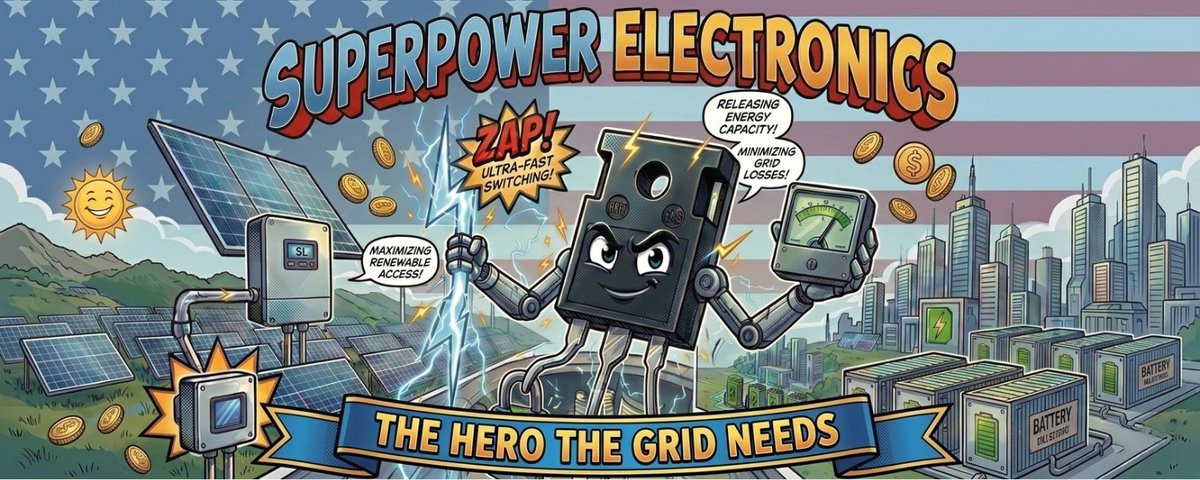
I frequently am asked why, after nearly two decades working on foundational battery, electric vehicle, and energy storage engineering and scale-up, I founded a grid-scale power electronics company. So I wrote this long-form piece talking about why @heronpower, and why now. Enjoy!
Had a great time covering everything from micro-Nuclear "NIMBY" and next generation power electronics with @RadiantNuclear CEO @DougBernauer and @espricewright on the A16z podcast a few weeks back. podcasts.apple.com/us/podcas…
Drew Baglino retweeted

Working on something ambitious is like climbing a mountain that’s covered in fog.
You can't see a clear path to the top. You have to take a few steps into the unknown to be able to see the next few steps in front of you. Inevitably, sometimes you’ll end up a local maximum and have to backtrack. That’s fine, just keep moving.
Drew Baglino retweeted
“The constraint on America’s AI future isn’t algorithms — it’s atoms.”
At American Dynamism, @baglino laid out what it will actually take to reshore grid hardware manufacturing:
• Durable industrial policy
• Energy & manufacturing development zones
• Transmission buildout at scale
Reindustrialization is physical. 🇺🇸⚡
(@a16z | @MarianaMinerals | @espricewright)

Thanks @shaylekann for having me on the pod! It might be a tad wonky :), but useful for anyone interested in learning more about the mechanical foundation of our electrical grid, and what the future might bring...

This week, @heronpower announced a $140M Series B led by Andreessen Horowitz. Founder/CEO Drew @baglino and @shaylekann explore how solid-state transformers can transform the grid into a highly optimized machine.
Listen now: latitudemedia.com/news/catal…

Major day for the @heronpower team as we announce the closing of our series B fundraising! I'm proud to partner with @a16z and our existing team of amazing investors to accelerate Heron Factory 1 and Heron's vision of a next-generation power grid. Calling all exceptional engineers, project developers, and utilities to join us on the journey! globenewswire.com/news-relea…

the DERVOS crew recently posted last fall's "energy dominance and the electrostate" thunderdome that I joined along with @sdamico @DaanWalt3r @tristandoherty and expert moderator @James_McGinniss
can the US catch the electric slide? youtube.com/watch?v=JI75i7jh…
