

Chestnut Hill, MA
Joined October 2024
- Tweets207
- Following61
- Followers334
- Likes107







Boston College Economics Department retweeted

1/ I am very excited about my new working paper with @tyfn_sonmez: "Reserve Systems in Dynamic Settings: Account Design and Inherited Rights." arxiv.org/abs/2611.22116

Meet the @BostonCollege Economics Department Job Market Candidates 2026-2027!
Learn more about their research:
bc.edu/content/bc-web/school…

Yufeng Shi
“One Child Policy and Marriage Market Outcome”
Website: sites.google.com/bc.edu/yufe…

1
1
148
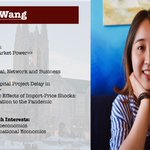
Manchun Wang
“Delivery Risk, Firm Heterogeneity and Market Power”
Website: sites.google.com/bc.edu/manc…

1
136


Boston College Economics Department retweeted
A 10-year US GDP growth conditional on alternative TFP growth paths using Chronos-2. For a structural interpretation based on Gen-AI see the paper papers.ssrn.com/sol3/papers.…

Boston College Economics Department retweeted

"3 Signs Cash-Strapped Consumers Are Nearing a 'Spend-pocalypse' That Would Hurt the Economy" latest @MarketWatch blog post by CRR Research Fellow and @BostonCollege Professor Geoff Sanzenbacher: marketwatch.com/story/3-sign…

Boston College Economics Department retweeted

It was a pleasure to have a poster of my JMP, at the WE_ARE_IN Conference in Rome, hosted by @bancaditalia and jointly organized with the @BIS_org , @cepr_org , and @ecb. Many thanks to the organizers for bringing together such an inspiring group of women researchers! 👏😍


Boston College Economics Department retweeted

What's the impact of AI on OLDER workers? Prof. Geoff Sanzenbacher of Boston College breaks it down on this week’s podcast. He also tells us which older workers are MOST vulnerable to AI. A MUST-LISTEN! rebrand.ly/799976
@geoff34wc @RetirementRsrch @BostonCollege #AI #artificialintelligence #workforce #employment #seniors #aging #retirement

Boston College Economics Department retweeted
Yesterday, we reached our 100th liver exchange transplant of 2026, marking the third consecutive year with at least 100 transplants!
Banu Bedestenci Sönmez (BBS) Liver Paired Exchange Program, İnönü University, Malatya, Türkiye. 1/5

Boston College Economics Department retweeted
"The Good, the Bad, and the Ugly of Rising #InterestRates" latest @MarketWatchblog post by CRR Research Fellow and @BostonCollege Professor Geoff Sanzenbacher: marketwatch.com/story/the-go…

Boston College Economics Department retweeted

A superb summary of our paper by my great coauthor Ahmad @ALashkaripour

A critical tension in global governance is that trade agreements raise CO2 emissions, and pricing those emissions would disrupt the balance of concessions the agreements are built on.
But trade agreements also offer an opportunity. Leaving the WTO is costly; leaving the Paris Agreement is not. That gives trade agreements leverage that climate agreements always lacked.
Our new NBER paper asks whether the WTO can use that leverage to sustain a carbon price. We show that it can: with simple amendments to its rules, the WTO could cut global emissions in half.
🧵Thread 1/

Boston College Economics Department retweeted

Geoff Sanzenbacher, Economics Professor and @retirementrsrch Research Fellow, penned a MarketWatch blog about older Americans' wealth and how to they might be able to spend it.
on.mktw.net/4yd7QtL
Boston College Economics Department retweeted
"Nearly Half of Adults Under 30 Live with Their Parents. The Financial Fallout Could Last for Decades." latest @MarketWatch blog post by CRR Research Fellow and @BostonCollege Professor Geoff Sanzenbacher: marketwatch.com/story/nearly…
Boston College Economics Department retweeted

FRESH OFF THE PRESSES from our lab
(🔗rubin-lab.mgh.harvard.edu/)
How does anticipated regret influence ECMO candidacy decision-making?
With a team including economists, we apply Regret Theory to analyze this question and demonstrate its role in ECMO candidacy.
Clinicians prefer clear-cut cases, but even then, and certainly in more gray-zone cases, fear of regret emerges:
1⃣ Regret of omission: Even if we know ECMO won't help, we will feel terrible for not trying.
2⃣ Regret of commission: Even if there's a chance ECMO will help, it's very small and we will almost certainly regret having tried when this inevitably becomes a bridge to nowhere.
Many questions follow:
Is regret-dominated decision-making ever appropriate? Should it be corrected for? Does it exist across critical care or medicine more broadly?
This is only the beginning
journal.chestnet.org/article…
Thank you to Boston College Economics (@bc_econ) and @accpchest @journal_CHEST
@MGBResearchNews @HMSbioethics @MGHHeartHealth @MGHHeartHealth @PCCSM_BIDMC @MGH_PCCM @HarvardPulm


Boston College Economics Department retweeted

Thanks to @captgouda24 for reading & writing about Vasco and my new paper, Firms as Foragers.
If you're curious for more, you can find the complete draft here: lukasbfreund.github.io/files…
Or a complementary thread here: nitter.cf/_LukasFreund_/status/2…


Boston College Economics Department retweeted

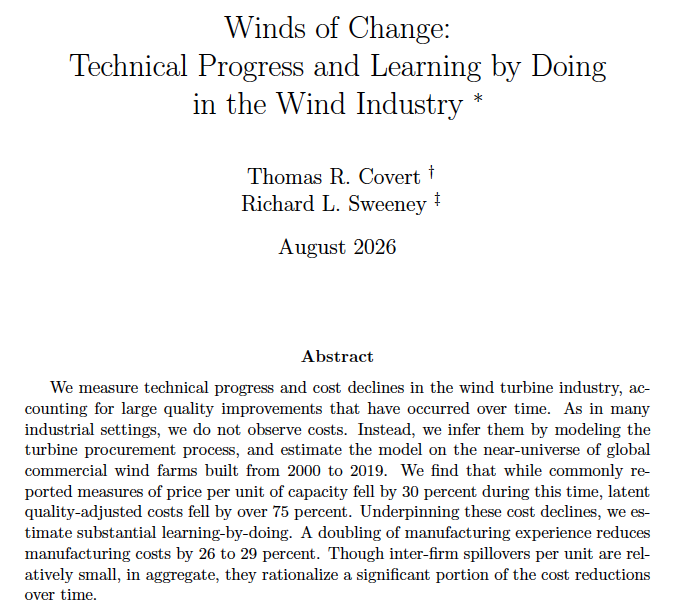
🚨New working paper 🚨
How much better are we getting at manufacturing clean energy technologies? And how much of that improvement is driven by learning-by-doing?
We answer these questions for wind energy.
Watch this short video or read on for details.
Boston College Economics Department retweeted

1/ The recent letters from mathematicians (Leiden Declaration, Fields Medalists) aren't just about AI "solving" math problems.
The deeper risk: commercial AI incentives may break the reciprocal loop that advances mathematics.
This maps onto a framework I've been developing.

