
Ex-pharma strategy. Writing about biotech valuations, catalysts & policy. Connecting the dots.
Joined May 2026
- Tweets103
- Following63
- Followers142
- Likes104




$IOVA is down hard pre-market today after the IOV-LUN-202 lung cancer update. Overall ORR came in at 24.6% (17/69), unchanged from the prior 25.6% in 39 patients. The biomarker-enriched subgroup (KRAS wild-type + HER2 wild-type + ever smoker) reached 59.1%, but that was retrospective and small. The company is now shifting to a precision strategy with the POSITILITY cohort starting in November and an sBLA planned for 2027. After a >400% YTD run and elevated valuation, the market sold the news.
A few weeks ago I trimmed around $15.11 as a de-risk against the September 1 buy at ~$7.66. The view was that U.S. melanoma commercialization was working, but the lung contribution and residual dilution risk were not yet cleanly priced. Today’s move lines up with it. Full piece down below.
Still long the remainder into Q4, watching the full data and how the confirmatory Phase 3 gets funded.
Disclaimer: This is not investment advice. It reflects my personal views and positions for informational purposes only. Biotech stocks are highly volatile and can result in significant losses. Do your own research and consult a qualified advisor before making any investment decisions.
bridgelabd.substack.com/p/wh…


$CELC has been sliding for months because there’s still no early sales data. I think that discount is overdone.
The ESMO subgroup update is impressive. In the no-liver-mets group (about 60-70% of patients), the triplet hit 21.5 months median PFS vs 9.1 months for alpelisib (HR 0.46). The HR was essentially the same in patients with liver mets. So the overall 11.1-month result isn’t being skewed by one high-risk subset and the benefit holds across the whole 2L population.
That supports broader use, not a narrow high-risk label, and strengthens the sNDA case. Until commercial numbers appear the stock can stay pressured, but the clinical data looks better, not worse. Still like the setup.
Agree — and to be clear, this is not a comment on whether $MRNA Phase 3 itself succeeded. From a commercialization and ultimate patient-benefit standpoint, the logic is straightforward: if simply moving a few doses of pembrolizumab earlier (before surgery) can already deliver a large relative risk reduction, why add a fully personalized vaccine on top later?
INTerpath-001 showed an RFS HR of 0.58 (2-year RFS 82.2% vs 70.0%) and DMFS HR of 0.62 for intismeran + pembro versus adjuvant pembro alone — nearly identical to the HR 0.58 from neoadjuvant pembro versus adjuvant pembro in SWOG S1801.
That overlap is hard to dismiss when the vaccine requires individualized manufacturing and logistics at very high cost. Cost-effectiveness looks challenging when a simpler neoadjuvant approach can produce a similar relative benefit. This is also a key reason $BNTX has leaned toward off-the-shelf mRNA strategies rather than fully personalized ones.
I’ve been saying the market’s expectations after the August topline were too aggressive. These numbers look like a solid but incremental adjuvant result, not the major paradigm shift that was priced in.

$MRNA with the single most hilarious possible outcome in this study. EFS HR 0.58. Down the the hundredth, EXACTLY what *NEO*-adjuvant treatment with pembro yielded against adjuvant pembro (the nerfed comparator $MRNA studied against) in SWOG S1801.
What does this mean in English? $MRNA’s drug is showing the exact same benefit versus adjuvant pembrolizumab as NEOadjuvant pembrolizumab did.
Even more simply? If you just give patients a few doses of the pembrolizumab BEFORE you cut their cancer out, you do what $MRNA does for you, except with just the free tumor that’s already inside your body. No need to pay for this $400K drug.
And this makes rational sense, right? The whole point of $MRNA’s vaccine is to produce stuff that looks like the tumor.
You know what looks A LOT like the tumor does? THE FREAKING TUMOR!!!!!!
Absolutely poetic that $MRNA produced the EXACT HR benefit as neoadjuvant pembro did. Truly, the most hilarious possible outcome.
Now can we move on from this bullshit? $MRK and $MRNA should feel free to study their vaccine against the REAL standard of care now - NEOadjuvant immunotherapy.
From my perspective, this has been total fugaze, and an amateurish pump and dump worthy of much lesser enterprises.

$IRON The $75 $450M offering is standard post-data financing. Dilution is normal. The thicker cash position actually supports commercialization. No need to over-worry.
Competition exists:
• $CLVLY (Clinuvel)’s Scenesse (afamelanotide): subcutaneous implant, MC1R agonist (increases pigmentation)
• LEO Pharma’s dersimelagon (acquired from Tanabe): oral MC1R agonist, PDUFA ~Feb 2027
But $IRON’s bitopertin is currently the only oral, disease-modifying agent that reduces the pathogenic PPIX at the source, clear mechanistic differentiation.
Base case: $1B peak sales × 5x = ~$5B value. Current EV (post-offering) roughly $1.8-2B, so some upside remains.
Next step is regulatory attitude. The core CRL issue has been answered with Ph3 functional data. Most regulatory risk is removed. Remaining risk is review details after resubmission. Year-end NDA resubmission is the near-term catalyst.
Honestly, this is already a bit of an old story. $BNTC has largely pivoted to antibodies and ADCs. Its own mRNA tumor vaccine efforts were always designed to step outside melanoma and push toward off-the-shelf (fixed-antigen) products — and from a pure biology standpoint, that is a much harder problem than melanoma.
BNT113 + Keytruda readout in first-line HPV16+ head and neck cancer (missed PFS, continues to OS) just reinforces the point.
mRNA cancer vaccines have a narrow window. Melanoma worked because it is a special case: high TMB from UV damage, immunogenic (“hot”) tumor, and a clear adjuvant / residual-disease setting where a vaccine can help clear micrometastases. Moderna/Merck’s personalized vaccine + Keytruda succeeded in exactly that niche. So I still do not understand the frenzied run-up in Moderna $MRNA .
Step outside it and the odds drop. Most solid tumors are colder, lower mutational burden, and more immunosuppressive. Even HPV-driven head and neck — which at least has a defined viral antigen — didn’t show a clear PFS benefit when added to Keytruda. The earlier BNT122 colorectal cancer adjuvant monotherapy trial was stopped after an OS numerical imbalance favoring the control arm.
Fixed-antigen “off-the-shelf” approaches have limited coverage. Personalized ones are complex to manufacture. Almost all of them still need a strong IO backbone and the right clinical window. I still think treating mRNA vaccines as a broad anti-cancer platform is too optimistic.
$BNTX own pipeline has already reflected this: weight has shifted toward ADCs and next-gen IO (PD-L1×VEGF bispecific pumitamig, multiple ADCs, anti-CTLA-4, etc.). mRNA remains a pillar, but it is no longer the main story.

$CGEM: The Competitor Left. December Is Still the Trade. $CGEM is getting another look this week. Because $AVBP ArriVent's FURVENT missed. A lot of you were on this name for CLN-978 call. Zipalertinib was the layer I wanted underneath the bet. The floor got stronger. This week the field changed.
Firmonertinib had Breakthrough designation in first-line EGFR exon20 insertion lung cancer, and it could have reached the US at or ahead of zipalertinib plus chemo. It did not beat platinum. $AVBP fell more than 50% before the open. $CGEM opened Tuesday at $17.24 and closed Thursday at $15.46.
One fewer likely competitor, so first-line peak share goes from 30% to 35% in my model. I also raised POS and base case share price.
The question I bought the stock to answer did not change: can CLN-978 deliver repeated B-cell depletion at a safety burden a rheumatologist can actually use? I'll write that one when the December data print. I'll keep updating as it changes.bridgelabd.substack.com/p/cg…
"Tools don't discover drugs" is the lazy bear case on $RXRX. I'm bullish.
AI is compressing timelines significantly in early discovery. $RXRX took REC-1245 from biology discovery to dev candidate in 18 months, which the company says is more than 2x faster than the industry average. REC-7735 went from first hit to candidate in ~10 months and 242 compounds, vs an industry norm of ~4 yrs and ~2,500. That's a clear, measurable speed-up.
And it's translating in the clinic: REC-4881 cut median polyp burden 43% at wk 13 in a Ph2 FAP study (53% at wk 25, after stopping). Next data Nov 2.
Big pharma is betting on it. Roche/Genentech $216M and Sanofi $134M to date. $556.8M on hand, runway into early 2028.
AI-bio peers YTD: $ABSI +230%, $RLAY +129%, $SDGR +82%, while $RXRX is only ~+17% and still ~1/3 below its 52-wk high, with ~1/3 of float short.
AI won't replace human trials, but it changes the cost and speed of getting there. I'm long-term long on $RXRX. NFA

this $RXRX is a good short. has always been a dumpster fire company and always will be. drug development isn't about your tools (especially not AI). it's about your translational judgment about what good medicines looks like
Congrats to $PCVX . VAX-31 OPUS-1 Phase 3 data actually cleared the bar.
The adult pneumococcal vaccine landscape is about to shift.
A 31-valent shot matched $PFE Prevnar 20 and $MRK Capvaxive on shared serotypes (non-inferior), beat them on the unique ones (superior), and held a comparable safety profile. Coverage potential sits well above the current 20- and 21-valent products, closer to 90%+ of adult IPD.
That puts real pressure on $PFE and $MRK. Not an overnight share grab, but once OPUS-2/3 read out in 1H 2027 and the BLA window opens in 1H 2028, ACIP recommendations and market split stop being a simple continuation of the current vaccine. Though both already have higher-valent programs in motion. They’ll need to keep pace.

$PCVX Vaxcyte Reports Positive Topline Data from OPUS-1, the Pivotal Adult Phase 3 Trial of VAX-31, the Company’s 31-Valent Pneumococcal Conjugate Vaccine Candidate - Vaxcyte, Inc. investors.vaxcyte.com/news-r…
Had dinner yesterday with a few friends in FA and private equity. Lots of real collisions and idea exchange, which I enjoy.
What I don’t is when someone keeps circling back to make sure you fully agree with them. Not just that you follow their reasoning, but that you endorse the whole conclusion. Even after you say you respect the view, the logic, and the years of experience behind it, and even after you call the point sharp, they still seem to need you to sign off completely.
I don’t think that’s necessary. People are allowed to hold their ground. Disagreeing on the conclusion doesn’t cancel respect for the reasoning. Why push for total agreement?
$NKTR AA, I follow closely. The Treg mechanism is genuinely elegant, but I have no position.
The off-treatment durability numbers are 6/8 at four months and 5/8 at six months for maintaining SALT ≤20. Still small subset of patients who completed 52 weeks of treatment and had already reached the response threshold. Need full trial population or an ITT analysis. With an n this small, one or two patients moving in or out changes the percentage a lot.
Context from the earlier readout also matters. The Week 36 primary endpoint missed statistical significance in the full analysis set and only reached it after excluding four patients who did not meet major eligibility criteria. Discontinuation rates were also elevated (these are always indicative red flags, especially in non-fatal diseases). Those points, plus the small durability sample, help explain why the stock sold off roughly 20% on the data despite the headline.
The signal itself is still interesting due to the IL-2 mechanism. JAKs generally lose response after discontinuation, whereas here most of the responders held SALT ≤20 off drug and the deeper SALT ≤10 rate rose from 7% at Week 52 to 19% six months off treatment. That is consistent with the idea of immune resetting and it supports looking at less frequent maintenance dosing. It remains an exploratory observation in a handful of patients and needs confirmation in the Phase 3 ZENITH AA study planned for early 2027.
$NKTR AA off-treatment durability data. 75% maintained their SALT<20 response at 4 months of no treatment, and 63% after 6 months.
They even saw some continued deepening of effect *without* new treatment - they gained another SALT<10 responder.
This off-treatment durability is a unique and highly desirable feature in alopecia areata. As discussed elsewhere:
1). The current SoC (JAKi) loses efficacy rapidly when stopped/interrupted. In the real world, dose interruptions happen often for any number of reasons.
2). Interruptions of treatment when using drugs that lose efficacy rapidly when stopped is a big problem for this disease specifically. Growing hair takes time. Literally years for people with longer hair styles. AA makes hair fall out at the follicle. If you have even a short term lapse in treatment, it has long term consequences in this disease - unlike most I&I conditions where you simply resume the drug and get your response back, that process can take *years* in AA.
So now, $NKTR can not only say they have the first to market safe biologic for AA, beating out JAKi with their 5 point black box warning (for this relatively cosmetic condition). Now they can also say “we have major off treatment durability, so in the real world when patients miss a dose, their hair isn’t just going to fall out”.
This indication seems to have been written to $0 net present value for $NKTR recently. I really do not understand why. There’s a product here.
What I Wrote on $IOVA in August and How I See the Flywheel Before the Lung Data bridgelabd.substack.com/p/wh…

I think $IOVA 's pivotal lung readout in Q4 is quite clear.
From the previous two Phase 2s. Basket cohort (n=28, heavily pretreated, up to 6 prior lines): 21.4% ORR. Registrational trial, cleaner 2L population (n=39): 25.6% ORR, mDOR not reached at 25 months.
Same population and signal twice with responses in the checkpoint inhibitors fail (PD-L1-negative, TMB-low, STK11). Responses deepen over time, same as melanoma. Tighten the population, the number goes up. That's what a real drug looks like (I know RP1 is still competing but I am not sure if their efficacy is comparable).
Only if the Q4 update shows ORR slipping below ~20%, or ugly manufacturing-dropout. Until then, at a market cap roughly covered by melanoma + cash. The asymmetry is the point.

$QURE 4y note
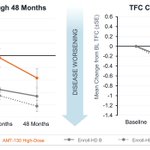
Payers price the treated slope. High-dose cUHDRS went from −0.28 at 36m to −0.90 at 48m (n=12). Versus Enroll-HD B: 44% slowing, p=0.144. Swap the older Enroll-HD A control and you get 54%, p=0.041 (−0.90 vs −1.94). TFC is cleaner on both frames: 61% vs B, 68% vs A. The composite giveback is SDMT (20%) and TMS (5.6%). SWRT still holds.
A only changes the denominator. The treated line still dropped ~0.6 points in year 4. Company can argue 53% missingness in B and slower survivors. That lifts percent slowing. It does not flatten year 4 on drug.
BLA already sits on the 36m package. Launch is a different buyer. For a ~$1.7m one-time striatal gene therapy, year-4 slope has to stay shallower than natural history. Even against A, that underwrite got harder today.

AZN putting $2B into $SMMT is less “who wins IO2.0” and more confirmation that IO2.0 + ADC is the stack. Not who files the bispecific first, but which combos can cover which tumors and which lines — later-line first, then surround 1L.
That’s why I’ve liked $BNTX’s earlier setup. BNT327 + ADC, including the B7-H3 combo, already put a safety floor under the class. Different route from SMMT, not a head-to-head.


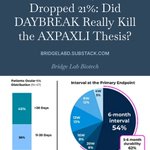
$KOD Doubled, $OCUL Dropped 21%: Did DAYBREAK Really Kill the AXPAXLI Thesis?
On $OCUL market share: Yes, DAYBREAK reshapes the baseline, but Zenkuda isn't a direct head-to-head competitor as a 'long-interval product.' The onus remains on AXPAXLI's SOL-R trial to demonstrate a meaningfully extended interval that clears the bar for payers and clinicians.
bridgelabd.substack.com/p/ko…

$KOD KOD’s data are real. If you own $OCUL, don't panic. It does not make AXPAXLI the same drug. One stays inside the current shot paradigm. The other is a TKI hydrogel implant aiming for far fewer visits (if you compared the previous KOD deck, they removed “High durability” claim in the new one).
SOL-1 already showed something KOD did not have to show: superiority on vision maintenance versus a single anti-VEGF dose, with ~66% maintaining vision and ~69% rescue-free at week 52. That is not a guaranteed 9–12 month label for everyone on day one. First approval is more likely flexible redosing, with 6 months as the practical base and 9–12 months as the extender.
SOL-R, year-2 redose safety, and real-world treat-and-extend are how that longer interval gets written in later. Wet AMD is big enough for both. KOD raises the bar. It does not erase a clean safety profile, a different mechanism, or a path to skip some step therapy if the superiority claim holds.
The product question is unchanged: can AXPAXLI be the option patients get when they are done living on a calendar of injections? That advantage is still there.


Yeah this is the part that feels off to me.
Street is basically treating $CGEM as a zipalertinib story only (EGFR ex20ins NSCLC — 14.5 vs 8.5 mo PFS is strong, even if safety might come with a black box).
The CD19 TCE in SLE / RA / Sjögren’s is getting almost zero credit. Implied POS looks like ~10%. Safety so far hasn’t been that ugly (mostly low-grade CRS).
If December multi-dose data just holds the current CRS profile, $20 doesn’t feel crazy from here.
Anyone else seeing it that way?

$CGEM (NP)
$800M EV after the selloff, catalyst-packed Q4
-BCMA T-cell engager data in SLE at ACR (Nov 6 to 11), moved this up first b/c they know it's going to be good
-CD19 data was pushed back from September (bearish or wanted more complete data?), now presenting for all 3 indications together (SLE, RA and Sjogren's) in December
-FLT3 updated dose escalation data with longer follow-up in December (ASH?)
I went back through the deck. The monthly numbers aren’t a dose series. At the same mg/week, every-other-week beats monthly. That’s trough, not average. With a great safety profile, QM could still stand with a higher dose. Let's see PK in November.
[Deepdive] Viking’s Maintenance Print: Interval Matters, and PK Data in November Can Prove It bridgelabd.substack.com/p/de…
$VKTX maintenance data printed this morning. I wrote the calls down on September 4, before the readout. Scoring them now.
Week 21, 17.5 mg induction (n=118): −17.8%. I called −15% to −18%. At my bullish end.
The placebo-maintenance arm was the non-consensus part of the piece. I said it would hold 60–70% of induction loss and make the separation look thinner than the biology warrants. It held 61%. I put the gap at 3 to 5 points of body weight. On the monthly combined comparison it came in at 4.2.
Monthly dosing: I said at least one regimen retains 75% or more. All five did, 82% to 90%, way better than I expected. Every-other-week did 90%, and 10 mg QOW did 97%.
The line I cared about most was that induction GI is noise and maintenance GI is signal. Maintenance TEAEs landed at 38% every-other-week and 49% monthly, against 52% on placebo. Below placebo. That was the line.
Where I was wrong: I expected 10 to 16 patients per arm to blur the separation. Every cohort cleared p≤0.004. That was never the objective of a Phase 1 exploratory endpoint, but it means the effect was larger than the band I used to argue the comparison was underpowered. For a BD screen, that’s the difference between “monthly is just a hypothesis” and “monthly is data you can bring to the table.” It is not, however, a takeout price.
The number I have not seen screenshotted yet: the exploratory 17.5 mg weekly-continuation arm is at −21.7% at Week 33, still no plateau. That is the VANQUISH-1 dose.
Stock indicated +25% premarket. PK, troughs, and ADA were not in the release. Let’s see how it presents during ObesityWeek. Though this maintenance update is already very impressive.
Full write-up after.
$VKTX The Real Alpha in Viking’s Upcoming Maintenance Data [Deepdive] bridgelabd.substack.com/p/th…
BNTX: Toxicity Cleared the Floor, but Most Important Data Was Deferred
Said WCLC would ignite $BNTX. It didn’t. Safety printed. Synergy couldn’t. Holding a deferred option — settles on NSCLC Part 1. Scorecard and call in the piece.
bridgelabd.substack.com/p/bn…
Same point as before: Voyxact already set a bar on eGFR that is just really hard to beat. $VERA ORIGIN 3 is basically in the same place. Trutakna’s annualized eGFR slope is −0.6, Voyxact’s is +0.3. Both are inside normal aging loss, both beat placebo by about 4.5–5.0 mL/min per year, and that gap is well within cross-trial noise. Vera’s bigger placebo-adjusted delta is not a meaningful clinical win.
Trutakna is still a weekly shot. Voyxact is every four weeks and already has two-year eGFR proof. And Vertex’s povetacicept is the same dual BAFF/APRIL idea, also every four weeks, with a better proteinuria readout with about 50% placebo-adjusted UPCR drop at week 36 versus Vera’s roughly 42% ,and a PDUFA of November 30. So Vera gets maybe five months of first-mover time, building its own commercial team, against a proven monthly drug and a same-class drug from a much stronger sales team.
The market is big is true. That still doesn’t answer the simple question, why would you pick Vera over a drug that’s already proven, or wait a few months for the same class from big pharma?
More on @BiotechObserver’s side here.
$VERA Latest eGFR numbers are slightly negative, while Voyxact already showed a positive slope. Selective APRIL inhibition may already be sufficient and adding BAFF blockade could oversupress B cells and dilute the benefit. Voyxact’s positive annual eGFR slope is just too hard to be beaten . @seedy19tron