










---🌩--- retweeted

Parecen extraterrestres descendediendo del cielo, pero es ciencia pura
Madrugada del 10 de septiembre. Desde Almería capturé este espectro rojo (Sprite), un fenómeno luminoso que ocurrió sobre una tormenta situada a 200 km en el mar.
Dura milisegundos y ocurre a 80 km de altura. ¡RT para que más gente conozca este fenómeno!
#RedSprites #Meteo #Almeria #Tormenta

---🌩--- retweeted

Me presento, que hay gente nueva por aquí:
23 años, desde los 12 metido en hacking y ahora en IA.
Aquí cuento lo que aprendo: herramientas, errores, recursos gratis y batallitas.
Si te va la IA y la ciberseguridad, sígueme. Un RT me ayuda a llegar a gente como tú.
---🌩--- retweeted

“el carro no se va a mover solo si no te montas a manejarlo”... muchos quieren cambios mientras siguen estacionados en el mismo miedo, en la misma indecisión, en la misma versión de sí mismos. esperan señales, esperan confirmaciones, esperan que el universo prácticamente los empuje… pero el movimiento también requiere voluntad. no es que tu camino esté bloqueado, es que sigues mirando el camino desde afuera... el universo no te pide más manifestaciones, ni más visualizaciones, ni más “cuando esté listo” te pide acción, te pide dirección, te pide tomar el control de tu propia energía porque ningún portal se abre para quien no decide cruzarlo, it is what it is


---🌩--- retweeted

llmfit. Useful tool that probes hardware and tells you exactly which LLMs will actually run.
- handles MoE expert offloading, picks the best quantization for your RAM, estimates tokens/sec before you even pull the weights.
Essential for local dev.
github.com/AlexsJones/llmfit
---🌩--- retweeted

BREAKING: The largest collection of AI coding skills
860+ skills. One repo. Works everywhere.
→ Claude Code
→ Gemini CLI
→ Codex CLI
→ Cursor
→ GitHub Copilot
→ OpenCode
→ Antigravity IDE
→ AdaL CLI
What are skills?
AI agents are smart but generic. They don't know your deployment protocol. They don't know your company's architecture patterns. They don't know AWS CloudFormation syntax.
Skills are small markdown files that teach them.
One skill = one capability. Perfectly executed. Every time.
This repo has 860 of them:
→ Architecture (system design, ADRs, C4)
→ Security (AppSec, pentesting, compliance)
→ DevOps (Docker, AWS, Vercel, CI/CD)
→ Data & AI (RAG, agents, LangGraph)
→ Testing (TDD, QA workflows)
→ Business (SEO, pricing, copywriting)
Install once:
npx antigravity-awesome-skills
Then:
"Use @ brainstorming to plan a SaaS MVP."
"Run @ lint-and-validate on this file."
Your AI agent just got 860 new capabilities.
GitHub Repo Link in comments.

---🌩--- retweeted

80% done on an explorer for the tiered memory system in Solum, my Elixir-based @openclaw killer™️
The context is just a frame. I've been running this system for a couple of days. It is no longer stuck in the user->agent message loop, and through context engineering, it treats context as a frame, with inference producing actions. An action can be: message another agent or the human, or use tools. And what triggers inference is sensory data: subscriptions to state changes outside of itself, or email/chat notifications. It no longer feels like before. It's what I thought OpenClaw would be, truly autonomous. But autonomy needs a primer. It needs a context that removes this pure assistant, user-to-agent comms. Also, async tool-calling is the way, once you see that you can't go back. I'm wondering what sort of beast people at @AnthropicAI or @OpenAI are running, because what I've seen my setup do has really impressed me.
Follow this space, will open-source in a few days at this rate.

---🌩--- retweeted

CEO of Y Combinator shared his CLAUDE.md prompt for Claude Code
It helps him ship 4,000+ line features with full tests in about an hour:
This prompt pushes Claude to:
Decide if the plan is overbuilt, underbuilt, or "engineered enough" before writing any code
Aggressively review test coverage, edge cases, and failure modes
Look for performance risks, scaling issues, and refactoring opportunities
But the real difference is the workflow.
Instead of jumping into implementation, he makes Claude:
Do a structured review (architecture → code quality → tests → performance)
Present tradeoffs with opinionated recommendations
Pause for feedback before proceeding
In other words, Garry is using it as a senior engineer reviewing the system before changes are made.
For small teams, this is a game changer. When you don't have a staff engineer reviewing every PR, you design the review process into your Al.

---🌩--- retweeted

2/ The tool: CodeFlying
What makes it different?
It doesn't wait for prompts.
It doesn't generate scaffolding you have to fix.
You literally call it like a phone conversation.
The entire development happens through Voice Chat
And it argues with your ideas in real-time until they're sharp enough to build.
Then it ships the entire stack.
---🌩--- retweeted

Prediction:
In less than 6 months, you'll see blackmarkets on PC parts,
that are great at running local AIs.
And contrary to popular belief having a Mac Studio is not the best choice compared to getting the right PC spec:
A dual RTX 6000 produces
> twice as much ai compute tokens per/sec
> compared to a Mac Studio 512gb
> on recent benchmarks on Minimax 2.5
> while costing half of a Mac Studio
Still Mac Studios are sold out everywhere due to hype from OpenClaw users.
While benchmarks clearly suggest that buying PCs for running local LLMs is multiple times more effective!
Now that Minimax 2.5 came out open source, as a free to run Ai model that runs on your local machine while delivering close to Opus 4.5 level results: shift towards buying PCs will accelerate.
As once you pay for such a spec once, you won't need to pay for subscriptions.
And you'll have your privacy instead of sending all your data to servers of AI companies.
Blackmarkets on PC parts is sure to happen because:
99% of the world hasn't awakened to the fact that the age of true/useful AI has arrived in the last 2 months.
They will in the next 6 months.
Most businesses will want their privacy and cost efficiency.
Most vibe coders will want these shiny new toys, that will be the specs to run local AIs.
They will be the new Ferraris and Rolexes. Except these toys will be useful to spawn countless agents working for you for free after you pay the initial hardware costs.
Except electricity, which you can handle by moving to a free electricity rental.
I have 0 doubt that PC part demand will skyrocket within the next 6 months, and most parts that are great at running AIs will start to have blackmarkets on eBay etc.
If you wanna be early to the movement and already vibe coding give the article below a read to choose the right PC spec for yourself:


---🌩--- retweeted

🚨BREAKING: Someone built an AI coworker that actually remembers everything you've discussed.
It's called Rowboat and it builds a knowledge graph from your work.
- Connects Gmail, Calendar, Drive, meeting notes
- Runs 100% locally (your data never leaves your machine)
- Generates PDFs, briefs, emails from your context
- Plain Markdown files you can edit anytime
4.6K stars. 100% Opensource.


---🌩--- retweeted

Dexter hit 10,000 stars on GitHub.
It’s OpenClaw and Claude Code, for finance.
What Dexter can do:
• find undervalued stocks
• break down financials
• turn research into a thesis
All our code is open source.


---🌩--- retweeted

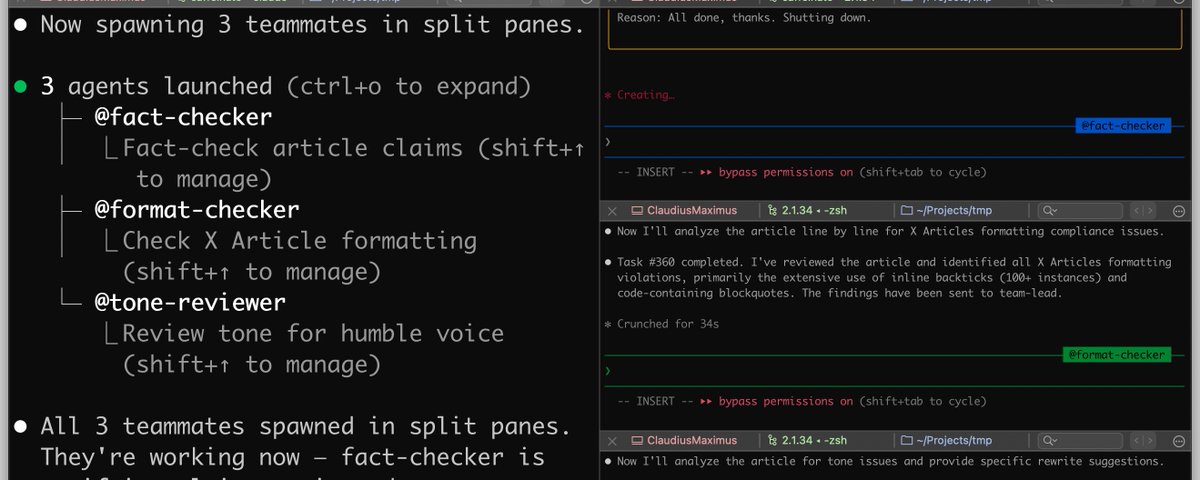
Trying out Claude Code's new agent team feature.
To get this view, you have to start cc in tmux.
The prompt was "create a team that looks for security vulnerabilities in our app and fixes them".
It created a team of four:
1. admin-hardening
2. xss-fix
3. rate-limit
4. rls-audit

---🌩--- retweeted

I reversed engineered every skill in digital marketing and then trained my AI on all of them.
Here’s how I did it...
Oh, and I’m giving away all 84 marketing skill files at the end of this post.
This all took place over 5 days.
Step 1: The Skill Tree
I started by working with @ManusAI because I knew I was going to need their almost infinite context window.
My first request was for Manus to create a skill tree starting with the base skills of earned media, paid media, and owned media.
Aka paid traffic, free traffic, and your own subscribers.
We started cookin up branches and branches of skills from those 3 base skills.
Step 2: Teams of Experts
I noticed Manus was struggling to think outside of the basics so I started asking it to embody expert after expert.
For example:
“Embody Neil Patel and critique this skill tree for what’s missing.”
“Embody Frank Kern and critique this skill tree for what’s missing.”
“Embody Russell Brunson and critique this skill tree for what’s missing.”
After I brought in 12-15 virtual experts to critique the skill tree we (me & my pal manus) had over 1900 individual tactics mapped out across 152 unique categories of skills.
Step 3: Coworking with Claude
At this time Manus hadn’t released their skills feature yet. But Claude had a skill creator skill.
First I filled in Claude on the details of the project and the goal.
Because context.
The other reason for using Claude was because with Claude Desktop in Claude Cowork mode you can work directly with files and folders on your computer.
This was key to the organization, context, and memory for this project.
Once Claude was up to speed I asked it to remove overlapping skills and tactics. Stuff like SEO for Google vs SEO for Bing.
We came up with 84 total skills that would need to be created that would encompass all 1900(ish) individual tactics.
For example the media buying and planning skill includes writing headlines, customer personas, keyword research, copywriting etc.
And then we locked in…
Step 4: Best Practices Ranked
For each of the 84 skills I had Claude go into deep research mode and create a report on the best practices for that skill.
This means each skill was based on reading no less than 300 articles about that skill.
Then I would review the skills with my own 20yrs of experience overlooking what it found.
When I felt it was shallow on something I would ask Claude to embody a specific topic expert to enhance that skill.
Giving us 84 best practice documents that were extremely thorough, human reviewed, and expert enhanced.
Next I sent these docs back to Manus for its wide research mode. Manus can do up to 150 tasks in parallel. Essentially running 150 prompts at once.
I told Manus to rank every tactic in these best practice reports from S-tier (always do) to D-tier (never do).
This created huge context and rulings that would be necessary for our final skill files.
Step 5: Creating Skill Files
Back to Claude.
One by one I asked Claude to use the skill creator skill with my best practice reports and the S-tier rankings.
My wife kept the coffee flowing while I grinded these out.
For some like the long form sales letters skill I even included examples as reference files.
And then I loaded all 84 skills onto a directory I vibe coded into my website.
All 84 of these skills + an 85th I’m working on are available for free.
Just comment “skills” and I’ll DM you the link. Can’t post it because algo will throttle this post.
Bookmark this so you have a recipe for creating your own skills too.
Follow @IMJustinBrooke for more wallets fattening tips on using AI for marketing.
