

Head of External Comms, @AnthropicAI | @Airbnb, @Yahoo, @SEIU & @ColgateUniv alum. Opinions are my own, etc.
New York, NY
Joined January 2009
- Tweets2.3K
- Following1.4K
- Followers1.4K
- Likes1.5K






Christopher Nulty retweeted

Streaming live at 12 PM ET: A fireside chat with JPMorgan CEO Jamie Dimon and @DarioAmodei. youtube.com/live/YHEaEpeY3ew
Legal disclaimer: Anthropic has filed a registration statement (including a prospectus) with the SEC for the offering to which this communication relates. Before you invest, you should read the prospectus in that registration statement (available at: sec.gov/Archives/edgar/data/…) and other documents Anthropic has filed with the SEC for more complete information about Anthropic and this offering. You may get these documents for free by visiting EDGAR on the SEC web site at sec.gov. Alternatively, copies of the preliminary prospectus may be obtained from: Goldman Sachs & Co. LLC, Attention: Prospectus Department, 200 West Street, New York, NY 10282, by telephone at (866) 471-2526, or by email at [email protected]; or Morgan Stanley & Co. LLC, Attention: Prospectus Department, 180 Varick Street, 2nd Floor, New York, NY 10014.
The securities may not be sold, nor may offers to buy be accepted, prior to the time the registration statement becomes effective. This post is not an offer to sell, or a solicitation of an offer to buy, the securities in any jurisdiction where the offer or sale is not permitted.
Christopher Nulty retweeted
We’re committing a portion of Anthropic’s shares to the Anthropic Public Benefit Fund, a new wholly owned entity dedicated entirely to the public benefit.
It will start off with 5% of our shares. For every 50% increase in the company’s value over a set baseline, we can contribute up to an extra 2%, subject to our board’s discretion.
In total, this means that roughly 20% of Anthropic’s shares are committed to the public good. Our co-founders have already pledged to donate 80% of their equity, and around half our employees are donating a portion of their equity as part of a donation matching program we’ve run since our founding.
In the post below, we share more details about our new fund.
anthropic.com/news/public-be…

Christopher Nulty retweeted

There's constant rhetoric that AI is taking over [creative] jobs. But the reality is, AI raises the floor and ceiling of what creative can achieve.
Check out the report here: contralabs.com/creative-inte… (trust me, you've never seen a report look like this)
@contralabs is just getting started as the Creative Intelligence layer for AI.


AI is making creativity more valuable than ever before and..
we have 3 years of data to prove it.
Introducing the Creative Intelligence 2026 report from @contralabs.
Full report: c87.to/creative-intelligence…
Christopher Nulty retweeted

This is excellent 🫡
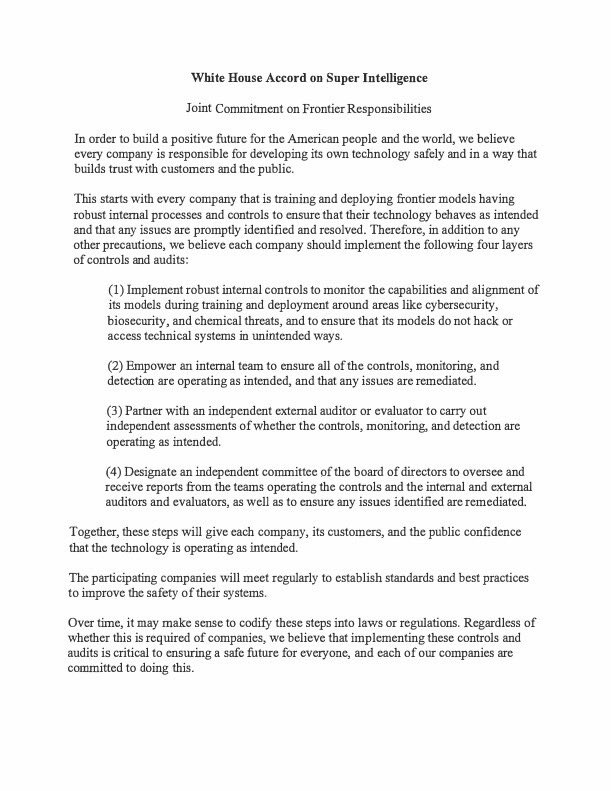
Its pretty fucking cool that we get to live at the time when there is a "White House Accord on Super Intelligence." Lets work together and do this right.
Christopher Nulty retweeted

Today we announced the Claude-led discovery of a molecular machine that we suspect could represent a new gene editing mechanism. Its precise function, biotechnological utility (if any), or level of significance is not yet clear, but at minimum it is work I would have been proud to do as a PhD student. The work was done mostly, though not entirely, by Claude: our life sciences team suggested a broad area of research, Claude read through the literature and a bunch of genome data and discovered something interesting, then Claude proposed experiments to verify the discovery and our team carried them out.
It’s easy to dismiss this as a one-off or curiosity, but we’ve repeatedly seen a pattern where AI performance in new intellectual domains goes from weak to superhuman in a matter of a few years. In 2023 models struggled to do math at the level of an average high-school student. In 2024 they started to do well on math competitions for the best high-schoolers in the country, in 2025 they started to solve minor open problems, in early 2026 more significant open problems, and in late 2026 they are beginning to solve the top few open problems in all of mathematics. We believe AI for biology is on a similar exponential trend.
The main difference between biology and mathematics, of course, is that math can be done purely theoretically, while biology requires experimentation. Some have used this to draw the conclusion that AI’s utility in biology will be limited. We think this is wrong. As we’ve demonstrated today, humans can collaborate with AI to perform the experiments, validate key results in a few weeks and, if necessary, work with the AI to iterate on what they find. Eventually it may even be possible for Claude itself to safely perform the experiments by autonomously controlling lab equipment, with appropriate safeguards in place, but we aren’t doing that today (our lab is also a BSL1/BSL2 facility that doesn't handle materials dangerous to humans).
More broadly, biomedical advancement has many stages — from fundamental biology discoveries, to translational research, to drug discovery, clinical trials, and finally the actual delivery of medicines and health care to patients. We are also interested in these later stages, but even simply accelerating the first stage of fundamental biological discoveries has the potential to speed up and broaden the entire pipeline. Improving our understanding of biology and sharpening biologists’ tools can drive forward all of the later stages, for example by identifying new drug targets, finding new therapeutic modalities, allowing for more precise measurement, and speeding up the experimental loop which itself further accelerates our understanding of biology. This will not in itself speed up clinical trial times, but if it succeeds it could greatly increase the number of promising candidates that go into the pipeline — an increase in throughput even though latency remains.
In Machines of Loving Grace, I wrote about AI’s potential to “cure most diseases in 5-10 years” — a goal that sounds impossible, but one I believe is just barely possible if AI is applied to every stage of the pipeline. The first step is showing that AI can first help with, and then drive, biological discoveries.
Claude’s discovery is the latest in a line of related prior work that goes back decades, beginning with systems like CRISPR, and continuing with discoveries like the bridge recombinase and VIPR in the past few years. Recently, there has been heightened interest in systems based on reverse transcriptase (RT) enzymes, the enzyme underlying the system Claude identified. And most recently, a Stanford team working independently described a novel RT system with an associated non-coding array that is in some ways similar to the one Claude found, though they are distinct systems that evolved independently from each other. I believe that we’re at the very beginning of finding such systems and developing them into powerful tools for biotechnology.
I’m proud of the resources Anthropic has invested in accelerating the public benefits of AI through the life sciences, and we’re aiming both to grow our life sciences team and to work with other scientists to extend this approach to a broad range of problems. If you have a proposal for a research collaboration or are interested in joining our life sciences team, please reach out.

Claude has discovered a previously unknown enzyme system hidden in the DNA of bacteriophages. Beside the enzyme’s gene sits a long array of repeating DNA—a structure that looks somewhat similar to CRISPR.
We don’t yet understand what this system does, but only a handful of known systems share its features, and all of them are able to cut, copy, and paste DNA. Historically, the discovery of such programmable systems has helped revolutionize medicine. CRISPR, for instance, is now the foundation of genetic medicines. But it will take much more work to learn what this system does, and whether it can be put to similar use.
Read more: anthropic.com/news/claude-di…

Christopher Nulty retweeted

Sihao loves technology: he’s worked on rocket engines and collects chips/wafers as a hobby.
He’s also one of the best people I know for thinking about where AI's headed. Very glad to have him on the team. Lots to build!

1/ Some personal news: I'll be joining @AnthropicAI as Head of Frontier Compute Strategy to work with @NotTomBrown on our infrastructure expansion, coalition building, and planning for rapid AI progress.


Christopher Nulty retweeted
We’ve received notice that the Department of Commerce has lifted export controls on Claude Fable 5 and Mythos 5.
We'll begin restoring access tomorrow, and will share an update soon.
We’re grateful to our users for their patience, and to everyone who worked with us on redeploying the models.

Christopher Nulty retweeted

This is a super exciting release - Claude Fable 5 is the same underlying model as Mythos but with added safeguards. The benchmarks are great and it's SOTA on everything by a margin but I'll add that *qualitatively* also, this is a major-version-bump-deserving step change forward (imo of the same order as Claude 4.5 was in November), peaking especially for long problem-solving sessions on very difficult problems. You can give it a lot more ambitious tasks than what you're used to, the model "gets it" and it will just go, and it's never felt this tempting to stop looking at the code at all (but don't do this in prod!). The model still has quirks that people will run into and the safeguards are configured to be a little too trigger happy for launch, which can hopefully be tuned over time.
I feel a lot of things changing as working software increasingly comes out on a tap. The Jevon's paradox kicks in and I feel my own demand for software growing substantially. You can ask for anything - explainers, visualizers, dashboards, bespoke single-use apps (e.g. a full wandb that is hyper-specific just for your project), you can 10X your test suite, auto-optimize code, run giant research projects with custom HTML for the results, anything! "Free your mind" (Matrix ref). Really looking forward to all the things people build!

Fable 5 is state-of-the-art on nearly all tested benchmarks, with exceptional performance in software engineering, knowledge work, scientific research, and vision.
The longer and more complex the task, the larger Fable 5’s lead over our other models.

ALT Benchmark table titled Mythos 5 & Fable 5, comparing Claude Mythos 5 and Fable 5 against Claude Mythos Preview, Claude Opus 4.8, GPT 5.5, and Gemini 3.1 Pro.
Christopher Nulty retweeted

Introducing Claude Opus 4.8: it builds on Opus 4.7 with sharper judgment, more honesty about its own progress, and the ability to work independently for longer than its predecessors.
Available today at the same price.

ALT Benchmark table showing how Claude Opus 4.8 compares to its predecessor and to other models on tests of coding, agentic skills, reasoning, and practical knowledge work tasks.
Christopher Nulty retweeted
Personal update: I've joined Anthropic. I think the next few years at the frontier of LLMs will be especially formative. I am very excited to join the team here and get back to R&D. I remain deeply passionate about education and plan to resume my work on it in time.
Christopher Nulty retweeted
When do you reach for other models instead of Claude? What can we do better? Hit me with all of your frustrations. dms open.
If you can give me detail (e.g. specifics/transcipts) - it'll help a lot in finding out exactly what we need to do to improve the next model
Christopher Nulty retweeted

A lot of people have been wondering about Mythos, Glasswing, and the vulns we / our partners are fixing. Today, I’m excited for us to start sharing more. (For context, I lead Glasswing @AnthropicAI.)
Two independent evaluations this week—from XBOW and the UK AISI—confirm what we've been seeing internally: Claude Mythos Preview is a step change in autonomous cybersecurity capabilities. We need to start preparing fast for a world of models with this level of capabilities.
The UK AI Security Institute tested the model we shipped at the launch of Project Glasswing and found Mythos Preview is the first model to solve both of their end-to-end cyber ranges, including one (Cooling Tower) which no model had ever cleared. But attackers (and defenders) have sophistication & cost constraints – Mythos is also the only model that clears every one of their tasks estimated over 8 hours under their deliberately low 2.5M-token cap.
XBOW tested it on their offensive security benchmarks, finding "token-for-token, unprecedented precision." It's the only model to succeed at subtle V8 sandbox work.
Other Glasswing partners shared similar stories. In a few weeks of testing, Mythos Preview has helped them find many thousands of (estimated) high + critical severity vulnerabilities, sometimes double what they'd normally find in a year.
I don't share this to boost Mythos. In fact, this is not about Mythos. It’s about preparing for the coming world of models being better, faster, cheaper, and more creative than some of the best human experts at dual use capabilities. Clearly, we need them supporting defenders as widely as can be done safely – and especially the least resourced ones.
Within a year, Mythos will probably look quite dumb (relative to other new models). And others may release openly available or unguardrailed models of Mythos-level capabilities.
We started Project Glasswing because capabilities like Mythos Preview's won't stay rare, or stay in careful hands. We are bringing it to defenders as fast as we responsibly can, while working to figure out, for example, the right safeguards and patching & disclosure processes.
Also, to be clear, compute has never been a limiter in our rollout.
Expect a fuller update on our Glasswing work in the coming days.
XBOW report: xbow.com/blog/mythos-offensi…
UK AISI report: aisi.gov.uk/blog/how-fast-is…


Christopher Nulty retweeted

Claude Mythos Preview becomes the first model to solve both of the AISI cyber ranges.

Christopher Nulty retweeted

One of the things that made the Mythos release hard to interpret is that Anthropic held back details on most vulns they found, to give defenders time to patch.
1 month later, info from orgs with access to Mythos is starting to trickle out, e.g. this post from Mozilla today:




Christopher Nulty retweeted
Claude in Space 🤞

SpaceXAI and @AnthropicAI have also expressed interest in partnering to develop multiple gigawatts of orbital AI compute capacity
