

Decasonic is the venture and digital assets fund building blockchain, Web3, AI and metaverse innovation.
Chicago, IL
Joined April 2018
- Tweets2.9K
- Following20
- Followers2.5K
- Likes1.5K




Decasonic retweeted

great read. as consumer AI investors (@decasonic) we generally tend to view the landscape for investment opportunities as being defined by the ability of new products to present differentiated experiences.
those experiences are often defined by behaviors:
1/ existing and familiar: products tend to provide "automation," enabling (1) time or (2) cost-saving
2/ introducing new behaviors: leads to (1) enhanced defensibility and provides an opportunity to demonstrate (2) magic to users.
naturally the opportunities for "remixing," provides a reason for consumers to stay and increase product utilization (which is a natural byproduct of a network of users being onboarded). primary question is centered on the "time to magic," as the initial hook for users.


Decasonic retweeted
there's really two main obstacles to agentic commerce today, which is resulting in an increasing amount of "walled gardens,"
1/ disruption of business models: advertising revenue. combination of the latest quarterly earnings from (1) google and (2) reddit point towards the disruption of the search models and increasingly reliance on leveraging AI to drive answers (minimize the time to intent). advertising is the lifeblood of commerce-related revenue.
2/ refunds: likely the biggest obstacle, and primarily is about ownership and liabilities. (1) there's a number of "layers," involved in agentic commerce: (1) users, (2) agent/interface of intent, (3) marketplace, (4) payment provider, (5) financial issuer. in the case of a misfire of an intent (as seen with the recent @Visa benchmarks) - who is the liable party responsible for delivering on a refund? this remains a very large question to be answered, despite the significant amount of fundamental work being made.
increasingly realizing that the "poppy standard," could truly be a solution to this. businesses provide a means for (1) agents to communicate with their business, and (2) this is likely the most standard approach - but it serves as a means of introducing A2A. this means you can encode a business's rules and limitations in an attempt to provide a solutions to the identified obstacles noted above.
Decasonic retweeted
part of the ease of software creation is the development of experiences at scale. often times what this leads to is the development of (1) one-time software, non-reusable and (2) standalone software.
assistant-first platforms similar to @Muse and @wabi could provide the ability for users to more efficiently utilize the software being created through:
1/ reduce tech debt from the need to maintain the many applications at scale. in theory, now it's one prompt to muse (or done proactively in the background)
2/ mitigate against hosting considerations (one click deploy. no need to figure out cloud considerations - similar to Replit and Lovable). of course this also includes security considerations
3/ enable remixing of software that could allow individuals to build and leverage on top of one-time software (system-level network vs individual standalone software). imo this is the crown jewel that leads to the ability to build network effects through multiplayer experiences.

Decasonic retweeted

Learnings from today’s @decasonic AI Ship Day: Trust in AI grows when systems connect observed evidence, explicit assumptions, and human judgment to verified scenarios.
We learned from today’s demos that making that process visible and capturing the expertise that improves our thinking about today and tomorrow.
A few takeaways:
1. Forecasts and scenarios work together. A forecast assesses what is likely to happen. Scenarios explore what could happen under specific conditions. Connecting observations to milestones, a base case, and alternative scenarios helps us understand which assumptions drive the assessment and what evidence would change it.
2. Physical AI simulations become more useful with richer sensor data. We are active in deal flow across this area. Collecting and synchronizing data can create more signal-rich simulation environments. That richness helps capture physical interactions, operating constraints, and failure conditions. The opportunity is to build environments where AI can test scenarios against a more complete representation of reality, with real-world validation guiding each cycle.
3. Human observation and verification build trust. Chain of thought is part of this discussion: a model-generated explanation can help people investigate an answer, but it does not necessarily reveal the model’s actual internal reasoning or establish correctness. Trust requires traceable evidence, explicit assumptions, and verification. Experts identify meaningful signals, challenge missing context, and test whether the stated rationale holds up against observed outcomes.
4. Expert feedback can become valuable post-training data. As we train our open-source models, expert demonstrations and corrections can support supervised fine-tuning. Comparisons between outputs can support preference training, while reliably scored outcomes can provide reinforcement learning feedback. Capturing the context and rationale makes that feedback more useful. Improvement still needs to be demonstrated on cases held out from training.
5. Human expertise improves what reinforcement learning rewards. Experts help define success, distinguish meaningful progress from superficial performance, and identify when a system exploits a scoring rule without achieving the intended result. Capturing their interventions, corrections, and outcome assessments can improve reward models and evaluation criteria. Preserving who contributed the judgment and under what conditions helps us assess where that feedback applies. This gives RL a stronger signal for learning behavior that holds up in practice.
AI augmentation becomes more valuable when human expertise is captured, tested, and applied across workflows, esp those related to the future decisions we need to make. The opportunity is a learning loop where verified outcomes strengthen shared context and inform the next training cycle.
Always shipping. Always learning.
Decasonic retweeted
increasingly, there's a clear-trend of companies emerging with the dedicated goal of selling real world deployment data (logs and traces - "data") to frontier labs. the business model is primarily predicated on determining the (1) value of benchmark improvements relative to the (2) cost of acquiring the data.
there's a very interesting question about the number of middle "layers," needed to provide the data back to the labs. there's a potential opportunity in the future where labs could offer "inference cashback," beyond the "promotional period," often seen on @OpenRouter and other inference marketplaces that could last and be durable. this cashback would be offered to businesses and users directly, with the labs guaranteeing the "anonymization," of user data.
will see if this emerges in the near-future, but there's clearly an opportunity for "capital markets," in the data layer to play a role.
Decasonic retweeted
the frontier is
multiplayer networked,
multi-interface across physical and digital,
multinational in ambition,
with AI and blockchain integrating intelligence and ownership.
stay ambitious

Decasonic retweeted
incredibly excited for the adoption trajectory of @robocurve.
the physical AI benchmarks and evals market will note a similar trajectory to the software AI benchmarks (from generalized tasks to economic tasks). as this continues to accelerate, and as deployment continues to be a crucial focus of my companies - a standard benchmark is needed to assess the performance of models in the real world.

Check out the full 120 eval rollouts done by @robocurve . Full transparency is the only way to move the industry forward.
Decasonic retweeted
we @decasonic continue to be actively deploying capital in early stage AI (software and physical) and crypto companies.
we are a team of investor operators. I have developed my team’s AI OS - and post trained models. if you are actively aiming to crush the frontier, and are looking for aligned partners - my inbox is open.
Decasonic retweeted
What does a consumer AI product need to offer when capable assistants are already available for free? ... A specific reason to exist.
Incumbents own enormous distribution. A new consumer product cannot win simply by adding intelligence to a familiar experience. It needs to save people meaningful time or money, unlock something they could not do before, or become more valuable when used with others.
We see three compelling areas of opportunity:
• Old behaviors made dramatically better
• New behaviors made possible by abundant intelligence
• Multiplayer AI experiences shared with family, friends, and communities
The third is especially interesting to us.
Many AI products today are designed for one person interacting with one assistant. But the most durable consumer products have rarely been solitary. They become part of how people create, play, plan, communicate, and spend time together. Social strengthens but also creates human connections and increasingly, human and AI connections.
That is why we believe shared context and multiplayer dynamics can become meaningful advantages. A product connected to the people in someone’s life has more reasons to be used and more reasons to be part of someone's daily routines.
Decasonic retweeted
Abundant intelligence spawns abundant opportunities.
Today, intelligence is still constrained. Expertise is expensive. Knowledge is unevenly distributed. Turning an idea into an outcome still depends heavily on access to talent, capital, institutions, and networks.
Tomorrow, intelligence becomes abundant.
AI dramatically lowers the cost of knowledge, creation, experimentation, and execution. More people can turn imagination into action. Individuals gain capabilities once reserved for organizations. Small teams can pursue opportunities that once required enormous resources.
Abundant intelligence spawns abundant opportunities.
More entrepreneurs can build. More creators can create. More people can participate in economic growth. Entirely new products, companies, markets, and forms of work become possible.
This is the investment opportunity that excites me most about AI.
The largest value creation will come from companies that transform abundant intelligence into human agency and economic opportunity. They will give people new capabilities to pursue their ambitions, solve problems, create value, and shape their own futures.
Today, intelligence is scarce.
Tomorrow, intelligence is abundant.
The opportunity is what we create with it.
Decasonic retweeted
new interfaces are emerging that are providing experiences at the point of presence (primarily derived from users' context):
- muse might potentially allow for collaboration through both the muse app and the gadgets released (opening up a multi-device approach for human-AI collaboration)
- pickle - with their recent approach to a new and interactive characters that have the (1) pathway to allow the animation of the character to change based on the context of the conversation
- dots from OpenAI across the "super application," and different interfaces (re: iMessage as a potential surface area for recent exploration)
ultimately, the focus is delivering on (1) valuable experiences that drive (2) retention, and (3) provide a pathway towards durable monetization

🚨 side project alert 🚨
Announcing Muse Gadgets, an open source ESP32 firmware and Linux sdk so that you can make hardware devices that work with Muse.
Grab an API token from gadgets.muse.ai and point your favorite coding agent at the github repo to build your own peripherals for Muse.

Decasonic retweeted
the pace of innovation from the @orthogonal_sh team is exponential

Introducing OpenAI’s Dots x Orthogonal
Try it out: orthogonal.com
Ask for a pipeline before bed. Wake up to verified leads, cited sources and the first replies.
Your always-on dots now have every tool they need, from company and people data to email.
Decasonic retweeted
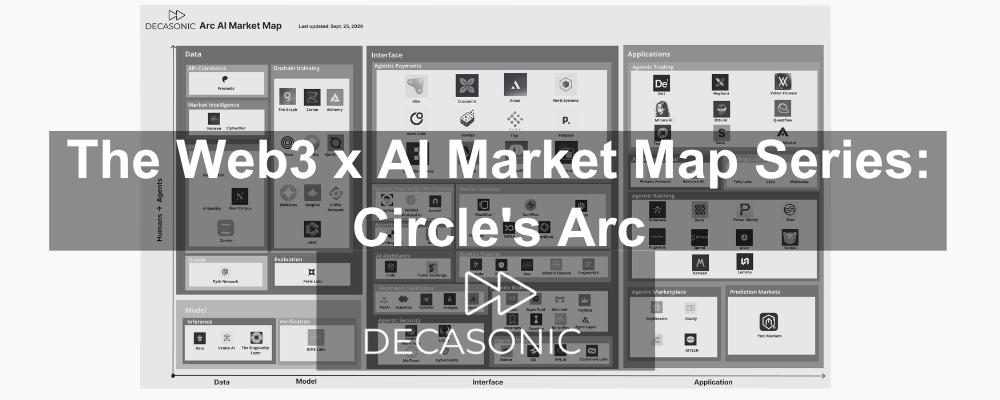
we mapped out over 100+ projects (104 to be precise) building the @arc AI ecosystem. Arc's AI ecosystem is differentiated primarily due to the (1) nature of the Circle <> USDC relationship, and (2) the verticalized product suite developed by the Circle <> Arc teams across the supply and demand side of the agentic economy.
what is clear to us is that the AI ecosystem for @arc is differentiated due to the focus on Agentic Liquidity; extending the subsequent use-cases into Agentic Finance, Agentic Payments, and Agentic Trading.
if you are building - reach out to me and the @decasonic team.


Decasonic retweeted
At @decasonic, for the past month, we’ve been exploring what comes after AI systems scale to the mainstream... On this horizon, multiplayer AI interfaces that bring people and agents into shared workflows and improve through reinforcement learning.
Most AI today is still single-player: one person, one model, and one chat session at a time. Increasingly, we're seeing that chat interface disappear into native iMessage interfaces presented by Muse and other personal AI agents. When the session ends, much of the learning generated through that interaction disappears with it. If there were improvements, they weren't shared across the firm, transparently to compound the expertise.
My colleague @abdulalali has been trailblazing the frontier of these RL interfaces, anticipating what's next for consumer AI and personal assistants.
What we've been cooking: AI interfaces live where decisions already happen across chat, calendars, meetings, notifications, ranked feeds, voice, and generative UI. When upgraded, these interfaces can learn from explicit signals such as approvals, corrections, reactions, rankings, and preference changes. They can also learn from implicit signals such as accepted suggestions, dismissed notifications, completed actions, meeting outcomes, and changes in workflows.
But reinforcement isn’t universal. It depends on context. A dismissed notification could mean “wrong answer,” “wrong time,” “wrong device,” or simply “not now.” An edited response could signal a factual correction, a stylistic preference, or a change in the user’s objective.
The interface isn’t just how we access AI. It is part of the learning system. That requires a strong control plane with clear permissions, approval boundaries, confidence indicators, history, corrections, and an RL ledger. People should be able to see what the system has learned and have the power to change it.
Our work started with single-player AI through a CLI. The next step is bringing reinforcement learning into multiplayer AI interfaces embedded natively across shared workflows.
When many people contribute feedback, corrections, decisions, and outcomes, the learning loop becomes broader and faster. Each interaction can improve the system. Each workflow can generate reinforcement. Each human can contribute to shared expertise, shared intelligence across the entire firm.
That’s how intelligence begins to compound across the AI-Native firm.
The future of the AI Native firm is a network of multiplayer AI interfaces, upgraded through reinforcement learning, that transforms everyday work into a collaborative learning system.
Decasonic retweeted
what's truly impressive to see about @Muse is the level of trust. you are able to see the tool calls, the interactions initiated by the agent, and a live view of the browser session when in usage. a live view of what the agent is initiating step by step.
great demonstration of generative UI to accelerate adoption and win customer trust.
Decasonic retweeted

Arc mainnet going live feels like a real tipping point for agentic finance.
Most “financial agents” have still been operating inside human financial infrastructure. Give an agent access to an account, allocate capital, set guardrails and let it execute.
Arc appears to be pushing toward a different model: financial infra built with machines and humans
An agent can have a policy-controlled wallet, make usdc payments, discover and pay for services. Arc Studio even pushes the builder side toward agents being able to create applications.
More importantly, there is an actual financial system underneath it. StableFX brings 24/7 FX (localized payments) BUIDL, USYC, and other tokenized assets create productive collateral. Aave + morpho + uni create open credit and liquidity layers. Agents are not limited to taking actions inside one application they can increasingly interact with a fully composable market.
The institutional layer makes this especially interesting. DTCC, Visa, blackrock and others participating as founding network operators is a very different starting point from launching another retail L1 and hoping institutional liquidity eventually arrives.
What we are also seeing is that the endpoint may not just be software agents. The next step would be physical machines autonomously negotiating and settling payments on Arc without a human in the loop.
Obviously there is still a gap between “Can I” and “Would I”. But the pieces are starting to come together.
We @decasonic are actively evaluating the Arc ecosystem and where value ultimately accrues as this market develops.

Arc Mainnet is live.
Arc launches as the Economic OS for the internet: an open platform for global markets, real-time value movement, tokenized assets, and agentic economic activity.
Arc is more than a blockchain.
It launches as a full-stack financial platform with assets, applications, interoperability, developer infrastructure, and Circle platform services live from day one.
Arc delivers USDC as native gas, deterministic sub-second finality, EVM compatibility, and institutional validators.
It integrates with Arc Studio, App Kits, Arc Portal, Circle Agent Stack, CCTP, Gateway, CPN, and StableFX.
A complete economic platform at genesis.
Arc launches with infrastructure for:
→ Agentic economic workflows
→ Lending and borrowing
→ Trading and liquidity
→ Onchain FX
→ Payments and settlement
→ Tokenized assets
→ Exchanges, wallets, custody, compliance, data, and developer tooling
190+ institutional and ecosystem builders are building across Arc.


Decasonic retweeted
Interesting points here. Canton has been capturing the TradFi side of onchain finance for a while, and the institutional pull seems to keep getting stronger.
The part I find most interesting is what comes after more assets actually move onchain.
If an asset manager can hold billions of dollars of treasuries onchain, the opportunity starts to expand into how that capital gets traded, financed, used as collateral and moved around an always on 24/7 market.
That is also why we’ve increasingly started calling this category fintech at @decasonic . The line between crypto infrastructure and financial infrastructure has blurred pretty heavily. You have the same institutions, assets and capital markets activity, just moving onto new rails with different capabilities.
@CantonNetwork feels particularly well positioned here because privacy is still (and will always be) a real requirement for institutions, while composability is what makes these assets more useful and actionable over time.
Robinhood is interesting from the other side. Retail is already sitting at the frontier of adoption, experimenting with what tokenized equities can actually do once they are onchain. I expect institutions to catch up to a lot of those use cases as more assets and liquidity move over.

Takeaways from Canton Summit NYC:
- tons of suits everywhere, feels like the mix was 65% finance 35% DeFi
- privacy privacy privacy
- canton founders are chads, both Eric & Yuval are well spoken and resonate well with institutions
- epic venue in FiDi
- most asset managers are all very bullish composability with tokenized assets
- vault companies are struggling to raise series B rounds b/c of little revenue
- stablecoins are such an obvious snowball trend that they almost aren’t talked about as much as you’d think with TradFi
- trillions are coming onchain
- 24/7 trading is clearly the focus of the finance industry to solve urgently
- canton pulls an insane crowd
- some asset mngrs want to be able to buy a yard of T-bills onchain by 2028
Overall extremely positive on the convergence of finance and digital assets.