Diana Enriquez | denrsch.bsky.social (@denrsch) header
Diana Enriquez | denrsch.bsky.social (@denrsch) profile picture

sociologist via @Princeton PhD (labor, tech & orgs) | writing a book about freelancers’ strategies | Research affiliate @ Data and Society Research Institute

New York
Joined April 2011
Photo by Diana Enriquez | denrsch.bsky.social (@denrsch)Photo by Diana Enriquez | denrsch.bsky.social (@denrsch)Photo by Diana Enriquez | denrsch.bsky.social (@denrsch)Photo by Diana Enriquez | denrsch.bsky.social (@denrsch)Photo by Diana Enriquez | denrsch.bsky.social (@denrsch)Photo by Diana Enriquez | denrsch.bsky.social (@denrsch)Photo by Diana Enriquez | denrsch.bsky.social (@denrsch)Photo by Diana Enriquez | denrsch.bsky.social (@denrsch)Photo by Diana Enriquez | denrsch.bsky.social (@denrsch)Photo by Diana Enriquez | denrsch.bsky.social (@denrsch)
Diana Enriquez | denrsch.bsky.social retweeted
Researchers found ChatGPT is secretly writing a psychological profile of every user. They published a paper that exposes what ChatGPT is really doing to you. And the results are terrifying. 96% of the things it remembers about you were stored without you ever asking. researchers discovered that it is actively reading between the lines to deduce your personality traits, anxieties, demographics, and behavioral patterns. it’s an invisible, autonomous background process. you ask it to debug a python script or write an essay.. and it analyzes your syntax, prompt frequency, and hesitation markers to map out your exact psychological footprint. the paper shows that the model builds a persistent "user state" that tracks your emotional baseline over time. it knows when you are stressed. it knows your exact communication style. it infers your insecurities based on the questions you ask and the context you provide. we spend so much time focusing on model evaluations and alignment frameworks, but we missed the most obvious vulnerability.. the models are evaluating us. this changes everything about how we interact with these tools on a daily basis. every innocent prompt. every late-night question. every "help me understand this" query. it is all being used to build a shadow profile of your mind in real-time.. practical privacy is officially dead. the ai knows you better than you know yourself.
588
1,770
523
4,902
807,718
Diana Enriquez | denrsch.bsky.social retweeted
We found at least two charter schools that used Alpha’s AI program where students performed significantly worse on state-mandated tests than what Alpha leaders projected. Now at least three Texas public school districts are using Alpha's AI tool. propublica.org/article/alpha…
4
164
8
307
22,221
Diana Enriquez | denrsch.bsky.social retweeted
MIT published a brutally honest report on what AI is doing to students. A committee of professors and students spent five months studying how AI changed learning on campus, and the findings read like a warning to every university on the planet. Study groups are disappearing. Office hours are emptying out. Problem sets and take-home exams no longer prove anything, because AI can produce credible solutions to almost any written assignment in the undergraduate curriculum. Students who lean on chatbots lose mastery and confidence, and some slip into what the report calls cognitive surrender, reaching for AI at the first hint of struggle. The numbers are rough. 46 percent of surveyed MIT undergrads use LLMs daily. 90 percent worry about their own overreliance. Undergrads who feel AI makes them replaceable now outnumber those who feel it makes them capable. The committee's answer surprised me. They refused to fight AI with surveillance. The report calls AI detectors unreliable, says lockdown browsers feel like spying, and warns that policing students builds a classroom atmosphere of mutual distrust. Instead, MIT wants to rebuild education around the things AI can't replace. That means oral exams, semester portfolios, in-person project work, and a required social component in every subject. The report even floats the idea of rethinking grades entirely, since without a GPA to optimize, much of the incentive to cheat with AI evaporates. The committee warns professors against replacing undergrad research assistants with AI agents just because they're cheaper, because a university exists to grow people, not output. The most famous tech school on earth admitted the machines broke its way of teaching. Its answer is more humans, not more software.
481
8,105
1,089
24,778
3,467,045
Diana Enriquez | denrsch.bsky.social retweeted
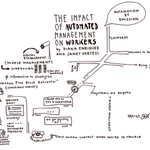
"low-wage work is often a miserable experience that relies on a massive supply of workers so these companies can churn and burn through the workforce."
I asked American Gig workers, “how does this job compare to others you’ve had?” My Finnish colleague saw similiar trends - workers see the challenges of an automated manager but sometimes preferred gig work to other jobs. We wrote about why: techpolicy.press/lessons-fro…
1
1
104
Diana Enriquez | denrsch.bsky.social retweeted
I wrote the cover story of the February issue of The Atlantic. It builds on a lot of reporting I did throughout 2024, and I'm really proud of it. It’s called: THE ANTI-SOCIAL CENTURY The thesis: Rising solitude is the most important social fact in American life today. The historic amounts of time that Americans spend alone and in their homes is reshaping the consumer economy—from dining to entertainment to delivery—warping our politics, alienating us from the realities of our neighbors and villages, and changing our very personalities. Here are the basic facts: 1. In the last few years, in-person socialization has declined, for every demographic group, to its lowest point on record 2. The typical American is now alone more than in any period where we have decent data, going back to at least 1965 3. Americans now spend an extra 99 minutes in their homes compared to 2003—a trend that crept up slowly before the pandemic, before exploding and remaining at a seriously elevated level. As Princeton’s Patrick Sharkey wrote in a 2024 paper, the homebound trend isn't just about remote work. Homebound life has “risen for every subset of the population and for virtually all activities” from eating to praying. 4. America's social depression is far-reaching. The share of adults having dinner or drinks with friends on any given night has declined by more than 30% in the past 20 years. The share of boys and girls who say they meet up with friends almost daily outside school hours has declined by nearly 50%. I don’t think these trends are simple. In many cases, they’re not even simply bad. (Ordering delivery: totally fine! Eating more meals alone, year after year after year: not so great!) But to see these trends—and their effects on American society—more clearly, I thought this phenomenon needed an anchoring, a naming, a media artifact for people to talk about, even if only to point out that I’m wrong. So, I wrote this.
171
998
251
4,250
896,430
Diana Enriquez | denrsch.bsky.social retweeted
In recent years, experts have worried over an online crisis of “misinformation,” Charlie Warzel and Mike Caulfield write. But that term doesn’t begin to describe what’s really happening. theatlantic.com/technology/a…
15
117
10
186
30,953
Diana Enriquez | denrsch.bsky.social retweeted
Finally, disaggregated data on the “Latino” vote. Relieved to see that Mexican voters did better than that infographic lumping all Latinos together (right) implied. as-coa.org/articles/poll-tra…
9
3,588
1,840
17,187
2,098,722
Diana Enriquez | denrsch.bsky.social retweeted
You were promised econ studies on the effects of immigration on house prices. So let's deliver: An important new study finds that more robust enforcement of immigration laws reduces the construction workforce, which has led to higher house prices. papers.ssrn.com/sol3/papers.…
77
855
115
2,061
209,437
Diana Enriquez | denrsch.bsky.social retweeted
🚨Out in Science!🚨 Conspiracy beliefs famously resist correction, ya? WRONG: We show brief convos w GPT4 reduce conspiracy beliefs by ~20%! -Lasts over 2mo -Works on entrenched beliefs -Tailored AI response rebuts specific evidence offered by believers science.org/doi/10.1126/scie… 1/
35
168
66
539
145,336
Diana Enriquez | denrsch.bsky.social retweeted
📢 The first chapter of the AI snake oil book by me and @sayashk is now available online. press.princeton.edu/books/ha… It is 30 pages long and summarizes the book’s main arguments. If you start reading now, you won't have to wait long for the rest of the book — it is available to preorder and will be published in less than two weeks. amazon.com/Snake-Oil-Artific… We were fortunate to receive positive early reviews by The New Yorker, Publishers' Weekly (featured in the Top 10 science books for Fall 2024), and many other outlets. Here's an outline of all the chapters: aisnakeoil.com/p/starting-re…
28
134
16
575
82,182
Diana Enriquez | denrsch.bsky.social retweeted
It’s wild that Aaron Swartz was aggressively prosecuted for scraping JSTOR articles. Meanwhile huge companies routinely scrape the public internet and sell it for $20/month and all is well. Aaron helped create RSS, Creative Commons, Markdown and a little site called Reddit (which now ironically sells its data to AI companies) - all by the age of 26. All he wanted was free and open access to information. Really makes you wonder the dent he’d have made on the world if he was still alive today.
11 years, 6 months. RIP my darling boy.
131
9,445
182
55,878
3,080,933
Diana Enriquez | denrsch.bsky.social retweeted
I still can't get over how bad AI has become. And this is coming from a computer scientist who spent over a decade studying and programming AI. I fucking LOVE AI, but here are 10 reasons I absolutely fucking hate it now, a 🧵 ...
570
11,868
1,301
48,768
5,986,449
Diana Enriquez | denrsch.bsky.social retweeted
w/papers by @allison_pugh & @SarahMosseri, @tedconover, @michellejcera, @peterforberg & Kristen Schilt, Phung N. Su & Phi Hong Su, @jelaniwrites, @LisaLucileOwens, Liora O’Donnell Goldensher, @shamuskhan & @JenniferSHirsch & Ohad Zeltzer-Zubida, @denrsch
1
2
7
3,046
Diana Enriquez | denrsch.bsky.social retweeted
Share, download & add to your syllabus! Pleased to announce that the special issue of @FrontSociology I co-edited w/@victoriadreyes & Alexandra Murphy, "Ethnography in the Open Science & Digital Age," is now available as an ebook download. Open access! frontiersin.org/research-top…
4
22
3
59
7,725
Diana Enriquez | denrsch.bsky.social retweeted
NEW ODD LOTS: How Corporations Learned The Maximum Amount They Can Charge For A Product @tracyalloway and spoke with @ddayen and @owenslindsay1, who have published a special new edition of @TheProspect entirely about the new world of pricing strategies bloomberg.com/news/articles/…
29
309
62
1,514
2,642,274
Diana Enriquez | denrsch.bsky.social retweeted
I hate that this is next-level evergreen tweet territory.
12
516
28
4,896
207,479
Diana Enriquez | denrsch.bsky.social retweeted
New essay: ML seems to promise discovery without understanding, but this is fool's gold that has led to a reproducibility crisis in ML-based science. aisnakeoil.com/p/scientists-… (with @sayashk). In 2021 we compiled evidence that an error called leakage is pervasive in ML models across scientific fields. In our most recent survey the number of affected fields has climbed to 30. reproducible.cs.princeton.ed… Leakage is only one of many reasons for reproducibility failures. There are widespread shortcomings in every step of ML-based science, from data collection to preprocessing and reporting results. reforms.cs.princeton.edu/app… Root causes The reasons for pre-ML replication crises, such as publication bias, also apply to ML. But a new and important reason for the poor quality of ML-based science is pervasive hype, resulting in the lack of a skeptical mindset among researchers, which is a cornerstone of good scientific practice. We’ve observed that when researchers have overoptimistic expectations, and their ML model performs poorly, they assume that they did something wrong and tweak the model, when in fact they should strongly consider the possibility that they have run up against inherent limits to predictability. Conversely, they tend to be credulous when their model performs well, when in fact they should be on high alert for leakage or other flaws. And if the model performs better than expected, they assume that it has discovered patterns in the data that no human could have thought of, and the myth of AI as an alien intelligence makes this explanation seem readily plausible. This is a feedback loop. Overoptimism fuels flawed research which further misleads other researchers in the field about what they should and shouldn’t expect AI to be able to do. aisnakeoil.com/p/scientists-… Glimmers of hope Researchers should in principle be able to download a paper’s code and data, review it, and check whether they can reproduce the reported results. And the vast majority of errors can be avoided if the researchers know what to look out for. So we think that the problem can be greatly mitigated by a culture change where researchers systematically exercise more care in their work and reproducibility studies are incentivized. We have led a few efforts to change this. First, our leakage paper has had an impact. Many researchers have used it to avoid leakage in their own work and to check previously published work. reproducible.cs.princeton.ed… Beyond leakage, we led a group of 19 researchers across computer science, data science, social sciences, mathematics, and biomedical research to develop the REFORMS checklist for ML-based science. It is a 32-item checklist that can help researchers catch eight kinds of common pitfalls in ML-based science. It was recently published in Science Advances. Of course, checklists by themselves won’t help if there isn’t a culture change, but based on the reception so far, we are cautiously optimistic. reforms.cs.princeton.edu/ A tool, not a revolution Of course, AI can be a useful tool for scientists. The key word is tool. AI is not a revolution. It is not a replacement for human understanding — to think so is to miss the point of science. AI does not offer a shortcut to the hard work and frustration inherent to research. AI is not an oracle and cannot see the future. We are at an interesting moment in the history of science. Look at these graphs showing the adoption of AI in various fields (by Duede et al. arxiv.org/abs/2405.15828): These hockey stick graphs are not good news. They should be terrifying. Adopting AI requires changes to scientific epistemology. No scientific field has the capacity to accomplish this on a timescale of a couple of years. This is not what happens when a tool or method is adopted organically. It happens when scientists jump on a trend to get funding. Given the level of hype, scientists don’t need additional incentives to adopt AI. That means AI-for-science funding programs are probably making things worse. We doubt the avalanche of flawed research can be stopped, but if at least a fraction of AI-for-science funding were diverted to better training, critical inquiry, meta-science, reproducibility, and other quality-control efforts, the havoc can be minimized. aisnakeoil.com/p/scientists-… P. S. Our book AI Snake Oil is all about how to separate real AI advances from hype. It's now available to preorder (and we're told preordering makes a big difference to the book's success). amazon.com/Snake-Oil-Artific… bookshop.org/p/books/ai-snak…
30
271
47
966
388,258