

Own Your Perspective! Pakistan & regional geopolitics, current affairs, economy & history. Interviews, roundtables, research & opinion.
Joined October 2023
- Tweets2.6K
- Following1
- Followers12.1K
- Likes1.2K



Pinned Tweet
From university campuses to international discussions, in just one year, what began as a vision to challenge perspectives has grown into something bigger. Follow, share, engage, and be part of the team @digdebate .
1
4
230
Should Khyber Pakhtunkhwa come under Governor’s Rule, or would it put democracy at risk?
We put this question to students and asked them whether Governor’s Rule is the right solution for KP’s political and governance challenges.
3
133
Karachi recorded around 51,000 criminal incidents between January and October 2026, ranging from murders and kidnappings to robberies, vehicle theft and other offences.
With Karachi’s growing security and governance challenges, these statistics raise a key question: Is the existing administrative system equipped to effectively manage a megacity of Karachi’s scale?

1
44
The proposed Antalya Pact failed after the EU and other delegations rejected a text omitting reference to fossil fuels. Pakistan urged further efforts towards agreement; Ghana, representing the African Group, acknowledged weaknesses but said it would not block consensus.


1
2
58
The failure did not overturn the Paris Agreement or erase every outcome.
digdebate.com/cop31-outcomes…

1
17
The questions are coming from within India itself.
As voices from within challenge the official narrative, questions of Indian Air Force readiness, transparency, and accountability are becoming harder to ignore.
Can local elections address Islamabad’s governance challenges?
How does the debate over decentralisation and the creation of new administrative units fit into Pakistan’s broader political and administrative future?
DD is back with another Table Talk, bringing these critical questions of governance and administrative reform to the discussion.

“I think all our relationships will improve,” @Team_Musadik remarked on Pakistan-India relations during the First Shanghai Cooperation Organisation (SCO) Civilisational Dialogue Forum in New Delhi.


The visit demonstrated willingness to participate in a regional forum despite difficult bilateral relations.
digdebate.com/pakistan-sco-d…

1
56
"What is more urgent for Islamabad, therefore, is to build wider institutional contacts with Congress and US officials, not only with the White House," argues @meem_aen_kay
Trump has lost Congress. But he remains president. Democrats can challenge his policies, but they cannot replace his executive authority.


Read in detail:
digdebate.com/congress-chang…

2
48
Iranian Foreign Minister Abbas Araghchi’s statement that the Islamabad Memorandum is “no longer on the table” marks a significant change in Tehran’s negotiating position.

1
132
Pakistan has the mineral wealth the world needs. But can it turn this opportunity into prosperity?
From copper and lithium to rare earth minerals, global demand is rising. With major reserves in Chagai and Reko Diq, Pakistan has enormous potential.
@SaleemFarrukh


What’s driving rising tensions in the Middle East, and where does Pakistan stand?
Dr. Ishtiaq Ahmed, an International Relations Expert, explores Saudi Arabia’s security concerns, regional dynamics, and the geopolitical interests shaping the future of the Muslim world.
@ahmadishtiaq @M_EssJay
Pakistan has a real case for looking at new provinces. Long distances to government offices, unequal access to services and regional exclusion all need answers.
A referendum can show what people want, but only if it is run fairly. Supporters and opponents should both be able to argue their case with evidence.


1
3
56

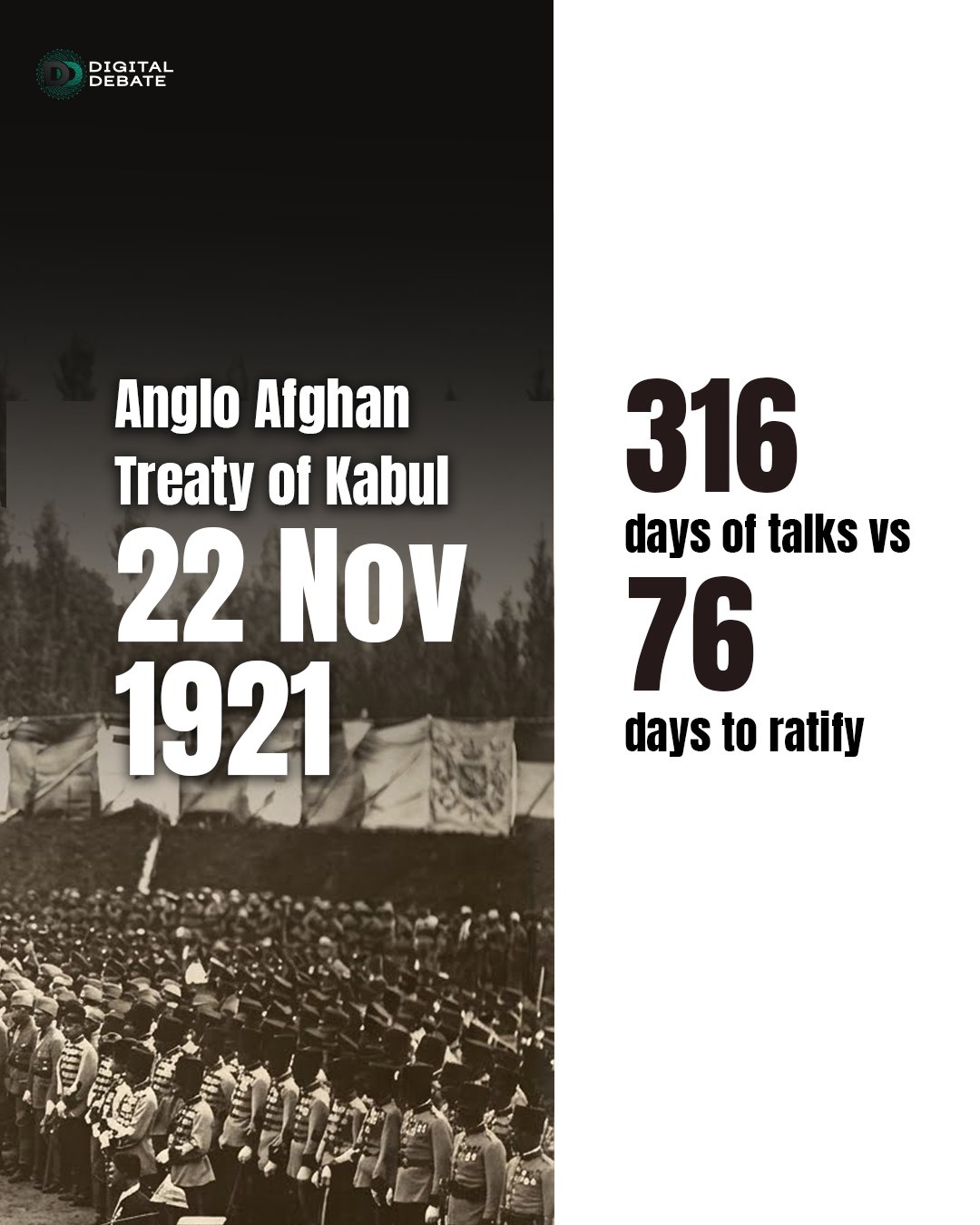
On 22 November 1921, Afghanistan and Britain signed the Anglo-Afghan Treaty of Kabul. Independence had already come with the Treaty of Rawalpindi on 8 August 1919, so the Kabul treaty settled the terms of the relationship that followed. Its dates and numbers show how long that took.
Afghanistan lost its arms import right at Rawalpindi on 8 August 1919 and got it back, with conditions, on 22 November 1921, after more than 27 months. The Kabul talks ran 316 days, from 10 January to 22 November 1921.
The first stage lasted 79 days, from 20 January, and Afghanistan spent it demanding territory and 43.6 million rupees. The last 65 days, from 18 September, included two moments when the British mission prepared to leave.
The final document was short: 14 articles and 2 schedules. Its bargains were small and exact. Britain got 2 consulates, at Kandahar and Jalalabad, while Afghanistan got 4 posts in India, a Consul General plus consulates at Calcutta, Karachi and Bombay. Afghan trade agents were allowed in 3 cities, and goods could be repacked at 3 railheads. One clause supplied water to a single place, Tor Kham, by pipe.
The treaty was designed as a short arrangement. Article XIV gave it 3 years and then continued it until 12 months after either side gave notice. The two sides had only 2.5 months to exchange ratified copies, and they used 76 days of that window, so the exchange on 6 February 1922 came almost at the deadline.
Then the treaty outlived its design by a wide margin. Encyclopaedia Iranica says it stayed in force until 1947, about 26 years. Afghanistan told the UN it gave notice on 21 November 1953, one day short of 32 years after signing. Either way, an arrangement meant to last 3 years survived roughly nine to eleven times longer
Britain got 2 consulates and Afghanistan got 4 posts in India. Who do you think got the better deal? Tell us in the comments.

3
49
Is Russia's Taliban outreach really just diplomacy?
Moscow is recognizing and engaging Kabul, but the real drivers may lie elsewhere.
Afghan affairs expert Hassan Khan unpacks it on Digital Debate, watch the full podcast now on YT.
@FidaAdeel1 @hasankhyber


1
2
45
