

Son of an Ulsterman, born and raised in Nova Scotia, now living in Western PA. Pastor of Nashua OPC 🇨🇦🇬🇧🇺🇸
Joined August 2020
- Tweets491
- Following98
- Followers541
- Likes898





Pinned Tweet
ICYMI: article on Covenant Theology
What Does Same in Substance but Different in Administration Mean?
"Understanding the proper meaning of the Reformed formula helps us to see that the modern notion of what is now called “administrative republication” is incoherent"
Link below
The Marrow controversy is often caricatured as good guys vs bad guys with Hadow being the leader of the bad guys, theologically speaking.
However, James Buchanan writes:
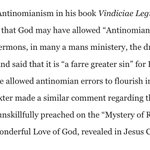
"We are not warranted, indeed, to say that Principal Hadow, and those who concurred with him in
Did The Marrow contain certain Antinomian errors?
James Buchanan:
"...we shall only say, that a book which is held even by its admirers to require explanatory or apologetic notes, may be fairly presumed to contain some unguarded expressions, which might be understood in
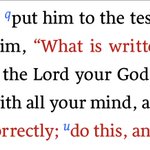
Although Ball is willing to use the phrase "Do this and live" in reference to the CW, he doesn't engage in eisegesis and read the CW into texts where it doesn't belong.
Ball has long been one of my favorites.
See the link below for an short article on Do This and Live:

𝐉𝐨𝐡𝐧 𝐁𝐚𝐥𝐥 𝐨𝐧 𝐰𝐡𝐲 “𝐃𝐨 𝐭𝐡𝐢𝐬 𝐚𝐧𝐝 𝐥𝐢𝐯𝐞” 𝐚𝐧𝐝 “𝐓𝐡𝐞 𝐝𝐨𝐞𝐫𝐬 𝐨𝐟 𝐭𝐡𝐞 𝐋𝐚𝐰 𝐚𝐫𝐞 𝐣𝐮𝐬𝐭𝐢𝐟𝐢𝐞𝐝” 𝐚𝐫𝐞 𝐭𝐨 𝐛𝐞 𝐫𝐞𝐚𝐝 𝐚𝐬 𝐆𝐨𝐬𝐩𝐞𝐥, 𝐧𝐨𝐭 𝐋𝐚𝐰
Below I will post the full excerpt which may be found from his influential magnum opus “A Treatise of the Covenant of Grace” (forthcoming print by @BerithPress), which shaped the distinct, Westminsterian covenant theology. Some key takeaways (full text attached below):
- The Mosaic Covenant being gracious, unlike the covenant of works, admits and allows of imperfect, sincere obedience. As such ‘Do this and live’ is an evangelical principle for the covenanted Israel, not legal — “We may soundly gather, that the Law as it was given to Israel, doth admit and allow of sincere and unpartiall obedience, though it be imperfect and answer not to that exactnesse which is required. These words, ‘Doe this and live,’ must not be interpreted, as if they did promise life upon a condition of perfect obedience, and for works done in such exactnesse as is required: but they must be expounded Evangelically”
- The same applies to the writing of St. Paul. The doers of the Law being justified is not preaching of Law strictly, but of the Gospel such that we can and must do it — “And in like manner that of the Apostle, ‘The doers of the Law are justified,’ may be expounded Evangelically, not of them that fulfill the Law, which should be justified by their works, but of them that soundly obey, who are justified of grace by faith, not for their works”
- Those covenanted in the covenant of grace have a moderated standard since God deals with them not strictly but paternally — “to them that be in Covenant the Law was given with such moderation, that sincere obedience was accepted of them, though attended with many imperfections, as is cleare by that of the Psalmist”
- Israel themselves when covenanting with God did not understand themselves to be agreeing to exactly and strictly fulfill the law (for this is impossible and would be a non-starter) — “And when [Israel] promised, and bound themselves by Oath to walk in all the Statutes, Judgements, and Ordinances of the Lord, or of the Law of Moses, they did neither pervert the sense of the Law, nor promise punctually to fulfill the Law in every jot and title. Therefore they understood the tenour of the Law as it was given unto them, to admit of upright, unfained and true obedience, the imperfection that cleaveth unto their best works being graciously
pardoned.”


"we cannot be saved from sin while we still desire and intend to continue to sin. If we are to escape God's wrath and curse, we must turn from our sins to God."
J.G. Vos
Kline:
"The works principle in the Mosaic order was confined to the typological sphere...Even individuals who were elect in terms of eternal salvation would be cut off from that temporal, typological realm as the penalty for various serious infractions of the law."

By contrast, according to Klinean "republication," the law's principle of works applied to all Israel, regenerate and unregenerate alike.
Hence, it can't be republication of the covenant of works. It must be something else.
191
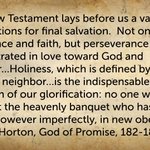
"But a justified Christian who is assured of his salvation in Christ Jesus ought also to have a healthy fear of the warnings against apostasy and thus final damnation."
From the 3rd article I wrote for MTP back in the day: Sanctification by Faith in the Threatenings
Link below:
1
11
466

Tip of the day:
Don't rip Scripture out of context so that you can use it to put believers under the covenant of works.
6
269
“they [believers] are also confident that their acts of obedience, although they are immature and still not perfect, do not displease their benevolent Father, but are acceptable to him in his love.”
-Synopsis Purioris
12
415
So, apparently you shouldn't "expand" the term "antinomianism." That is a sign of nomism.
But what is it a sign of if you expand the term "neonomianism," which you must do to pin that label on people like Piper?
1
29
803
If you want to know what Neonomianism is historically, then see here:
placefortruth.org/neonomiani…
1
2
243
By contrast, according to Klinean "republication," the law's principle of works applied to all Israel, regenerate and unregenerate alike.
Hence, it can't be republication of the covenant of works. It must be something else.

True.
And Klinean republication isn’t a form of republication for the simple reason that it doesn’t republish the covenant of works.
1
9
615
Interesting observation from Francis Beattie:

What is the relationship between faith and repentance according to the Westminster Standards?
Here is something to consider:
1. Faith and repentance are both defined as a saving grace wrought in the heart of a sinner by the Holy Spirit and the word of God.
2
7
461


Matt Bustin is a great guy, and his pumpkin carvings are fantastic!

Pumpkin carving artist honours Dolly Parton with Jack-o’-lantern portrait ctvnews.ca/atlantic/nova-sco…

201