*Lecturer. SR, Internal Medicine/Gastroenterologist & Hepatologist in Training⭐ Advance Endoscopy. Real Madrid Fan. Human Nutrition Enthusiast*
Nigeria
Joined January 2022
- Tweets11.6K
- Following600
- Followers712
- Likes17.1K






McMichelle Donbraye, MD. 💥 retweeted

The November 2026 ADS type 2 diabetes algorithm: individualise HbA1c, start metformin when suitable, review at 3 months, and let cardiovascular and kidney risk guide add-on therapy.

McMichelle Donbraye, MD. 💥 retweeted

This infographic summarizes the use of intravenous (IV) magnesium sulfate (MgSO₄) in the adult emergency department (ED), citing a narrative review (Am J Emerg Med. 2027;111:191–198).
instagram.com/p/DgQMUMrTse3/…


McMichelle Donbraye, MD. 💥 retweeted

APLAR Consensus Statements for the Management of Reproductive Issues in Autoimmune Diseases
⏩remission/low activity, ⏩preconception medication review
⏩Avoid teratogens (MTX/MMF/LEF/CYC)
⏩APS/anti-Ro monitoring ⏩breastfeeding-safe treatment
onlinelibrary.wiley.com/doi/…


McMichelle Donbraye, MD. 💥 retweeted

CARDIAC RESUSCITATION 2025 | AHA & ERC GUIDELINES
What does effective resuscitation look like across all age groups?
This 16-page clinical reference series brings together the latest 2025 AHA and ERC recommendations, covering:
◽ Adult BLS and Advanced Life Support
◽ CPR quality and defibrillation
◽VF, pulseless VT, PEA and asystole
◽ Resuscitation medications and the Hs & Ts
◽ Special circumstances of cardiac arrest
◾ Post-cardiac arrest care and ROSC
◾ Paediatric BLS and Advanced Life Support
◾ Neonatal resuscitation
◾ Resuscitation ethics and quality improvement
Includes clinical algorithms, medication doses, defibrillation energies, treatment pathways and important differences between AHA and ERC recommendations.
16 pages. Three age groups. One comprehensive resuscitation reference.
Based on the 2025 AHA CPR & ECC and ERC Resuscitation Guidelines.
#CardiacArrest #Resuscitation #ACLS #PALS #BLS
McMichelle Donbraye, MD. 💥 retweeted
ATRIAL FIBRILLATION | 2024 ESC GUIDELINES
A comprehensive 14-slide clinical reference on the diagnosis and management of atrial fibrillation.
From ECG diagnosis and CHA₂DS₂-VA stroke risk assessment to anticoagulation, rate and rhythm control, cardioversion, catheter ablation and long-term follow-up.
Featuring key recommendations, drug doses, clinical thresholds and practical management algorithms.
Based on the 2024 ESC Guidelines for the Management of Atrial Fibrillation.
📚 14 pages of practical cardiology knowledge in one post.
#AtrialFibrillation #Cardiology #ESC2024


McMichelle Donbraye, MD. 💥 retweeted
ANSWER: WELLENS SYNDROME
The ECG illustrates the two characteristic patterns of Wellens syndrome:
Type A (Pattern A):
- Biphasic T waves in V2–V3.
- Accounts for approximately 25% of cases.
Type B (Pattern B):
- Deep, symmetrical T-wave inversions in V2-V3.
- Accounts for approximately 75% of cases.
Clinical significance
Wellens syndrome is associated with critical proximal LAD stenosis and a high risk of extensive anterior myocardial infarction.
Typical clinical features:
- Recent episodes of angina.
- ECG abnormalities often become evident when the patient is pain-free.
- Cardiac biomarkers may be normal or minimally elevated.
Management
- Urgent cardiology assessment.
- Early invasive coronary angiography.
- Avoid exercise or pharmacological stress testing because of the risk of precipitating myocardial infarction.


Examine the #ECG patterns shown.
What is the most likely diagnosis, and which coronary artery is classically implicated?

McMichelle Donbraye, MD. 💥 retweeted
ATRIAL FIBRILLATION: THE 2024 ESC GUIDELINES | 14-SLIDE CLINICAL REFERENCE
How should we approach atrial fibrillation beyond simply controlling the heart rate?
This 14-slide educational series summarizes the 2024 ESC Guidelines for the management of atrial fibrillation, covering:
1. Diagnosis, classification & initial evaluation
2. AF-CARE framework and risk-factor management
3. Screening and ECG confirmation
4. Stroke prevention: CHA₂DS₂-VA
5. DOACs vs VKAs: doses and safety
6. Bleeding risk and left atrial appendage occlusion
7. Rate control: drug selection according to LVEF
8. Rhythm control and electrical cardioversion
9. Antiarrhythmic drugs and monitoring
10. Catheter ablation and advanced interventions
11. AF in heart failure and coronary artery disease
12. Special clinical populations
13. Follow-up and dynamic reassessment
14. Integrated clinical algorithms and key recommendations
A key message from the 2024 ESC Guidelines:
AF management should follow the AF-CARE pathway:
C – Comorbidity and risk factor management
A – Avoid stroke and thromboembolism
R – Reduce symptoms through rate and rhythm control
E – Evaluation and dynamic reassessment
#AtrialFibrillation #Cardiology #ESC
McMichelle Donbraye, MD. 💥 retweeted
Answer: A. Acute pulmonary embolism
McConnell's sign is an echocardiographic finding classically associated with acute pulmonary embolism (PE).
Characteristic findings:
- Regional akinesia or hypokinesia of the mid-RV free wall.
- Preserved or hyperdynamic RV apical contraction.
- Often associated with acute RV pressure overload.
Pathophysiology:
Acute pulmonary arterial obstruction increases pulmonary vascular resistance, causing sudden RV pressure overload and regional RV dysfunction.
Clinical significance:
◽Suggests acute RV strain in the appropriate clinical context.
◾May support the diagnosis of acute PE.
◽Is not sufficiently sensitive or specific to diagnose PE independently.
◾Can also occur in RV myocardial infarction.


McMichelle Donbraye, MD. 💥 retweeted
ACUTE ISCHEMIC STROKE: THE 2026 AHA/ASA GUIDELINE
A practical 12-slide clinical reference covering the early management of acute ischemic stroke.
From emergency assessment and neuroimaging to thrombolysis, mechanical thrombectomy, antithrombotic therapy, complications and pediatric stroke.
📚 Key recommendations, treatment thresholds, drug doses and clinical decision points.
Based on the 2026 AHA/ASA Guideline.
#Stroke #Neurology #AHA


McMichelle Donbraye, MD. 💥 retweeted
🚨 2026 AHA/ASA GUIDELINE: ACUTE ISCHEMIC STROKE
What should every clinician know about the early management of acute ischemic stroke?
I've prepared a 12-page clinical reference series covering:
1️⃣ Initial assessment & NIHSS
2️⃣ CT, CTA, CTP & MRI
3️⃣ IV thrombolysis: Tenecteplase vs Alteplase
4️⃣ Endovascular thrombectomy (EVT)
5️⃣ Antiplatelet & anticoagulant therapy
6️⃣ Blood pressure & glucose management
7️⃣ Stroke-unit care & rehabilitation
8️⃣ Cerebral edema, neurosurgery & seizures
9️⃣ Pediatric stroke
🔟 Key 2026 recommendations & clinical algorithms
Based on the 2026 AHA/ASA Guideline for the Early Management of Patients With Acute Ischemic Stroke.


McMichelle Donbraye, MD. 💥 retweeted
NEW CARDIOLOGY EDUCATIONAL SLIDE SERIES
Perioperative Cardiovascular Management for Noncardiac Surgery | 2026 Guideline Update
I'm sharing a 14-slide educational series covering important recommendations from the AHA/ACC perioperative cardiovascular guidelines.
The slides provide a concise, practical overview of:
1️⃣ Preoperative cardiac risk assessment
2️⃣ Coronary stents and timing of surgery
3️⃣ Antiplatelet and anticoagulant interruption
4️⃣ Perioperative cardiovascular medications
5️⃣ Heart failure and valvular disease
6️⃣ Arrhythmias, pacemakers and ICDs
7️⃣ Intraoperative blood pressure management
8️⃣ Postoperative myocardial injury (MINS)
9️⃣ Anaemia and perioperative care
📚 14 slides. Key recommendations. Practical clinical points.
Swipe through the attached images, save them for revision, and share with colleagues and medical students.
Based on the 2024 AHA/ACC Multisociety Guideline, reaffirmed in 2026.


McMichelle Donbraye, MD. 💥 retweeted
🫀 PERIOPERATIVE CARDIOVASCULAR MANAGEMENT FOR NONCARDIAC SURGERY 2026 GUIDELINE UPDATE
A comprehensive 14-page educational series covering the key recommendations from the 2024 AHA/ACC Multisociety Guideline, reaffirmed in 2026.
Topics include:
1. Principles of perioperative cardiac assessment
2. Cardiovascular risk assessment: RCRI, NSQIP and functional capacity
3. Preoperative investigations
4. Stepwise cardiac assessment algorithm
5. Coronary artery disease, previous MI and PCI
6. Perioperative antiplatelet management
7. Oral anticoagulants and heparin bridging
8. Perioperative cardiovascular medications
9. Heart failure and cardiomyopathies
10. Valvular heart disease and pulmonary hypertension
11. Arrhythmias, pacemakers and ICDs
12. Intraoperative haemodynamic management
13. Postoperative myocardial injury (MINS) and perioperative MI
14. Anaemia, anaesthesia, glucose management and final checklist
Clinical questions this series addresses:
🔴 When should elective surgery be delayed after coronary stenting?
🔴 How long should antiplatelet agents and anticoagulants be withheld?
⚪ When is perioperative heparin bridging appropriate?
⚪ Which cardiovascular medications should be continued or withheld?
🟢 What blood pressure targets should be maintained during surgery?
🟢 Who requires postoperative troponin surveillance?
Based on the AHA/ACC multisociety perioperative cardiovascular guideline and supporting clinical evidence.
A practical learning resource for cardiologists, anaesthesiologists, surgeons, physicians, residents and medical students.
McMichelle Donbraye, MD. 💥 retweeted
This infographic outlines a 6-step clinical decision algorithm for administering intravenous (IV) albumin in adult ICU patients, alongside reference ranges, dosing regimens, and safety precautions.
instagram.com/p/DgI4ueIRuR3/…

McMichelle Donbraye, MD. 💥 retweeted
ECG From Scratch #75: AV Nodal Reentrant Tachycardia (AVNRT)
AVNRT is a common cause of regular, narrow-complex supraventricular tachycardia.
Key ECG clues:
- Sudden onset and termination.
- Hidden or retrograde P waves.
- Pseudo-S waves in leads II, III and aVF.
- Pseudo-R′ waves in V₁.
Understand the dual AV nodal pathways, re-entry mechanism, and why adenosine can terminate this rhythm.
Recognize the pattern. Understand the mechanism. Treat appropriately.


McMichelle Donbraye, MD. 💥 retweeted
NEW EDUCATIONAL SERIES: ACUTE CORONARY SYNDROME (ACS) 🟢 2026 CLINICAL UPDATE
I'll be sharing a 16-slide educational series, posting each slide as an attached image.
The series covers the latest ACS recommendations, from initial assessment and ECG interpretation to reperfusion, PCI, antithrombotic therapy, complications and secondary prevention.
Each slide focuses on practical clinical knowledge, important treatment recommendations and high-yield learning points.
📌 Follow the slides one by one.
Based primarily on the 2025 ACC/AHA ACS Guideline and 2023 ESC ACS Guideline.
#ACS #Cardiology #STEMI #NSTEMI


McMichelle Donbraye, MD. 💥 retweeted
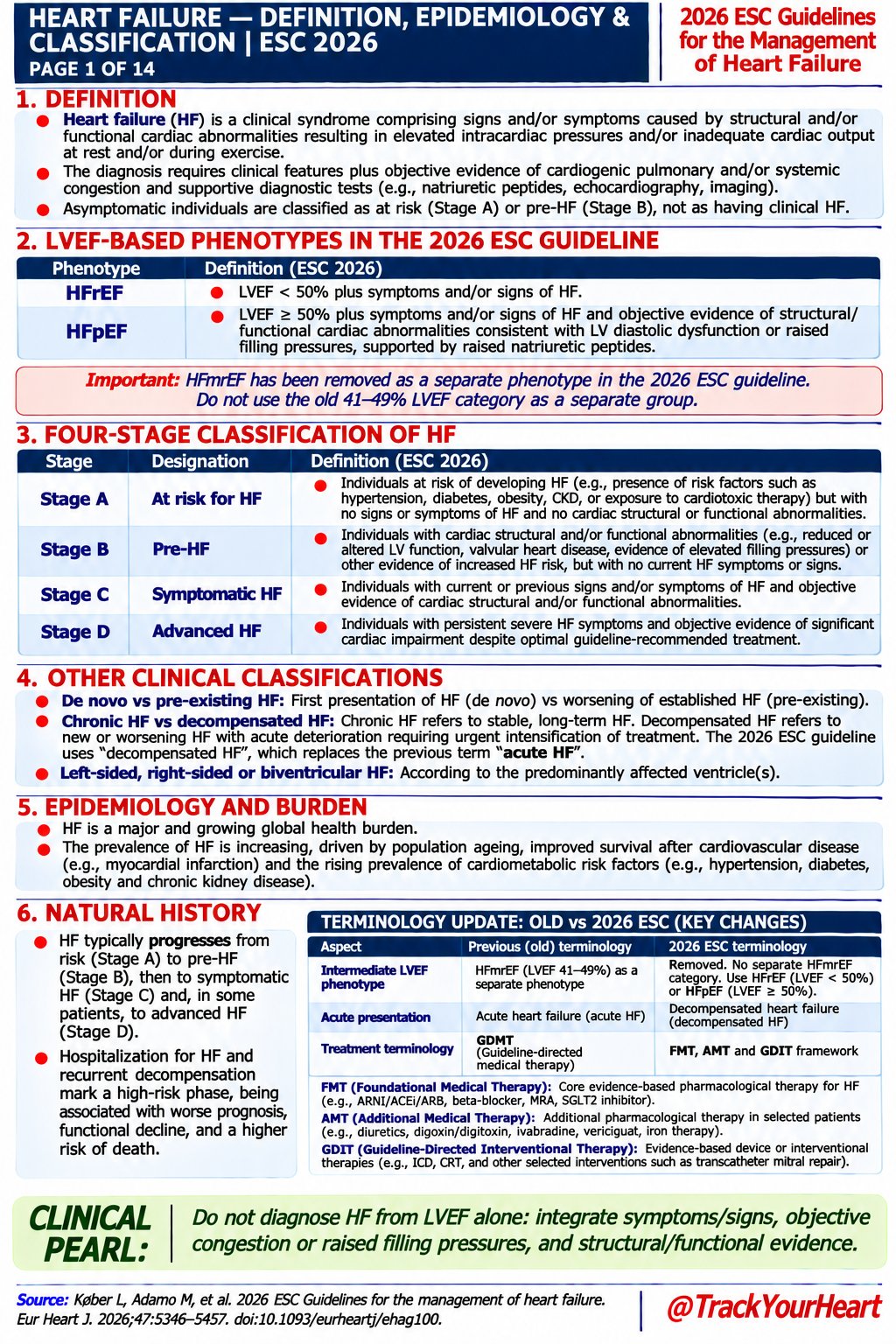
2026 ESC Guidelines for the Management of Heart Failure
I'll be sharing the slides one by one, highlighting important recommendations, clinical updates, treatment strategies and practical points for everyday clinical practice.