
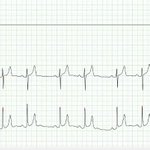


Woman 55 yo. Rhythm? What's happening with fifth and tenth beat? Is this a parasystole? @Ecgloverr @The_Nanashi_O @SergioPinski @smithECGBlog @PendellM @Arron_Pearce_


Pedro Contreras retweeted

What do you think❓🤔
@drharikrishrau
@Eugene4463
This post is from an account that no longer exists. Learn more
Pedro Contreras retweeted

Pre- and Post-RF Ablation for AVNRT
Patient: Male, 48 years old
- Pre-operative PA interval: 36 ms
- Post-operative PA interval: 29 ms
Standard Range:
PA Interval 25-35ms
AH Interval 60-110ms
HV interval 35-55ms
#### Advantages of the Advanced ECG Device
1. Comprehensive Cardiac Signal Detection:
The advanced ECG device is capable of detecting all intracardiac electrical signals, including those indicative of early-stage or subclinical cardiac conditions. This enhances the ability to identify potential issues before they manifest clinically.
2. Pre- and Post-Operative Monitoring:
The device provides critical support for continuous patient monitoring both before and after surgical interventions. This allows clinicians to assess cardiac function more effectively and track procedural outcomes with precision.
3. Non-Invasive Diagnostic Capabilities:
Designed for non-invasive surface monitoring, the device is particularly beneficial in resource-limited settings where access to specialized electrophysiologists or advanced electrophysiology equipment is restricted. Its ease of use and portability make it a valuable tool for widespread clinical application.
#### Complementary Role in Modern Healthcare
Every medical device is designed with a specific purpose to support clinicians and improve patient care. No single instrument can fully replace another, nor can any device substitute the expertise of a trained physician. Instead, these tools serve as essential aids, enabling healthcare professionals to make faster, more accurate diagnoses and deliver optimal treatment plans.
The advanced ECG device represents a significant advancement in medical technology, offering enhanced diagnostic capabilities that empower clinicians and contribute to improved patient outcomes. By integrating this technology into clinical practice, healthcare providers can further elevate the standard of care in cardiology and beyond.
PhysioSign USA
#ecg #ekg #ep #cardiology #medtech #innovation


Pedro Contreras retweeted

One of those ECGs you need to instantly recognize, which learners may struggle with at first
hqmeded-ecg.blogspot.com/202…
@PendellM


Pedro Contreras retweeted

CASE4: 2025!
A bedside EKG of a 89years old patient, a known HTN, h/o ischemic stroke 9years ago, pw a day h/o LOC. .
What can you deduce from the attached EKG?!. Is it a cerebral TWs?!.
@ManualOMedicine @MakCHS_SOM @InternalmedMak @EmMakerere @lacor_hospital @smithECGBlog


Pedro Contreras retweeted

Due to the word limit, I can only illustrate and explain; I have done my best, hoping you can understand

Pedro Contreras retweeted
INTERATRIAL BLOCK ... IAB ... IAB
You can find it again and again if you look for it.
It's known to correlate with LA size (hence higher incidence of paroxysmal AFib than in those without IAB).
Here LA is 47 mm.


Pedro Contreras retweeted
>> An EKG to comeback on #cardiotwitter
This Ekg was sent to me
15 YO with paroxysmal palpitations
Two Drs said it’s a « normal EKG for the age ».
Not me .
What’s your thought ?
@DrRazi4 @IrmaMDv @ecgandrhythmRoe @ecgrhythms @EcgsOnly @EcgOxford @Arron_Pearce_


