

Working on fixing the financial system with reusable KYC. A ruthless empiricist, Co-founder/CEO @OpacityLabs
NYC
Joined November 2021
- Tweets7.3K
- Following3.1K
- Followers2.8K
- Likes6.7K





Hersh Patel retweeted

this panel caused the timeline to fork

-@eulerlagrange: zkTLS is increasing the brand value of zk… so shut the fuck up. 🎤💧
@SuccinctLabs hacker house

Hersh Patel retweeted

Americans en masse won't and don't need to care. Blockchain rails are for global public distribution.
That is the single biggest advantage they have over traditional financial rails.

Only 3% of Americans say they're extremely or very familiar with tokenized assets, and 89% are not very or not at all familiar, a new Ipsos survey for @fund_defi finds.
We'll keep building until that 3% becomes 100%.
Tokenize the World.

Hersh Patel retweeted

Until the input carries provenance of its source, verifiable inference use cases will be limited. Verifiable data comes first.

The bottleneck verifiable AI inference will hit:
A proof of inference only shows that the model ran correctly. The user supplies the input, so a forged input still yields a valid proof. Verifying the input is authentic is the bottleneck.
@AnthropicAI released FlashProve yesterday: a zkSNARK that an output came from a committed set of model weights. The user still checks only that their provider ran the right model. The moment the proof is shown to a third party as evidence, it is only as good as the input, and the proof says nothing about where the input came from.
Verifiable compute moves the trust from the party running the model to the party supplying the data.
That is why these proofs worked on blockchains first. A rollup's inputs are posted to the L1, so the proof covers data anyone can check. Off chain, there is a chronic shortage of verifiable data. A bank balance, a payroll record, a cap table or a lab result sits on a server that shows it to you over an encrypted connection. Once it leaves that server, it becomes a screenshot or a PDF.
Until the input carries provenance of its source, verifiable inference use cases will be limited. Verifiable data comes first. Verifiable compute is what you do with it.
@OpacityLabs
The bottleneck verifiable AI inference will hit:
A proof of inference only shows that the model ran correctly. The user supplies the input, so a forged input still yields a valid proof. Verifying the input is authentic is the bottleneck.
@AnthropicAI released FlashProve yesterday: a zkSNARK that an output came from a committed set of model weights. The user still checks only that their provider ran the right model. The moment the proof is shown to a third party as evidence, it is only as good as the input, and the proof says nothing about where the input came from.
Verifiable compute moves the trust from the party running the model to the party supplying the data.
That is why these proofs worked on blockchains first. A rollup's inputs are posted to the L1, so the proof covers data anyone can check. Off chain, there is a chronic shortage of verifiable data. A bank balance, a payroll record, a cap table or a lab result sits on a server that shows it to you over an encrypted connection. Once it leaves that server, it becomes a screenshot or a PDF.
Until the input carries provenance of its source, verifiable inference use cases will be limited. Verifiable data comes first. Verifiable compute is what you do with it.
@OpacityLabs
Tokenization is such a hard problem because you need a team that operates at a high level in a diverse set of skills.
It starts legal/regulatory and GTM / BD to map out incentives for how to get to the promise land. Then tech threads the needle.
Once the package is complete you need a great marketing person to explain it to people.
The order matters because tokenization requires doing regulated activity in completely different ways. If you focus too much on tech you’ll end up with something that’s impossible to sell.

Tokenization has yet to solve a problem for issuers. Issuers will adopt tokenization because it gives them a direct relationship with their shareholders.
Market structure for the past 50 years denied issuers direct shareholder relationships, because settlement scaled much better when firms deposited with a central depository and settled trades with each other on the depository’s ledger.
Most attempts at tokenization are trying to pad the margins of the intermediaries. It’s no wonder issuers are opting out of tokenization intermediary relationships like OKX.
The promise of tokenization is simple: settle trades directly on the issuer’s register without recreating the late 60s paperwork crisis.
The main innovation we need is a better identity verification that multiple firms can rely on. Follow @OpacityLabs to learn more.
I’ll include specific examples issuers have in the current market structure below 👇

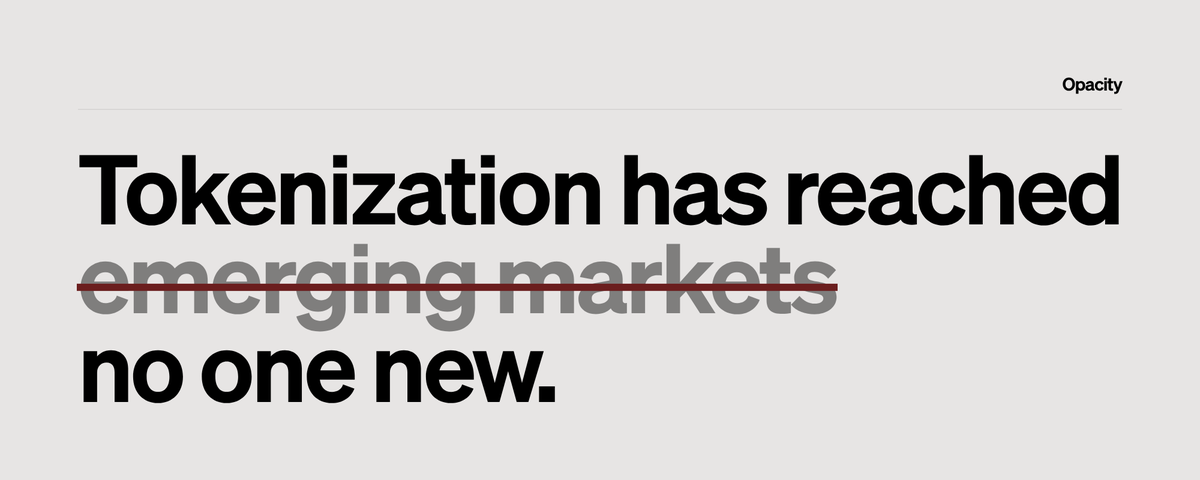
50 objections. Opting out just moves tokenization to markets that never asked for consent.
nitter.cf/EleanorTerrett/status/…
A public company cannot identify the holders of 52 to 60 percent of its shares. A fund has the same problem. In 2008, funds could see 94 million investor accounts one by one. In 2021, they could see 28.9 million.
The cause is the same in both cases. The holder's record is on the intermediary's books, not on the issuer's register.
1. Retail investors vote 11 percent of their accounts. When the SEC removed mail and phone voting in a test, account turnout fell by about 45 points. Funds spent between 675 million and 1.14 billion dollars on proxy campaigns from 2020 to 2025. The SEC's Investor Advisory Committee found that no fund lost because its shareholders voted against the proposal, while six lost because not enough shareholders could be reached to vote at all.
2. When a public company sends a proxy or an annual report, the broker owns the relationship with the investor chooses the vendor, and the issuer pays the bill. Funds have the same arrangement and pay 3 to 5 times more to reach investors through brokers than to reach them directly. The same logic explains why a fund pays most of its fees to the distribution channels.

Hersh Patel retweeted
Our tools let asset managers, fintechs and TSVs verify and onboard investors with reusable, attribute-based credentials. The implications are tremendous.
Credentials are fundamental to upgraded financial rails.

Banger

PETs distribute power instead of centralizing it and have the benefit of increasing our ability to compute and verify while reducing the accumulation of raw personal data in centralized institutions. This is in line with @VitalikButerin's d/acc philosophy. 9/

Hersh Patel retweeted

PETs distribute power instead of centralizing it and have the benefit of increasing our ability to compute and verify while reducing the accumulation of raw personal data in centralized institutions. This is in line with @VitalikButerin's d/acc philosophy. 9/
“There's been such a breach of trust in the custodian of personal information by institutions that were collecting it… combined with what AI can be putting together about every bit of metadata about someone and an onchain permanent record. There just has to be personal empowerment of privacy.” - @m_mosier_
🔥

Can TradFi use permissionless blockchains, given the Bank Secrecy Act & sanctions laws?
This @LawofCodeFM episode is a deep dive into the BSA, crypto compliance and a paper by @RebeccaRettig, @malekanoms and @M_Mosier, which argues that TradFi can embrace blockchains while complying with existing law.
Timestamps:
0:00 Intro
3:24 Problems they see
5:39 The router principle
7:13 What permissionless systems get right
11:28 Lessons from the open internet
14:23 Credible neutrality
19:20 A brief history of the BSA
23:55 What OFAC enforcement looks for
26:16 Treasury, Iran and open networks
28:29 The SEC's innovation exemption
34:03 Compliance belongs at the app layer
37:04 "The government will never allow it"
39:39 The paper's nine-part framework
44:12 Network layer vs. transaction layer
46:28 The $50,000 canoe
48:02 Safety, soundness and final settlement
50:29 Why this matters for national security
51:27 Privacy
58:07 What this means for DeFi
Thank you to the presenting sponsor of this episode, @altitude.
Nothing in this podcast is legal or investment advice.
Hersh Patel retweeted

Can TradFi use permissionless blockchains, given the Bank Secrecy Act & sanctions laws?
This @LawofCodeFM episode is a deep dive into the BSA, crypto compliance and a paper by @RebeccaRettig, @malekanoms and @M_Mosier, which argues that TradFi can embrace blockchains while complying with existing law.
Timestamps:
0:00 Intro
3:24 Problems they see
5:39 The router principle
7:13 What permissionless systems get right
11:28 Lessons from the open internet
14:23 Credible neutrality
19:20 A brief history of the BSA
23:55 What OFAC enforcement looks for
26:16 Treasury, Iran and open networks
28:29 The SEC's innovation exemption
34:03 Compliance belongs at the app layer
37:04 "The government will never allow it"
39:39 The paper's nine-part framework
44:12 Network layer vs. transaction layer
46:28 The $50,000 canoe
48:02 Safety, soundness and final settlement
50:29 Why this matters for national security
51:27 Privacy
58:07 What this means for DeFi
Thank you to the presenting sponsor of this episode, @altitude.
Nothing in this podcast is legal or investment advice.
Man when people realize that a one time KYC exists there’s gonna be a mad dash to run a TSV
Mark my words

Hersh Patel retweeted

“We also discussed the U.S. international economic agenda and financial services issues, including digital assets.” Great meeting conducted by @UnderSecIA Erin Browne focusing on the dollar’s role and economic security.

While in Hong Kong, I met with representatives of Bank of America, Goldman Sachs, BNY Mellon, Citi, JPMorgan Chase, Morgan Stanley, and State Street. I thanked them for joining the roundtable and welcomed their on-the-ground perspectives on the Asia-Pacific, U.S.-China relations, the dollar’s role, and economic security.
Under President Trump’s leadership, the United States is pursuing an ambitious agenda centered on economic growth, energy abundance, and regulatory streamlining. We believe these are the three pillars needed to unleash private sector-led growth. The Asia-Pacific offers tremendous opportunities for investment in infrastructure, energy, advanced technologies, and financial services. We also discussed the U.S. international economic agenda and financial services issues, including digital assets.

