

Especialista en Medicina Interna @udecuenca & Medicina Crítica @incmnszmx /@UNAM_MX, Cuidado Crítico Cardiovascular 🫀 Educación Basada en Simulación
Cuenca-Ecuador
Joined January 2011
- Tweets12.3K
- Following866
- Followers3K
- Likes24.5K




Pinned Tweet
Reconocer de forma oportuna una parada cardiorrespiratoria es fundamental para iniciar una RCP precoz, en la que el uso del DEA resulta determinante para el pronóstico final. Por ello, es imprescindible que el personal médico y paramédico a cargo del deportista esté debidamente entrenado, capacitado y certificado en estas habilidades de soporte vital básico (BLS)

🚨 | Según informa @martintravieso, Jesús de Miguel sufrió una parada cardiorrespiratoria. 🇪🇸👀
👉 Recuperó el pulso gracias a la RCP realizada por los servicios sanitarios en el interior de la ambulancia
👉 De Miguel respira por sí mismo, aunque permanece inconsciente

Fernando Ortega B retweeted

Clinical algorithms for the diagnosis and management of acute mesenteric ischaemia: an international multidisciplinary consensus
CCR Journal Watch
criticalcarereviews.com/late…

Fernando Ortega B retweeted
Today's Paper of the Day is:
Dead space in critical care: a practical approach with clinical scenarios
criticalcarereviews.com/late…
Join us to read 1 paper per day and stay up-to-date as we cover the spectrum of critical care across 2026

Fernando Ortega B retweeted
Today's Paper of the Day is:
Prolonged weaning from mechanical ventilation: who, what, when and how?
criticalcarereviews.com/late…
Join us to read 1 paper per day and stay up-to-date as we cover the spectrum of critical care across 2026

Fernando Ortega B retweeted
Monitoring that follows the patient: from the extended recovery room to a continuous, surgery-specific postoperative pathway
CCR Journal Watch
criticalcarereviews.com/late…

Fernando Ortega B retweeted
Today's Paper of the Day is:
Advances in the prevention and management of procedural bleeding in patients with cirrhosis
criticalcarereviews.com/late…
Join us to read 1 paper per day and stay up-to-date as we cover the spectrum of critical care across 2026

Fernando Ortega B retweeted

Resuscitation 2026: measured ventilation, adult-size bags and selective fluids during adult CPR. Three changes, with important exceptions. Weak recommendations; very-low-certainty evidence.
Read our clinical update:
updatesinmedicine.com/articl…


Fernando Ortega B retweeted
Advances in the management of pneumonia caused by drug-resistant bacteria: from antimicrobial optimisation to integrated treatment adaptation
CCR Journal Watch
criticalcarereviews.com/late…

Fernando Ortega B retweeted
Independent lung ventilation in severe left–right asymmetry: a physiology-driven narrative review of lung-specific mechanical loading
CCR Journal Watch
criticalcarereviews.com/late…

Fernando Ortega B retweeted
Cerebral near infrared spectroscopy – clinical use in the neonatal intensive care unit
CCR Journal Watch
criticalcarereviews.com/late…

Fernando Ortega B retweeted
Fluid Management in Patients with Concomitant Acute Brain Injury and ARDS
CCR Journal Watch
criticalcarereviews.com/late…

Fernando Ortega B retweeted
Lung recruitability in ARDS: from recruited volume to functional response
CCR Journal Watch
criticalcarereviews.com/late…

Fernando Ortega B retweeted
Lactate in Context: Physiology and Clinical Judgment
CCR Journal Watch
criticalcarereviews.com/late…

Fernando Ortega B retweeted

#ESPENMAW2026
TODAY!! TODAY at 15h CET! last chance to register!!
Joint Webinar ESPEN – DNSG Webinar: "Nutrition is the key in diabetes"
November 9th, 2026
3.00 - 4.30 pm CET (GMT +1)
Full Program and registration here: forms.office.com/e/EvJ4aCmX1…
espen.org/activities/malnutr…
People living with diabetes can also face important nutritional risks, including disease-related malnutrition, sarcopenia and micronutrient deficiencies.
ESPEN Malnutrition Awareness Week 2026 | 9–13 November
espen.org/education2/fact-sh…
Full Program and registration here: espen.org/activities/malnutr…

Fernando Ortega B retweeted
Today's Paper of the Day is:
Use of intravenous lipid emulsions in drug-induced toxicities: a 2025 narrative review
criticalcarereviews.com/late…
Join us to read 1 paper per day and stay up-to-date as we cover the spectrum of critical care across 2026

Fernando Ortega B retweeted

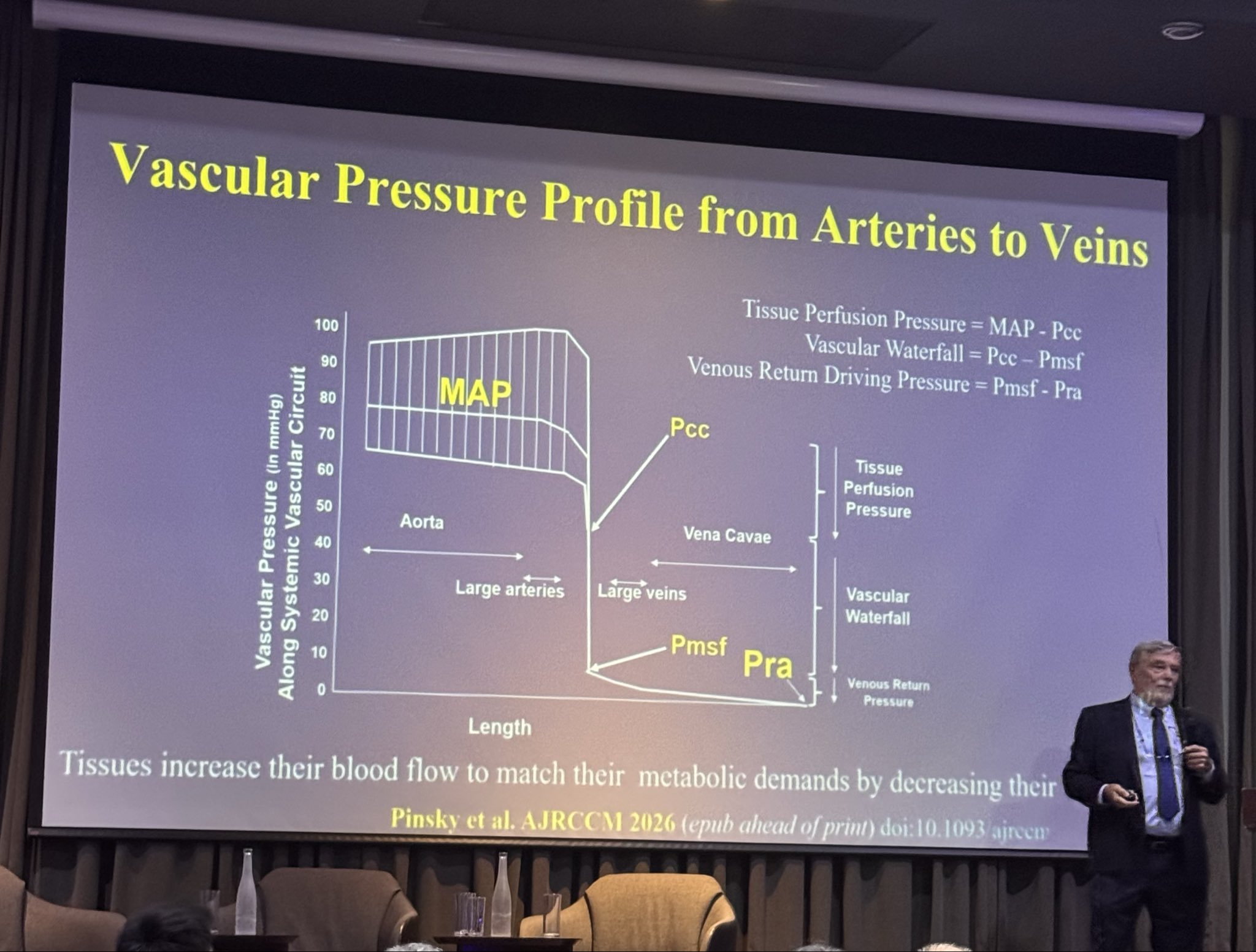
¿Por qué un paciente séptico con PAM de 70 puede seguir mal perfundido?
🏞️La teoría de la cascada 🌊💦💧
Piensen en una presa. El agua que cae depende de qué tan alto está el nivel de arriba y de la altura del borde. Lo que pase abajo no importa.
En la circulación pasa lo mismo:
• Arriba está la PAM. 🌊
• El borde de la presa es la presión crítica de cierre (Pcrit): la presión mínima que mantiene abierta una arteriola. La fija el tono vascular. 🦦
• Abajo está la presión venosa. 🏞️
📍La presión que de verdad perfunde el tejido no es PAM menos PVC. Es PAM menos Pcrit.
En el choque séptico la vasoplejía "derrumba" el borde de la presa: la Pcrit baja tanto que casi iguala la presión de llenado sistémico (Pmsf). Sin cascada, el tejido pierde su capacidad de autorregular el flujo.
Por eso la norepinefrina no sirve solo por subir la PAM. Sirve cuando sube la Pcrit.
Entonces:
1. La cifra de PAM es el medio, no la meta.
2. Evalúen la perfusión en cada paciente: llenado capilar, lactato, diuresis.
3. El mismo vasopresor puede funcionar en uno y fallar en otro.
Cómo saber si lo lograste, ya que la Pcrit no se mide de rutina:
⚪️Elastancia arterial dinámica (Eadyn): funciona como marcador indirecto del tono arterial y predice si la PAM responderá a la norepinefrina.
🔀Eadyn = VPP / VVS, es decir, la variación respiratoria de la presión de pulso (VPP) entre la variación respiratoria del volumen sistólico (VVS)
🟢Perfusión periférica: llenado capilar, lactato, delta pCO2 y diuresis. Si la PAM sube y estos no mejoran, probablemente no restauraste la cascada.
Rastrea!!!
💨Delta de CO2:
🔹Normal: menos de 6 mmHg.
🔺Mayor de 6 mmHg: el flujo sanguíneo no alcanza para lavar el CO2 que producen los tejidos. Sugiere gasto cardiaco o perfusión insuficientes, aunque la SvcO2 sea normal.
🔵Pausas inspiratorias: aún en investigación, se extrapola la relación PAM y gasto cardiaco durante las pausas para estimar la Pcrit y la Pmsf.
🔗doi.org/10.1016/j.jcrc.2026.…
Descarga:
t.me/DailyUrgencias/1612


Fernando Ortega B retweeted

praxiscritica.org/ritmos/
App simuladora de ritmos cardíacos de mi creación.
Funciona para android.
Gratis.

Fernando Ortega B retweeted

"Capillary leak" is still a clinical guess. We cannot measure permeability at the bedside, so a multimodal look at edema, congestion, and endothelial injury is the best we have. 🎩 tip to the authors, including @fabio_taccone and @PhilGuerci. eddyjoemd.com/foamed

Fernando Ortega B retweeted
Nutritional support in immunosuppressed critically ill patients
CCR Journal Watch
criticalcarereviews.com/late…

Fernando Ortega B retweeted

#SCAISHOCK 2026 @SCAI
#Shock is about perfusion, not just pressure
The updated SCAI SHOCK staging of #cardiogenicshock refines stages A to E, stresses serial restaging, says therapy alone does not set stage & covers 6 phenotypes. Expert consensus, JSCAI, 6 Nov, open access 1/6

Fernando Ortega B retweeted

Preoperative medicine is not “medical clearance”: it is risk modification
Surgery challenges physiological reserve. Anesthetic-induced vasodilation, blood loss, fluid shifts, inflammation and postoperative immobility can expose cardiovascular, respiratory or metabolic vulnerabilities that remain compensated in daily life. The question before surgery is not simply whether a patient is “fit,” but which risks are modifiable and which outcomes matter to the patient.
In this review, Irizarry-Alvarado and colleagues challenge the ritual of preoperative clearance. They advocate a stepwise assessment anchored in symptoms, comorbid disease, medications, procedural risk and shared decision-making.
More testing does not necessarily mean safer surgery. Routine laboratory panels, electrocardiography, chest radiography and ischemia testing in stable, low-risk patients can generate incidental findings, delays and downstream procedures without changing management. New exertional dyspnea, decompensated heart failure, significant valvular disease or declining exercise tolerance, by contrast, demand focused evaluation because they may signal inadequate reserve.
Medication reconciliation is an intervention, not clerical work. SGLT2 inhibitors may increase perioperative ketoacidosis risk during fasting, anticoagulant interruption requires balancing bleeding against thrombosis, and GLP-1 receptor agonists prompt individualized aspiration-risk assessment. These decisions must account for the procedure and the patient rather than follow automatic rules.
Importantly, frailty and baseline cognition can predict vulnerability that age alone misses. Functional decline, delirium and loss of independence may matter as much as traditional cardiopulmonary complications. Prehabilitation, nutrition, anemia management and postoperative support should enter the discussion before the operating room.
This is a guideline-informed narrative review, not a trial demonstrating that any single assessment strategy improves survival. Its value is a change in clinical reasoning: avoid low-value rituals, identify actionable physiology and coordinate care.
A useful preoperative consultation does not certify the absence of risk. It turns recognized risk into a plan.
Reference 📚
Irizarry-Alvarado et al. 2026. JAMA Internal Medicine. doi.org/10.1001/jamainternme…
#PerioperativeMedicine #Anesthesiology #PatientSafety #ClinicalReasoning #EvidenceBasedMedicine
