

Killing Death w Autonomous labs @cogworksai | Emergent Ventures Grantee | Stanford ASES fellow | lightbearer @ https://nitter.cf/t.co/Dw7EQss6Wg
Joined April 2022
- Tweets1K
- Following1.5K
- Followers1.8K
- Likes1K







Pinned Tweet
We just raised $400,000 in pre-seed funding from @joinef , Emergent Ventures along with angels and advisors including Jay Kim, @srajagopalan , @lmthang.
@b1shtream and I are building @cogworksai and our goal is to Accelerate Scientific Discovery using Autonomous labs.
We’re starting by building the integration layer between AI agents and laboratory equipment.


When defeating aging and death has become so near a possibility that the Pope has to come out and pontificate against it

Today, the promises of transhumanism and posthumanism are multiplying. These are ideological currents according to which, sooner or later, technology will eliminate all disease and pain, as well as aging and even death itself. Precisely because scientific progress is a supreme achievement of human intelligence, it must not be confused with a privilege reserved for millionaires seeking immortality, while entire peoples suffer from poverty and oppression. In the face of this mirage, which promotes the illusion of human beings perfected by cybernetics and biotechnology, Christian anthropology reminds us that a limitation is not a manufacturing defect, but rather the very condition of human grandeur. #ApostolicJourney #Peru #MagnificaHumanitas vatican.va/content/leo-xiv/e…
3
146
One of @dwarkesh_sp's core arguments is that efficiency in synthetic data generation would just scale up enough that you can maintain (or even accelerate) the rate of progress, even after exhausting all the real-world data.
But it's difficult to imagine how this would work for empirical sciences like bio and material sciences. Synthetic data is still basically sampling from an existing data distribution. I don't see how this would replace the need for real experiments in labs (which are slower)
Other than this one exception, the entire video was pretty much spot on. We have a crazy couple of years ahead of us. 😉

1
164

Our physical infrastructure needs to catch up if we need to be competitive against bioterrorism.
With AI becoming so good at design, bad actors don't have to go through all the big regulatory process to put out a toxin on the population. They can just design pathogens and viruses and put them out in a matter of weeks. If our infrastructure doesn't catch up to responding fast, humanity will really suffer.
The cost in bioterrorism is much, much larger than cyberterrorism, but we don't see the proper amount of attention being given to bioterrorism. At @cogworksai, this is one of the things that we are trying to do: build autonomous labs fast enough that designing efficient defenses becomes possible in real time.
6
241
"We see opportunities to leverage AI for faster and better processes at each step of the discovery and development process from target identification to market launch. These may include reasoning across existing academic literature to help pick and assess drug targets, leveraging predictive in silico models to prioritize molecules more likely to succeed, designing study protocols for clinical trials, improving patient recruitment, and speeding up document drafting for FDA submissions. While some timelines are heavily regulated by the FDA (e.g., long-term chronic toxicology studies), we expect to see lots of time and cost saving opportunities around many of these steps."
We also need to put pressure on the FDA itself to speed up their process.
sunnnybala.github.io/fda-acc…
"We believe Eroom’s law has finally found its equal and opposite force: continuous frontier model improvement."
🔥🔥🔥🔥


5
356
Check it out. Standwithjensen.com


7
534
Fully support standwithjensen.com

Jensen deserves real justice not a knee jerk mob hanging without evidence. I read the details of this letter carefully and emphatically support it. standwithjensen.com/
1
163
i just signed the petition to bring jensen back as ceo of nvidia
bringbackjensen.tanukade.com…

1
4
567


The FDA has gotten lazy. The public scrutinizes them for harm from approving a drug. The harm from withholding a useful one is much less visible.
So we built an open-source dashboard to make it visible.
For just 12 cancer drugs, we estimate their delay put about 12,000 years of life at stake.
they have gotten into the habit of setting famously long, very long deadlines and then claiming that they have a track record of hitting their deadlines.
check it out at: sunnnybala.github.io/fda-acc…
@b1shtream
You are only assuming a modest improvement in AI design. What if AI has efficiency increases in downstream steps like recruiting patients, filing documents, etc.?
The follow-up time is biology, agreed. For Alzheimer's that is about 18 months. But you are counting it twice, once in phase 2 and once in phase 3. Running them one after another is a funding constraint, not biology. Run them as one trial parallely and you wait the 18 months once.
In that case, phase 2 and phase 3 shouldn't take 3-4 years. If all of this is done, then the time for getting a drug to market shouldn't be more than 2 years, even with a chronic disease like Alzheimer's.
am I missing something? Why is the entire community so jaded and pessimistic?

🚨There is 0% this is possible. If you are developing drugs 🔺dementia or diseases with long-term follow-up, 🔺
🚨You can’t have a 12-week study and say you cured dementia. A participant has to be followed at least 12 months to 24 months.
Your trial at Phase 2 and 3 is going to be a minimum of 24 months; will say Phase 1 12 months (that’s 5 years in trials)
Fastest 6, 7-8 years with some kind of breakthrough designation. No one’s fault that’s the biology.
==
Ok, let’s say discovery and even synthesis of a compound takes 1 day (takes weeks to months) I’ll even say animal studies and IND take 12 months. So with human trials even if everything goes perfectly.
🚨 So it’s 6 or 7-8 years to approval even with some kind of breakthrough designation.
Also, they have zero drug candidates. A normal
thing to say after this is “we’re seeing progress in the lab”, but they don’t have anything.
It’s not being negative. It’s just not possible to assess a long-term outcome in a short time frame.
14
18
2,532
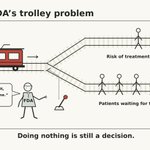
The FDA has a trolley problem.
Imagine you can pull a lever to save five people, but doing so carries a risk of killing someone else. Pull it, and that death becomes your responsibility. Leave it alone, and the five deaths become “just what happens.”
That’s the incentive problem in drug approval. the public scrutinizes the harm from approving a drug. The harm from withholding a useful one is much less visible.
we need to build a open-source dashboard that makes those invisible costs visible. I think the FDA would work a lot more efficiently if everybody could track how many deaths are occurring because of the bureaucratic slowness in each drug approval.
I don’t have deep expertise in this field so any help or advice from clinicians, researchers, patients, and regulatory experts would be vital. If you can help or think I’m full of shit, I’d like to hear from you.
Inspired by @VitalikButerin’s “My techno-optimism” and @ATabarrok’s writing on the invisible costs of FDA caution. @b1shtream

I just watched @bscholl's conversation with @jesslivingston and @cjoneslevy on The Social Radars. One of the most inspiring and exciting videos I've ever watched.
At @cogworksai, we build autonomous robotic labs so AI models can carry out biological experiments on their own. I was shocked to see how many of the problems we face are ones Boom has faced too.
Blake said that a blade @boomsupersonic could 3D print in 3 days takes 18 months to get from a manufacturer. We faced the same issue when we needed a part for our robotic arm. The manufacturer quoted us 6 weeks. We ended up 3D printing it ourselves in 6 hours.
The entire biotech industry is riddled with inefficiencies like this. One other example that I can recall is when @navvye and @tylerarose0 at @bindwell asked nearly 40 CROs for quotes for some experiments. The median quoted turnaround for an in-vivo study of 120 compounds was 10 months. In their own lab, they now test that many compounds in about a week, across insects, cells and proteins.
These legacy supply chains are quickly becoming a bottleneck and need to be overhauled.
Dhruv Agarwal retweeted

@archgen_ is building skyscrapers for semiconductor chips
Shrinking transistors is getting harder. Stacking them makes heat harder to manage. We’re building the tools to design chips in three dimensions.
We stack transistors vertically, shorten connections, and optimize timing and heat together.
Our foundational model for thermal simulation, predicts temperature roughly 5,000× faster than conventional EDA tools.
Our placement engine ranked #1 in HRT’s macro-placement challenge
We’re working with some of the largest fabs in the world to tape out our first chip in April 2027
archgenlabs.com