
Taking some time to find what comes next. Formerly AI @ BrightHire, Data Nerd at @periscopedata / @sisense, engineer at Google Search Ads UI and Google News.
Maryland
Joined November 2006
- Tweets148
- Following487
- Followers177
- Likes2.4K




Pinned Tweet
I've been making bespoke educational videos for my kid since Opus 5.5 released. The model is an amazing combination of programmatic animation and content planning.
One approach I've found useful is asking the model to build a reusable embodied narrator that can point and look. This helps direct attention in the midst of complex content. Having it as a reusable library saves time and tokens, and avoids repeating the same animation mistakes.
Here's a tech demo of one of these characters explaining itself. The narration is ElevenLabs v4, and everything else is javascript and canvas from scratch.
The full commissioned report on the 2026 digital SAT vs. 1980 SAT from John Hopkins is freely available and surprising (linked in reply).
The first line of the conclusion is: "In sum, the SAT's reading section has been redesigned rather than simply relaxed...."
The frequently mentioned shift in passage types, passage lengths, and vocab coverage is true, but there are several other findings.
For example:
- Although passages are shorter these days, there are 3x as many. There's 90% as many passage words today as 1980.
- The Lexile score for sentences has gone up substantially in more modern SAT versions. To be fair, short passage scores can swing on a single large sentence, but this big of a difference after averaging 17 passages and another nine for replication seems believable.


I am speechless. Thomas Aquinas College just dropped a study on the rigor of the new SAT.
It compares the 1980/87 test with 2026. The findings should terrify every parent and teacher...
Vocabulary has collapsed.
Old SAT: 70.6% of questions tested vocab.
New SAT: 15%.
The old test forced students to know a wide range of words through analogies, antonyms, and sentence completions. The new test abandoned that. Most vocab questions now just ask students to fill in one blank from context.
Reading passages also got radically shorter (average ~97 words vs 300–340).
The new test uses short expository passages and hands you the necessary background knowledge inside the text. The older tests leaned much more heavily on argumentative and persuasive writing, assumed far more historical, scientific, and cultural knowledge, and penalized students who lacked it.
This is a redefinition of what "college readiness" means.
If you believe that kids should develop rigorous vocabulary, be capable of sustained reading, and possess background knowledge, I have bad news for you. The SAT no longer measures these.
If you want a future where children can actually read difficult texts and construct complex arguments, the SAT must be replaced now.
This cannot go on.

The SAT Reading Section: A Comparative Analysis of the 1980, 1987, and 2026 Practice Tests:
education.jhu.edu/edpolicy/w…


The 5.5 opus programmatic animations are impressive. I tried to create one like @pleometric's, with a loose prompt, no example images/video, and no animation or art libraries.
The one-shot prompt asked for an animation in html and javascript with a vague description of Clawd watching Tiktok videos of his AI friends. It did not include a scene by scene breakdown or a list of the actual content.
This cost 5% of weekly usage on a $100/mo plan, on high. It did write a reusable library of functions that might make future animations cheaper.
It also helpfully included an mp4 export button in the generated .html, which I had not thought to ask for.
Completely inspired by @pleometric's post.

My kid hit a hurdle in his reading homework. The passages were suddenly longer, more difficult, and he was losing interest because of the effort per task.
I read a few of the passages and noticed myself re-reading some sentences because they were difficult to process completely in one pass.
"Extended-duration human exploration missions that are now the focus of NASA will require extended life support capabilities."
My kid reads frequently, but rarely encounters this denser, more academic style of writing. It wasn't impossible, just a slog.
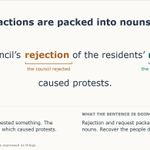
So, I asked Astra in Codex to (1) research the most prevalent academic sentence patterns in middle school content, and (2) make a slide deck with examples, diagrams, terms, and explanations.
With that, he told me that 6 of the 18 patterns were effortful for him to read. The fourth screenshot was met with an "I hate it."
Feedback in hand, I was able to build a bespoke small learning app to practice dense sentences and paragraphs. The text was shorter, harder, and without extraneous load from a tricky homework question. If he could parse the paragraph, the answer was obvious.
He seems to be building his skill at reading this kind of text, although I misunderstood at least half of the problem. The app is giving him focused practice with unfamiliar syntax forms, but also teaching him to notice confusion and resolve it. I think this is called metacognitive monitoring and control. He's improving at that too.
It is amazing how much easier it is to help my kid learn more, as I repeatedly gain access to better AI models. I've been building him bespoke little apps for years (since GPT-3.5 Turbo), and each major generation builds the apps better and faster.


David Ganzhorn retweeted

Does spaced retrieval practice work in all subjects? New study suggests the honest answer is sometimes, and we do not yet fully know when. 🧵⬇️

David Ganzhorn retweeted
"3-year olds are already self-directing their learning - through questions, exploration, and play."
Yes, and letting them understand all these weird symbols everywhere in their life is a great way to further empower them to ask questions, explore, and play.
I taught my kid to read at 3 with "Learn to read in 100 easy lessons", and it was amazing to see how much more of the world he could engage with. Books obviously, but also words on toy boxes, menus, instructions for games, warning signs, building names, etc. It's like a whole new sense flips on.
David Ganzhorn retweeted

Your bookshelf makes you smarter
Every time you walk past a book you've read, pause for a few seconds and recall 2-3 key takeaways
This simple habit combines two powerful learning science principles:
- Retrieval practice: actively pulling info from memory strengthens those neural pathways
- Spaced repetition: these random encounters naturally space out your reviews
but wait there's more
When you recall those takeaways today, you're a different person than when you first read it
new experiences, new lens
This creates fresh pathways to that knowledge
like building new roads to the same destination
Your brain literally rewires itself with each recall, making that wisdom more accessible when you need it
So yes, display those books proudly
they're not just decor
They're mini learning sessions waiting to happen throughout your day.


David Ganzhorn retweeted

US education PK12 market numeracy:
* there are about 4M children per grade level
* total public school spending is about $1T == 20k/student/year
* about 20% of that is special ed
* total private school consumer spending, including prek, is about $100B
David Ganzhorn retweeted

We've always been excited about self-play unlocking continuously improving agents. Our insight: RL selects generalizable CoT patterns from pretrained LLMs. Games provide perfect testing grounds with cheap, verifiable rewards. Self-play automatically discovers and reinforces reasoning strategies.
We introduce SPIRAL, where models learn reasoning by competing against themselves in games, creating an infinite curriculum without human supervision. Training LLMs with self-play RL on Kuhn Poker improves math reasoning by 8.7% average. Just playing Kuhn Poker improves Minerva Math scores by 18.1 points! 🃏
🔗 Paper: huggingface.co/papers/2506.2…
🧑💻 Code: github.com/spiral-rl/spiral

David Ganzhorn retweeted

GPT-5 shows remarkable robustness for production instruction-following. On IFScale—our benchmark testing 100s of simultaneous constraints—it maintains >90% accuracy* through 500 instructions. Huge leap over previous bests o3 & gemini-2.5-pro (~69%@ 500).
*run on 1 seed, 5 ongoing

David Ganzhorn retweeted

Take: Chain of Thought is a misleading name. It's really a "scratchpad". "Thoughts" are internal activations
Imagine you're solving a problem and have a scratchpad. Reading the pad gives me info!
You *can* avoid writing down key thoughts. But it's a handicap. Real but fallible
OpenAI's Agent mode has a roundabout live interaction mode.
I gave it a google doc with "anyone with the link can edit" enabled, and it successfully picked up new instructions and wrote incremental updates to the doc, in the middle of a single agent run. The doc explained to check back for new instructions frequently, and to post updates.
It was surprisingly bad at google docs formatting though. Plaintext or markdown would be better.


David Ganzhorn retweeted

Building this app has been a journey. Balancing work and going indie, I’ve rewritten it four times to control its scope. I think I’ve finally reached a good stopping point—for now.
Materia AR is now in the App Store
#buildinpublic
David Ganzhorn retweeted

We announced @OpenAI o1 just 3 months ago. Today, we announced o3. We have every reason to believe this trajectory will continue.


David Ganzhorn retweeted

When people age, they accumulate biological damage that eventually reaches a tipping point and leads to a cascade of catastrophic health issues.
The same thing happens to students learning mathematics: a death spiral caused by compounding knowledge gaps.
Students accumulate knowledge gaps as they progress through math, and they stop taking math classes once the number of gaps reaches a tipping point and spirals out of control.
Knowledge gaps can form in a variety of ways. To name a few:
1) A student may get stuck on foundational topics yet still be required to complete homework on more advanced topics, leading them to scrape by without really understanding the subject matter.
Even a grade of B+ or A- means that there are things in the course that the student never completely grasped, much less mastered.
2) Students typically do not review material learned in previous years (unless it just happens to be practiced implicitly while attempting to learn new content), and they often do not even review material from their current year unless they are preparing for a test.
This leads them to forget what they’ve learned -- often so severely that they need to re-learn it from scratch when it shows up again in the future.
3) Gaps can also be created if a student takes a course that is watered down or otherwise not comprehensive. When a future course assumes prior knowledge that the student never actually learned, that’s a gap.
Now here’s the real kicker:
Gaps beget more gaps.
Once you have a gap, you are unable to fully understand any new information further down that learning path. The gap proliferates.
Consequently, once a student amasses a critical number of gaps, things spiral out of control and a vicious cycle kicks off.
The cycle begins with a student trying to imitate procedures cookbook-style, without really understanding what’s going on, because they can’t intuitively grasp any of the new material that they’re being taught.
Soon after that, they find themselves unable to solve any problems that involve critical thinking or many steps.
Finally, they stop taking math classes because they feel it’s impossible to succeed no matter how hard they try.
The student may interpret this situation as “I’m not smart enough to learn more math” – when in fact, their mathematical lifespan could have been extended simply by having their knowledge gaps detected and repaired.
