

GNC is a community-driven initiative aimed at promoting discussions around national development, socio-economic growth, and communal harmony in Nigeria.
Nigeria
Joined January 2012
- Tweets744
- Following5
- Followers16.7K
- Likes1.5K
Pinned Tweet
If you’ve ever felt like the things that actually matter get buried under all the noise, this page is for you.
We’re here for the conversations Nigeria can’t afford to lose.
Come find your people.
Follow us:
X: @GrowNgConvo
TikTok: @growngconvo
IG: @GrowNigeriaConversation
FB: Grow Nigeria Conversation
#GrowNigeriaConversation

Imagine your child sitting on the floor in class, then hearing that money meant to improve schools had been released but left unspent.
According to The PUNCH, ₦264 billion sent to state education boards remained unspent as of July 2025.
That money could have helped put desks in classrooms, repair leaking roofs, provide books and make school toilets usable. Basic things every child deserves.
We need to know what has happened since. How much has been spent? Which schools have benefited? What are children still waiting for?
Parents deserve to know what has been done with that money. A child who needed a desk last year should not still be waiting for one.
#GrowNigeriaConversation


On 20 October 2014, the World Health Organization declared Nigeria Ebola-free. We recorded 20 cases and lost 8 lives, and the world took notes on how we contained it.
On 20 October 2026, twelve years to the day, a new imported case was confirmed in Abuja. The patient is in isolation and health authorities are tracing 44 contacts.
We have beaten this before, and we can do it again. Here is how each of us can help:
• Know the signs. Sudden fever, weakness, headache, muscle pain and sore throat, often followed by vomiting and diarrhoea. Early symptoms can look like malaria, and bleeding does not always happen.
• Know how it spreads. Ebola is not airborne. It passes through direct contact with the blood or body fluids of someone who is sick with it or has died from it.
• Speak up early. If you develop a fever after travelling from an affected country or after contact with someone suspected to have Ebola, call NCDC free on 6232 (24/7) and tell health workers where you have been.
• Check before you share. In 2014, a salt-water “cure” spread across social media, sent at least 20 people to hospital and cost two lives.
• Don’t stigmatise. Fear makes people hide symptoms, and hidden cases are how outbreaks grow.
There is no approved vaccine or specific treatment for this strain yet, so early reporting is our best protection.


Save 6232 in your phone and share this with your family group. To every nurse, doctor and lab scientist on the frontline: we remember Dr Ameyo Adadevoh, and we are grateful for you.
#Ebola #Nigeria #GrowNigeriaConversation


PVC collection starts TOMORROW, October 9!
INEC says more than 103 million Nigerians are now on the voters' register. But being registered is only half the job. Without your Permanent Voter Card, you can't vote in 2027.
✅ Go to your INEC office or designated collection point
✅ Go in person, because no one can collect it for you
✅ Take your registration slip or a valid ID
Your PVC is your voice. Don't leave it sitting in a pile at INEC. Collect it, keep it safe, and tag someone who still needs to get theirs.
#GrowNigeriaConversation #PVC #CollectYourPVC #Nigeria2027 #INEC

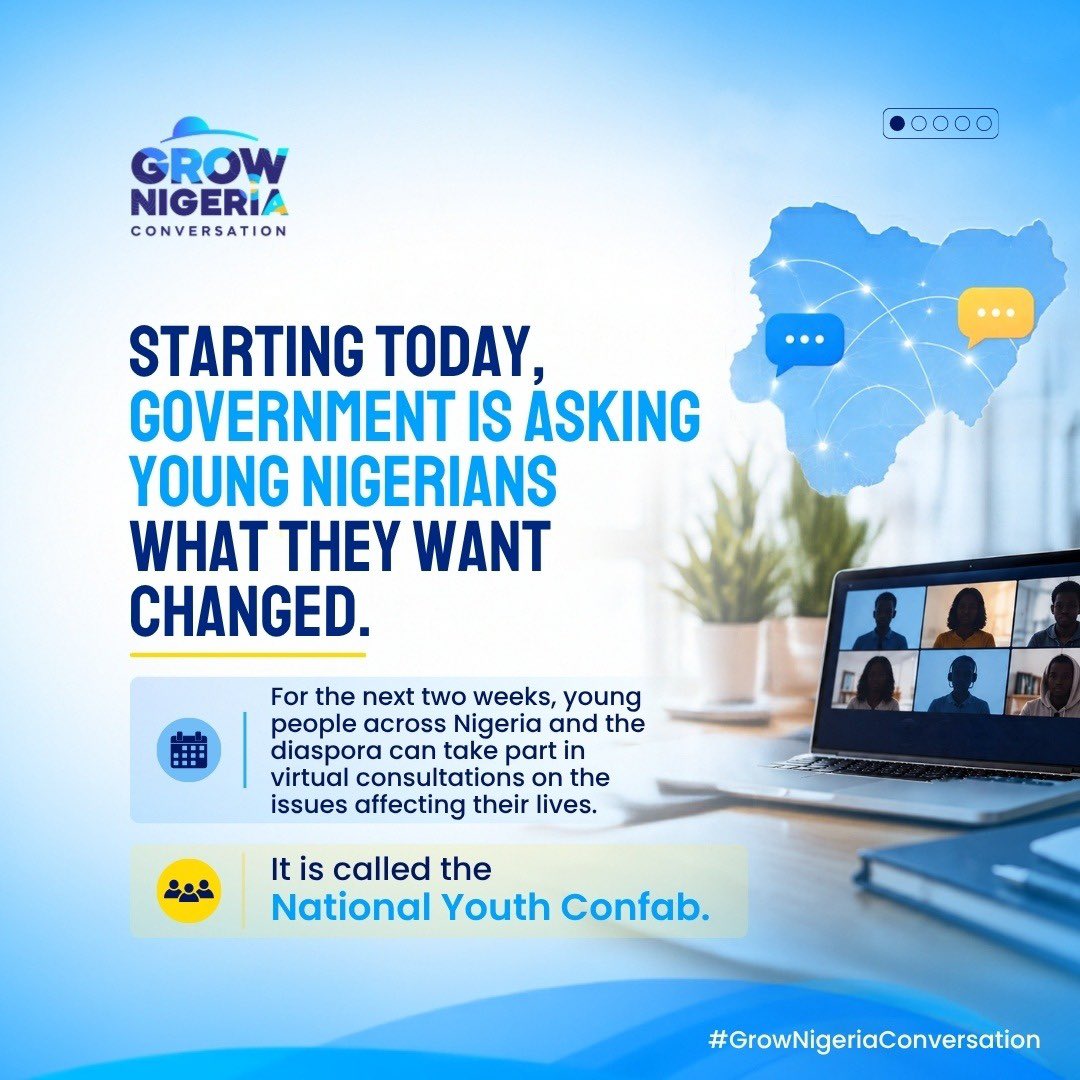
If you’ve been hearing “Youth Confab” and wondering what it actually means, here’s what is happening.
The Federal Government is asking young Nigerians to talk about the problems affecting their lives and the changes they want to see in policy.
The virtual consultations for the Youth Confab begin today with the North Central zone and will move through other parts of the country over the next two weeks. The ideas from these discussions are meant to feed into policy recommendations that will eventually be presented to government.
A few weeks ago, the #GrowNigeriaConversation asked young Nigerians what they hoped would be discussed at the conference.
The answers were pretty clear.
Cost of living came up again and again. So did security, jobs and economic opportunity.
People also talked about electricity, education, healthcare, access to capital, roads, electoral reform and federalism.
One response probably summed up the mood better than we ever could.
“Cost of living wan finish the living.”
So as the virtual consultations begin today, young Nigerians clearly aren’t short of things to say.
@NITDANigeria is also bringing AI into the process. The agency says it will help collect, sort and organise the ideas young people submit, while creating a way to follow how those ideas move into government policy channels.
The important part comes afterwards.
What makes it from these conversations into actual policy?
That is what we’ll be watching.
@fmydNG @ayowisdom_ @Youthconfab2026 @NGRPresident
#GrowNigeriaConversation


Want to take part?
The virtual consultations begin today with North Central and continue across all six geopolitical zones.
See the official schedule and join your session here 👇🏾
nationalyouthconfab.gov.ng/e…

Before October 1, GNC followers said they were spending roughly ₦2,600 to ₦6,000 a day in Abuja and ₦4,000 to ₦7,000 in Lagos. In Kwara, local trips came to around ₦1,000 to ₦2,000.
For national context, the most recent NBS Transport Fare Watch we could verify, for May 2026, put the average bus fare within a city at ₦1,431.25 per trip. Two trips a day comes to about ₦2,863.
The Federal Government said that from October 1, more Nigerians should start seeing measurable reductions in transport costs as CNG and electric transport expand.
So far, it's a mixed picture. Some cheaper CNG and subsidised routes are rolling out, but many commuters say their regular fares haven't moved.
Now we want the after.
What are you paying now? Has your fare dropped at all, or is it still the same?
Let's see what actually changed.
@NGRPresident @MinTransportNG @NBS_Nigeria @PiCNG_EV
#GrowNigeriaConversation


President Tinubu says more Nigerians should begin to see measurable reductions in transport costs from October 1 as States expand CNG and electric public transport.
Rather than wait until then to debate whether fares have actually come down, let’s establish a simple baseline now.
Tell us:
📍 Your city
🚌 The route you regularly take
💰 What you currently pay
We’ll save the responses and come back after October 1 to see what, if anything, has changed.
Let’s track it together.
#GrowNigeriaConversation #CheaperTransport #CNGBuses

Let’s #GrowNigeria retweeted
Nigeria is preparing for a National Youth Confab in October.
The plan is for one young person from each of the country’s 360 federal constituencies to be part of the physical conference in Abuja.
If the person representing your constituency could carry just ONE issue into that room, what should it be?
Jobs?
Cost of living?
Education?
Security?
Access to capital?
Something completely different?
Tell us your constituency too.
Let’s see whether young Nigerians in different parts of the country are actually asking for the same things.
#GrowNigeriaConversation

If you have business at a government office today, don’t be surprised if you meet a closed door or disrupted service.
Public servants across Nigeria have begun a three-day warning strike that runs from today until Sunday, October 4. It is deliberately short, meant to show that workers are prepared to go further if their demands are not addressed.
Workers say their salaries are no longer keeping up with the cost of living.
Nigeria’s national minimum wage is ₦70,000 a month, while food, rent, transport and other everyday costs have continued to rise. Labour leaders say workers’ purchasing power has been badly eroded.
Their immediate demands include bringing petrol down to ₦500 per litre and giving workers a wage award. They also want talks on the next minimum wage to begin now instead of waiting until 2027.
Federal, state and local government workers have all been asked to join the strike.
The strike may only last three days, but the pressure behind it has been building for much longer.
Workers say the gap between what they earn and what it costs to live has become too wide to ignore.
#GrowNigeriaConversation #MinimumWage


If Nigeria were a civil servant, she would have retired six years ago and would probably still be following up on her pension. 😅
But countries don’t get to retire. The work carries on every October 1st, and most of the people doing it today weren’t even born when the green-white-green first went up.
So this year we’re not asking how far we’ve come. We’d rather hear where you want us to go next.
What’s one thing you want to see fixed before Nigeria turns 67?
Happy Independence Day, Nigeria. 🇳🇬
#GrowNigeriaConversation #IndependenceDay #October1st

President Tinubu says more Nigerians should begin to see measurable reductions in transport costs from October 1 as States expand CNG and electric public transport.
Rather than wait until then to debate whether fares have actually come down, let’s establish a simple baseline now.
Tell us:
📍 Your city
🚌 The route you regularly take
💰 What you currently pay
We’ll save the responses and come back after October 1 to see what, if anything, has changed.
Let’s track it together.
#GrowNigeriaConversation #CheaperTransport #CNGBuses
How do you properly plan for a country when your last full population census was 20 years ago?
Nigeria’s last Population and Housing Census was in 2006, when the population was put at about 140 million.
Since then, Nigeria has relied on surveys, population estimates, birth and death records, NIN data and other official sources to understand how the population is changing.
All of that is useful, but it still doesn’t give the same full picture as a national census.
And after more than 20 years, that gap matters.
The UN estimated Nigeria’s population at about 230 million in 2024, showing just how much the country has changed since the last full count.
If we’re planning schools, hospitals, housing, roads and social programmes, we need the clearest possible idea of how many people we’re planning for, where they live and what they need.
Development isn’t only about how much money is available.
It’s also about having the right information to make better decisions.
@natpopcom
#GrowNigeriaConversation


Let’s #GrowNigeria retweeted

We should be thanking your organisation for providing us with a platform to air our opinions and burning concerns for our country's development and progress. And I am happy that my observation was noted in your feedback, and I hope the feedback will be communicated to the government and necessary stakeholders to take action, if not immediate but gradual...
#GrowNigeriaConversation
Yesterday, we asked what one issue young Nigerians would want taken to the National Youth Confab in October. @YouthConfab2026
Two concerns came through most strongly in the responses we received:
Cost of living and security.
Jobs and economic opportunity also featured repeatedly, alongside education, access to capital and electricity.
But some responses went further, raising questions about health, electoral reform, federalism, stronger institutions and continuity in government policy.
What stood out was that very few of these concerns exist on their own.
Electricity affects the cost of doing business.
Security affects livelihoods and movement.
Jobs matter differently when wages struggle to keep up with basic expenses.
Education matters even more when there is a clear path from learning to opportunity.
The responses were varied, but the underlying message was remarkably consistent: people want a country where they can feel safe, afford everyday life and have a fair opportunity to build a future.
Thank you to everyone who joined the conversation.
We listened. We hope those in positions of authority are listening too.
@ayowisdom_ | @fmyDng
#GrowNigeriaConversation


Let’s #GrowNigeria retweeted

Exactly. The deeper issues are:
🟢 Governance.
🟡 Economic planning.
If we fix these two critical issues, everything else will follow or fall into the right places.
Currently, our leaders are too distracted by elections, succession planning, power, ego, political hostilities, and control.
Economic policies and projects are also ad hoc. We need careful planning, stability, and continuity in the implementation of good plans.
Nigeria is preparing for a National Youth Confab in October.
The plan is for one young person from each of the country’s 360 federal constituencies to be part of the physical conference in Abuja.
If the person representing your constituency could carry just ONE issue into that room, what should it be?
Jobs?
Cost of living?
Education?
Security?
Access to capital?
Something completely different?
Tell us your constituency too.
Let’s see whether young Nigerians in different parts of the country are actually asking for the same things.
#GrowNigeriaConversation
Would you put ₦5,250 into Dangote Refinery?
That’s the minimum subscription in its public share offer, which opened on September 14. Each share costs ₦525, with a minimum of 10 shares.
For anyone who has followed the refinery’s story, there’s now a chance to own a small part of the business.
It also gets you thinking about business growth in Nigeria. When a company expands and opens up ownership, more people can have a stake in what it builds. Of course, buying shares comes with risks, and returns are never guaranteed.
But how do we help more Nigerian businesses grow in the first place?
Think about the food producer who could supply more shops, or the manufacturer who could employ more people if they could afford another machine. What would help them take that next step?
The refinery’s share offer gives us something to discuss beyond whether to buy shares: what needs to change so that more businesses can grow and more Nigerians can benefit?
If you run a business, what’s the biggest thing holding back your growth?


After 12 years, Uber has left Nigeria.
The company says the decision followed a review of its changing business priorities and where it wants to focus investment across Africa. However, it has not disclosed any Nigeria-specific financial or operational reason for leaving.
That leaves room for questions.
Rising fuel costs, inflation, currency volatility and fierce competition may help explain the pressures facing Nigeria’s ride-hailing industry—but Uber has not confirmed that any of these factors caused its exit.
There is also a wider picture. Uber exited Uganda on the same day and separately announced approximately 3,300 job cuts globally. Yet the company says it remains committed to Sub-Saharan Africa. Meanwhile, Bolt and inDrive say they are staying in Nigeria.
So, the honest question is not simply whether Nigeria drove Uber away.
Why did Uber choose to leave Nigeria while remaining in other African markets: high operating costs, stronger competitors, changing investment priorities—or a combination of all three?
What do you think?
#GrowNigeriaConversation #Uber #UberNigeria


