

Machine Learning practitioner in the AI x Bio space @arcinstitute | ex @illumina, @carnegiemellon, @iitroorkee
Mountain View, CA
Joined April 2018
- Tweets50
- Following169
- Followers69
- Likes170
Pinned Tweet
This is my first ever post on X!
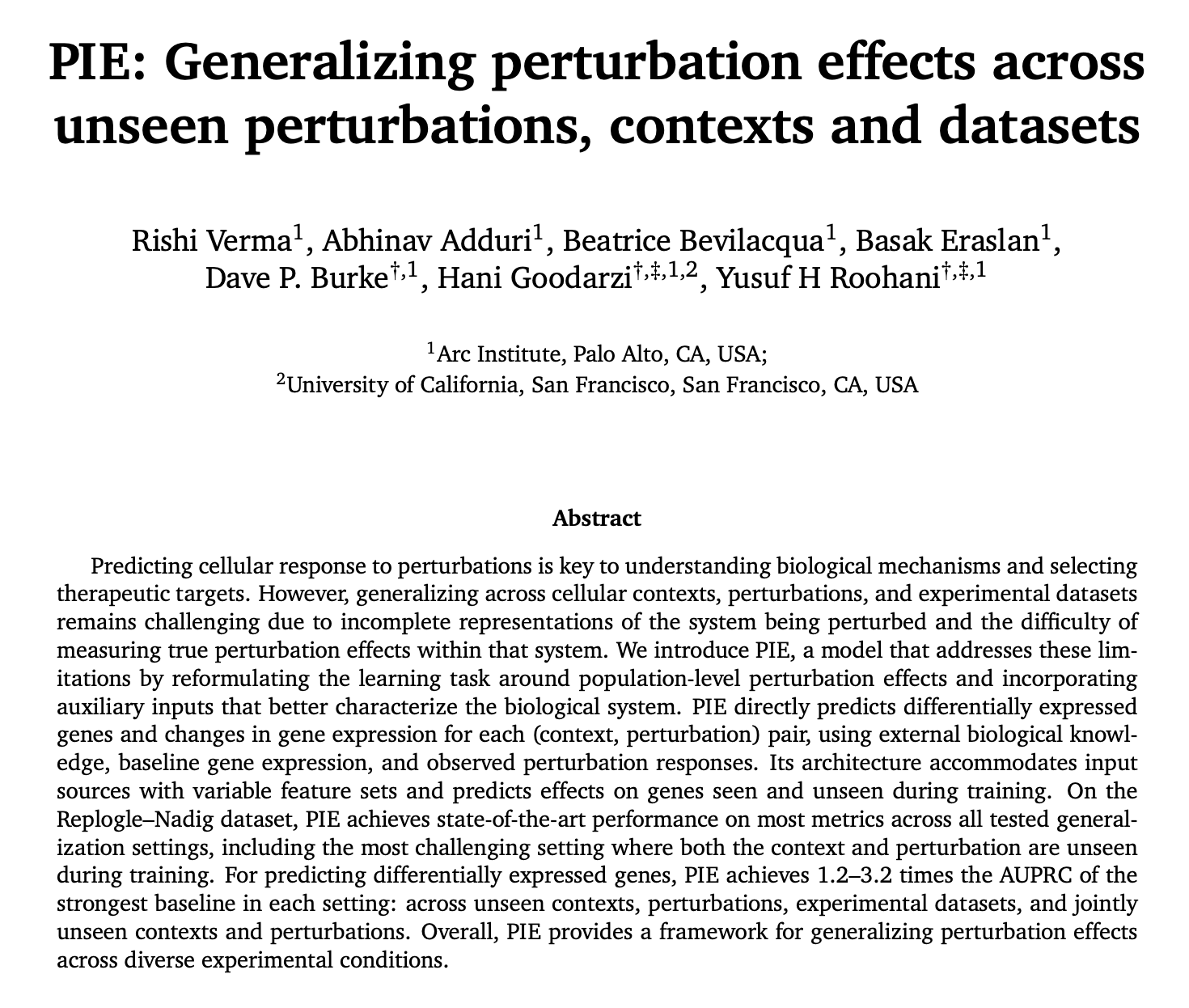
And I’d love to share my first ever preprinted work PIE - Perturbation is Everything!
Generalizing across unseen cellular and experimental conditions is challenging but essential to therapeutics discovery. Our latest model PIE addresses this challenge by simplifying the learning objective and leveraging curated biological knowledge from public databases. PIE generalizes across a combinatorial space of perturbation studies, unseen cell lines and unseen perturbations.
Check out the preprint at doi.org/10.64898/2026.10.02.…
Huge shoutout to the team at @arcinstitute for driving this project:@abhinadduri , @beabevi_ , @basak_ersln , @davey_burke , @genophoria , @yusufroohani .



Rishi Verma retweeted

Our CellularAI algorithm won @arcinstitute’s Virtual Cell Challenge! 🏆🧬 Here’s how we built a method to predict cellular responses to perturbations in unseen cell lines. 🧵👇

Rishi Verma retweeted

Each word you say is planned by a small patch of brain above your left ear, about a quarter of a second before you say it. It sits in a temporal lobe region textbooks describe as only for listening. Our paper today in @ScienceMagazine: science.org/doi/10.1126/scie…
@UCSF @NeurosurgUCSF

Rishi Verma retweeted

A few years ago, we were just a group of researchers chasing unconventional bets in AI.
That journey took us from new architectures like Hyena, to Evo and creating the field of generative genomics, to a much bigger realization.
We need AI that can understand biology as a whole. We started @RadicalNumerics to pursue that vision.
Here’s a conversation with my cofounders on how we got here, why we took the leap, and what we believe comes next.
Rishi Verma retweeted
I always wondered if multiomic models would enhance diagnostics. Now we know it does.
When finding a needle in the haystack, like detecting cancer from blood, I always thought, "wouldn't you want every signal / modality you can get your hands on?"
We post trained Omnii on methylation 5HMC, fusing 28 pretrained multiomic modalities - improving sensitivity and specificity across the board on pancreatic and multicancer early cancer detection (especially stage I and II). Extremely exciting direction!

Rishi Verma retweeted
I'm excited to share that @tri_dao has joined @RadicalNumerics as a scientific advisor!
Tri and I were labmates at Stanford's Hazy Research, where he pioneered advances in efficient ML systems (FlashAttention).
Scaling AI across multimodal biological data demands entirely new approaches to ML systems, and Tri will help guide our research at this frontier.
Welcome aboard, Tri!
Read more: radicalnumerics.ai/blog/tri-…

Rishi Verma retweeted

We assembled the Avengers to tackle the grammar of RBP-RNA interactions, especially how structure shapes who binds what: @MKarimzade, Lisa Fish, Heather Karner, @jjohlin, Ali Emadi, @drklly, @BoWang87, @hsnajafabadi, @LeonettiManuel
RNA-binding proteins (RBPs) recognize RNA by sequence and shape, but which matters varies by site. Introducing Pythia, an interpretable AI model trained on a new high-resolution atlas of 67 RBPs—a collaboration between the @genophoria lab, @czbiohub, @UCSF, @Calico, and @vectorinst.

Rishi Verma retweeted

Today we're launching the Alzheimer's Translation Challenge, a global AI competition to discover new therapeutic hypotheses for Alzheimer's disease.
At its core is a new 150M cell atlas of neurons, astrocytes, and microglia across different genetic backgrounds under combinatorial perturbations, with multi-modal readouts.
The data will be made available through the AD workbench, Hugging Face and Prima Mente's modeling platform.
The challenge is led by @PrimaMente and @AlzData in collaboration with @nvidia, @huggingface, @nebiusai, Talisman Therapeutics, @UltimaGenomics, @cellanome, @PrimeIntellect, @GoodfireAI, and @boltz_bio.
In 1906, Alois Alzheimer described a new disease of the brain. After 120 years of progress, we still don't fully understand what drives this disease. We want to change that.
Participants will use the dataset to build AI models, assessed through a series of evals from general benchmarks to more complex tasks.
Top teams will be shortlisted, and their experimental hypotheses tested in Prima Mente's wet lab. Teams win when their hypotheses demonstrate the predicted molecular and functional effect.
Rishi Verma retweeted

Today, we're releasing the Carbon Annotation Database and the model behind it, Carbon-A.
We've used this model to discover 566.34 million new gene candidates across 22,617 species, thousands of which have never been studied like this before.
We wet-lab validated a number of these new genes in well-studied species, such as in cats, chicken, and arabidopsis (plant), with our partners at Active Site and @UCSD, with more extensive wet lab results on previously-unstudied genomes coming soon.
Rishi Verma retweeted

Active learning practitioners choose an acquisition strategy before any labeling, but the best one changes with dataset, model, and task. What if we didn't have to pick just one? Introducing FractAL, a soft-strategy selection method (w/ @_romain_lopez_ ) arxiv.org/abs/2610.05544

Rishi Verma retweeted
Incredibly, incredibly excited to introduce SpliceAI2, the next generation of splicing prediction! 🧬🚀🧵


Rishi Verma retweeted

There are two major issues holding back perturbation models from generalizing across conditions: system representation and signal identification
Rishi Verma retweeted

At Arc we have a compounding delivery cycle for our AI/bio models, with model candidates every 6 months. Sometimes we have spinoffs where we explore ideas and cherry pick ideas forward. PIE is one such example. It explores how far we can push using prior biological knowledge sources to make direct differential expression predictions. Useful result as we build towards more general cell simulators. Congrats @i_m_rive, @genophoria, @yusufroohani and team.
Rishi Verma retweeted
Check out PIE! Our latest perturbation generalization model from @arcinstitute. Congratulations to everyone, but especially @i_m_rive and @yusufroohani!
Rishi Verma retweeted

The code is on GitHub, with model checkpoints and data on Hugging Face.
Learn more about PIE from co-authors @i_m_rive and @genophoria: arcinstitute.org/news/pie
Or access the preprint: biorxiv.org/content/10.64898…

Most models are specialized to be evaluated on unseen contexts or unseen perturbations, not both. The grey columns in the figure indicate regimes where these models could not be evaluated natively. PIE’s flexible architecture and data representation methodology allows generalization across both axes, even simultaneously.
On the Replogle-Nadig dataset, PIE was up to 3.2x better than the strongest baseline at identifying differentially expressed genes, with the biggest gain on unseen perturbations. It still made meaningful predictions when context and perturbation were both unseen.

2
147
Perturbation datasets are limited by scale and sparsity. ML models need to leverage prior biological knowledge to augment their representation of the biological system and perturbation/interference. PIE draws inspiration from the Perceiver IO architecture and ingests a variable set of heterogeneous knowledge sources, each with its own shape.
The gene vocabulary isn’t consistent across perturbation datasets. Instead of restricting the model to an intersection of genes measured across datasets or imputing measurements, PIE leverages natural language descriptions of genes to represent them, therefore being able to generalize to genes it hasn’t seen before in training.
PIE does this by turning public databases (Cellosaurus, NCBI Gene, Gene Ontology, DepMap, PubChem) into inputs.
Each gene is represented by its text description, so PIE works across the different gene sets measured in different studies.

95