

주재숙 retweeted

Stanford figured out how to clone a human personality from the inside an LLM.
And it gives them the terrifying ability to predict what you’ll think, feel, and say before you do.
For years, making an AI "act like someone" was purely superficial.
You’d feed it a system prompt, paste in a few writing samples, and hope it mimicked the right tone. It copied the surface, the slang, the punctuation, the catchphrases, but broke the second you pushed it off-script.
Stanford researchers changed the game with HumanLM.
Instead of teaching an LLM how a person writes, they used reinforcement learning to model how a person thinks.
Drawing on psychology, they mapped the human inner self across 6 core axes:
• Beliefs
• Goals
• Emotions
• Values
• Stances
• Communication styles
Before generating a single word, the model infers what that specific person is actually thinking, feeling, and aiming for in that exact moment, then uses RL to lock in that internal state.
And the results aren't even close.
They tested it on 216,000 responses from 26,000 real people across 6 domains, from emails and book reviews to political blogs and news comments.
It crushed every existing method.
Even in a live, real-time test with 111 human participants, it took the #1 spot.
And the wildest part?
They open-sourced it.
Prompting copies your voice. This copies your mind.

주재숙 retweeted

RAG is officially dead 🤯
MIT built an AI that doesn't need RAG.
It’s called MeMo, instead of storing knowledge in a database, you train a small, dedicated Memory model on your documents.
At inference time, your main frontier LLM stays 100% frozen. No vector DB. No chunking. No weight access.
It simply interrogates the Memory model in 3 quick turns, like a detective questioning a witness, to pull exact facts and synthesize the answer.
The results are brutal:
• NarrativeQA (long documents): 53.6% vs. RAG’s 23.2% (more than 2x better).
• Noise test: Doubled the corpus with fake distractors. RAG tanked -6.2%. MeMo didn't flinch (+0.55%).
And the sleeper advantage? It’s completely plug-and-play.
Train the Memory model once. When they upgraded the main LLM from Qwen2.5-32B to Gemini 3.0 Flash with zero retraining, accuracy jumped +26.7% overnight.
We spent 3 years trying to fix AI memory by building better search engines.
It turns out, the answer was giving the model a second brain.

주재숙 retweeted

"한 사람이 권력을 너무 다 쥔 거 아님?" 대놓고 저격당하자 일론 머스크가 꺼낸 미친 반박 뭔지 앎?
방금 일론 머스크 NYT 딜북 서밋 인터뷰 영상 보고 진짜 어이가 없어서 웃음만 나옴.
인터뷰어가 일론한테 엄청 날 선 질문을 던짐.
최근 아마존도 위성 쏘려다 사고 났는데 지금 스페이스X가 우주 판을 완전 독점하고 있고 한 개인이 권력이 너무 큰 거 아니냐는 거임.
보통 대기업이나 빅테크 CEO 같으면 "저희도 치열하게 경쟁 중입니다" 하면서 쩔쩔맬 타이밍임.
근데 일론 답변이 진짜 미쳤음.
스페이스X는 방어용 빼고는 특허 자체를 안 낸다고 함.
경쟁사 앞길에 '특허 지뢰' 같은 거 심어놓은 적도 없고 오히려 우리 로켓이랑 위성 좀 따라 하라고 권장하고 있다는 거임.
심지어 호손 본사 앞 대로변에 로켓 하나를 떡하니 세워놨으니까 누구든 와서 치수 재고 그대로 베껴가라고 함.
고소 절대 안 할 테니까 제발 좀 해보라고 대놓고 판을 깔아줌.
이게 독점이냐고 되묻는데 할 말이 없어짐.
남들 못 하게 사다리 걷어찬 게 아니라 그냥 우리가 남들보다 압도적으로 잘 만들었을 뿐이라는 팩폭임.
테슬라 때도 전기차 시대 빨리 열리라고 특허를 싹 다 오픈소스로 풀었던 거랑 완전히 똑같은 행보임.
비유하자면 전국 1등 맛집 사장이 비법 레시피 다 공개하고 주방 문까지 활짝 열어놨는데 아무도 그 불맛을 못 내서 손님이 다 몰리는 격임.
내가 봤을땐 이게 3040 우리가 진짜 소름 돋아야 할 포인트임.
보통 기업들은 특허라는 종이 쪼가리로 울타리 치고 좁은 파이 지켜 먹으려고 아등바등함.
근데 일론의 진짜 해자는 특허가 아니라 남들이 베끼려고 허덕일 때 이미 저 멀리 도망가 있는 실행 속도와 기술 체급 그 자체임.
내 생각에는 이게 바로 좁아터진 유한맵에서 치고박는 게 아니라 판 자체를 키우는 무한맵의 사고방식임.
결국 테슬라와 스페이스X는 단순한 자동차나 로켓이 아니라 인류의 한계를 넓히는 이 철학을 파는 곳이라는 게 또 한 번 증명됨.
남이 내 밥그릇 뺏을까 봐 전전긍긍하는 대신, 그냥 베껴도 못 따라올 만큼 나만의 실력과 속도를 키우는 쪽으로 시선을 돌려보자.


주재숙 retweeted

I deleted Linux completely, baked Qwen3-0.6B into a 24 KB pure x86-64 assembly OS, and it runs up to 54% faster than native Linux llama.cpp.
The entire Multiboot OS binary (asm-llm-os.elf) is 24,252 bytes, written from scratch without Linux, Windows, C, Rust, or libc. It boots in 74 to 94 ms straight into 64-bit Long Mode, wakes every CPU core over APIC, maps the 614 MiB Q8_0 weights directly from physical RAM, and drops you into a live multi-turn KV-cache chat over VGA, PS/2 keyboard, and serial.
I ran head-to-head CPU benchmarks against llama.cpp (Q8_0, -ngl 0) on the same AMD EPYC 7642:
- 1 thread hits 23.67 tok/s vs 16.63 (+42%)
- 4 threads hit 78.89 tok/s vs 51.08 (+54%)
- 8 threads hit 118.08 tok/s vs 80.79 (+46%)
- 16 threads hit 134.94 tok/s vs 103.03 (+31%, 136.6 peak)
On a diskless 0 GB Proxmox VM (2014 12-core Intel Xeon E5-2670 v3, 2 GiB RAM), it boots straight to the prompt in under 5 seconds (95 ms kernel boot) and runs live out of RAM at 78 tok/s decode and up to 111.5 tok/s prefill, with a hybrid BIOS+UEFI ISO builder included too. Output stays bit-exact across thread counts and matches all 64 greedy tokens against PyTorch FP32 (0.99965 cosine).
The 14.7 KB Linux ELF build (FAST_Q8=1 INT8xINT8 AVX2+F16C) also beats llama.cpp by 18% to 36% from 1 to 40 threads, and booting bare metal with 2 MiB huge pages squeezes out another 10% on top.
Repo, ISO builder, and Proxmox setup guide are in the reply below.
주재숙 retweeted

GitHub is a goldmine for game developers.
I found 10 insane repos that can help you build AAA-style games using Claude Code and Codex.
Bookmark this for later:
1. Jolt Physics
The physics library used in Horizon Forbidden West and Death Stranding 2. Add rigid bodies, collisions, and believable physical interactions to your game.
github.com/jrouwe/JoltPhy…
2. Terrain3D
Build massive landscapes in Godot. Sculpt mountains, paint terrain, import heightmaps, and add foliage with multiple levels of detail.
github.com/TokisanGames/T…
3. Material Maker
Create procedural textures and paint directly onto 3D models. Build materials through visual nodes instead of making every texture from scratch.
github.com/RodZill4/mater…
4. Effekseer
Create particle effects for explosions, magic spells, combat, and environments. Export them as 2D animations or integrate 3D effects into your engine.
github.com/effekseer/Effe…
5. Voxel Tools for Godot
Build worlds players can dig through and destroy. Supports caves, tunnels, overhangs, and terrain that streams as players explore.
github.com/Zylann/godot_v…
6. Recast Navigation
Help enemies and NPCs navigate your levels. Generate navigation meshes, calculate paths, and simulate crowds with collision avoidance.
github.com/recastnavigati…
7. ozz-animation
Load, play, and blend character animations. A performance-focused library for building smooth movement into your own engine.
github.com/guillaumeblanc…
8. The Forge
Building a custom engine? Start with cross-platform graphics infrastructure, resource loading, and animation systems instead of writing everything yourself.
github.com/ConfettiFX/The…
9. meshoptimizer
Detailed models can crush performance. Optimize, simplify, and compress your meshes to make assets smaller and more efficient to render.
github.com/zeux/meshoptim…
10. FastNoise2
Build procedural terrain and texture generators. Combine noise patterns in a visual node editor, then load those setups into your game.
github.com/Auburn/FastNoi…
Give Claude Code or Codex the relevant docs and ask it to help integrate the systems your project needs.
What did I miss?


every day closer to GTA 6 feels like a fever dream. finally get to say we made it.
celebrated by coding raw visual assets in ChatGPT and letting the CapCut plugin edit those materials directly into a cinematic reunion.
if you wanna try making your own, CapCut web’s doing 90% off your first month for Black Friday. Try GPT-6.2 Astra now on CapCut plugin.
capcut.com/tools/capcut-x-co…
#GTA6 #ChatGPT #CapCutDidThat #CapCut62Astra
주재숙 retweeted

RPG Paper Maker
Build a 3D world with 2D sprites and 3D objects
The engine gives you a simple interface for building game worlds, with pictures and music included in Basic Resources.
It runs in a web browser and on Windows, Linux, and MacOS.
The editor manages your game's JSON files, and game scripts read them.
A JavaScript build of those scripts can run in the browser and be edited in real time without compiling.
github.com/RPG-Paper-Maker/R…

주재숙 retweeted

혼자 게임 만드는 분들을 위한 AI 도구 18개, 용도별 정리
1. 기획 & 진행 관리
- eremes81/game-design-ai-practice: 24년 차 게임 기획자가 쓴 Claude Code 실무서예요. 전투·밸런스·레벨 중 필요한 챕터를 골라 예제 코드를 돌려보면 됩니다
- dudwns0921/claude-gamedev-kit: 게임 폴더에 설치하고 "아늑한 농장 게임 만들고 싶어"라고 말하면 에이전트들이 스펙, 디자인, 빌드를 돌려요. 진행 상황은 대시보드로 봅니다
- OpenDCAI/GameFactory-3A: 요구사항을 주면 이미지·3D·모션·사운드를 만들고 UE5·Unity·Godot·three.js 코드까지 짜줘요
2. AI가 엔진과 툴을 직접 조작
- Unity-Technologies/skills: 유니티 공식 스킬이에요. 프로젝트 생성·빌드·패키지 관리를 에이전트가 맡아요
- EL4CTEO/blender-skills: 블렌더 스킬 28개. 모델링·UV·리깅·베이킹·익스포트를 말로 시킬 수 있어요
- scenario-labs/skills: 텍스처·스카이박스·3D 에셋을 만들고, Blender·Maya·ZBrush·Unreal·Unity를 다루는 전문가 스킬도 들어 있어요
3. three.js 웹게임
- majidmanzarpour/threejs-game-skills: "threejs-game-director로 만들어줘" 하면 게임플레이·그래픽·UI·사운드·검증을 나눠 맡겨요
- MengTo/Skills: 디자인 스킬 모음인데, 전투 애니메이션·몬스터 시스템·레벨 작성·플레이 테스트 같은 게임 스킬도 골라 쓸 수 있어요
- lovisdotio/video-to-game: 게임플레이 영상을 넣으면 프레임을 분석하고 에셋을 만들어 브라우저 게임으로 바꿔요 (fal API 키 필요)
- viettranx/3dviz-pro-max: 아이디어 한 줄을 돌아다닐 수 있는 3D 씬으로 바꿔줘요
4. 이펙트·예제·최적화
- achrefelouafi/LinearAbiltyCastingThreeJS: 이펙트를 셰이더 코드로 직접 짠 롤식 스킬샷 샌드박스. 이펙트 코드 공부하기 좋아요
- boona13/mykonos-island-voxels: 14×14 격자에 클릭으로 블록을 쌓는 아이소메트릭 마을 빌더. 빌드 시스템 참고용으로 좋아요
- gykim80/andrew_game_perf: AI가 짠 게임 코드에서 프레임 드랍 패턴 10가지를 찾아 고쳐줘요 (Three.js·PixiJS·Phaser·React)
5. 2D 스프라이트 & 픽셀아트
- aldegad/sprite-gen: 기준 이미지 한 장으로 같은 캐릭터를 유지한 채 포즈별 투명 프레임과 스프라이트 시트를 뽑아줘요. 모션 루프 영상도 됩니다
- handsupmin/mono-pix: AI가 만든 가짜 픽셀아트의 흐린 경계와 어긋난 격자를 진짜 픽셀 그리드로 고쳐줘요. 브라우저에서 무료, 설치 필요 없어요
6. 3D 모션 & 애니메이션
- MaxLiu22/Motion2MixamoRig: 한 사람이 나오는 동작 영상(사진도 가능)을 Mixamo 캐릭터에 입혀 내보내요. 블렌더 애드온 버전은 코딩 없이 쓸 수 있어요
- Friedrich-M/UniMate: 사람·네발짐승·새·뱀처럼 뼈대가 달라도 텍스트 한 줄로 애니메이션을 만들어요. 내가 리깅한 GLB·FBX 모델도 넣을 수 있어요
- alchaincyf/3d-vibe-coding-handbook: 이미지로 3D 모델을 만든 뒤 폴리곤 줄이기·리깅·애니메이션까지 직접 해보고 쓴 386쪽 핸드북(중국어). 문제 증상별 색인이 알짜예요
일부는 비영리 라이선스라, 상업 게임에 쓸 땐 꼭 확인하세요.
혼자 게임 만드는 분들은 에셋이랑 모션만 AI한테 맡겨도 체감이 확 달라요.
써보고 괜찮았던 도구 있으면 댓글로 알려주세요.
주재숙 retweeted

Everyone is fine-tuning LLMs.
Almost nobody understands what is actually being updated inside the model.
Here are 5 techniques that change how you think about model adaptation, and what each one is actually doing to the weights:
1./ LoRA - Learn the update, not the weights
The pretrained weight W is frozen. Completely untouched.
Instead of updating W directly, two small matrices are trained =>
A ∈ ℝʳˣᵈ and B ∈ ℝᵈˣʳ, where r ≪ d
The weight update is: ΔW = BA Effective weight: W' = W + BA
The entire adaptation happens in a tiny low-rank space. W never changes.
2./ LoRA-FA - What if we freeze even more?
Same structure as LoRA. One change.
A is frozen alongside W. Only B is trained. Effective weight: W' = W + BA (A is fixed)
Half the trainable matrices of LoRA. Same core idea. Fewer parameters.
3./ VeRA - What if the matrices don't need to be learned at all?
This is where it gets interesting.
A and B are both frozen, and randomly initialized. What gets trained are just two tiny scaling vectors =>
b ∈ ℝʳ and d ∈ ℝʳ
Instead of learning the low-rank matrices themselves, VeRA keeps them frozen and learns small scaling vectors that modulate their contribution.
Initialization => b = 0, d = 1
You're not learning matrices. You're learning how to scale them.
One of the most parameter-efficient techniques on this list.
4./ Delta-LoRA - What if W itself learns from the low-rank updates?
This one is fundamentally different.
Unlike standard LoRA, the base weight W is not fully frozen. It is updated through low-rank delta propagation at every step =>
W^(t+1) = W^t + c(B_(t+1)A_(t+1) − B_t A_t)
Where c is a scaling factor.
A and B are trainable. W evolves, but guided entirely by low-rank changes.
5./ LoRA+ - Same structure. Smarter learning rates.
Identical to LoRA, freeze W, train A and B.
One change => B is assigned a larger learning rate than A. η_B > η_A
A ← A − η_A · ∂J/∂A B ← B − η_B · ∂J/∂B
A small optimization change that can make LoRA training more effective.
The core idea running through all five:
You do not always need full fine-tuning to adapt a model.
LoRA updates two matrices.
LoRA-FA updates one.
LoRA+ updates two at different speeds.
Delta-LoRA lets W evolve - guided by low-rank deltas. VeRA updates two vectors.
Same goal. Five different answers to the same question:
=> What is the minimum we actually need to learn?
That is the core idea behind parameter-efficient fine-tuning.
And now you know what is actually happening inside the model.
Happy Learning!!!

주재숙 retweeted

Memory is what allows Claude to learn from experience. In a new Engineering Blog post, we share how “dreaming” helps Claude organize what it’s learned, correct its mistakes, and find what it needs more easily the next time. anthropic.com/research/compo…


주재숙 retweeted

📖 The Ultimate MoE Training Handbook 📖
We spent 1/2M GPUh to optimize MoE training and wrote the most comprehensive blog about it. With 30k words and 50+ interactive figures it covers everything from profiling to large cluster training.
huggingface.co/spaces/huggin…
주재숙 retweeted

NeurIPS 2026 Spotlight! 🌟 Physics simulators like MuJoCo MJX are changing robotics. But for studying the sensorimotor learning of speech, there's no equivalent. We built diffTLM, a differentiable vocal tract simulator, to help close that gap. (1/6)
주재숙 retweeted

Imagine MetaSynth, but in reverse. Instead of turning images into sound, I guided Claude to use code to paint pictures with audio frequencies while composing the audio at the same time. Faces, birds and spirals. No DAW, MIDI or samples.
#CreativeCoding #ClaudeAI

주재숙 retweeted

A new technique just made attention 23x faster!
At 10M tokens, sparse attention slows down not because of attention itself but rather because of deciding which keys to attend to.
Let's understand why and how a new technique solves it without scanning every key.
1) Full attention at long context:
In full attention, every query is compared against every earlier key. This leads to O(T^2) complexity for prefill, and at 10M tokens it dominates the forward pass.
2) Sparse attention:
Sparse attention lets each query read only a small set of <k> keys instead of all of them, so the attention becomes cheap.
But something still has to pick those <k> keys, and at long context, this step becomes the bottleneck.
3) Why picking keys is still quadratic:
DeepSeek's DSA uses a lightning indexer that scores every earlier key. GLM-5.3-Flash pools 4 keys into 1 before scoring. NSA, MoBA, and Quest score blocks of nearby keys.
Each of them scans the whole context for every query, so the indexer stays O(T^2), and at 10M tokens, it takes 98% of the layer's time.
Block methods have another issue. Blocks group keys by position, so one relevant key within filler can get averaged away in the block summary.
4) How LSA picks keys:
Latent Sparse Attention (LSA) is a new approach that groups keys by meaning instead of position.
- Each key is projected into a 64-dim index space, and every 4 consecutive keys are pooled into one.
- When a 512-key block fills up, it's clustered into buckets of ~8 similar keys, with one centroid per bucket. Finished blocks are never rebuilt.
- A query scores only the centroids, keeps the top 1,024 buckets, and expands them into 4,096 keys, plus 4 sink tokens and the 512 most recent keys.
- Exact FlashAttention then runs over that list with an unchanged kernel.
If you've built RAG, this is like cluster-based vector search running inside attention. The kernel design even cites FAISS.
At 10M tokens, LSA's prefill is 72.4x faster than full attention on Qwen-3.8-27B and 22.7x faster than GLM-5.3-Flash's own sparse attention.
The time to first token improves:
- 9.2x on Qwen
- 2.2x on GLM
Below ~512k tokens, it's roughly break-even.
Here's the paper: arxiv.org/abs/2610.42147
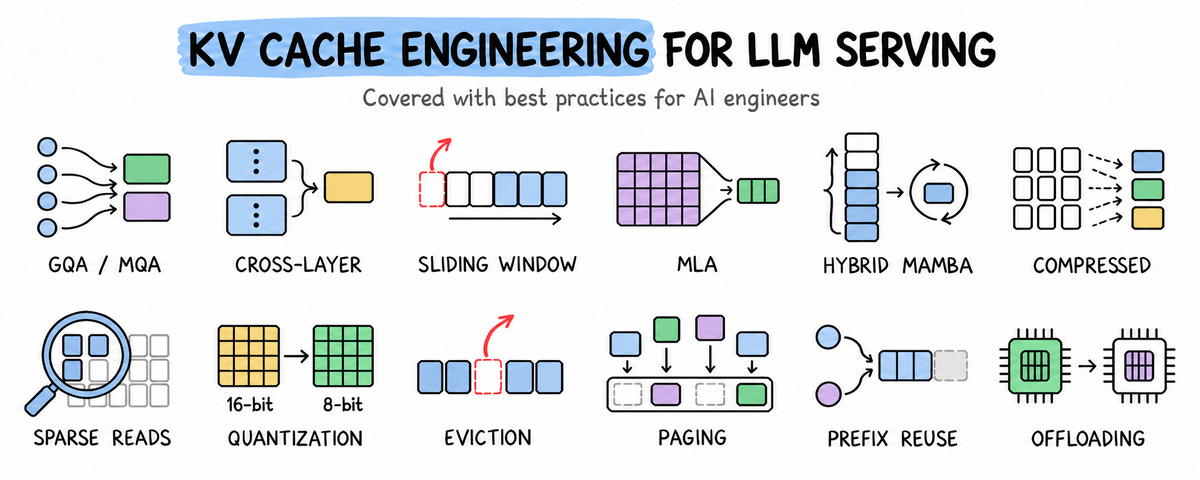
That said, LSA attempts to find the keys more cheaply, not storing them. The KV cache still grows linearly with context, and at 10M tokens, managing that memory becomes the next engineering problem.
I wrote an article on how 12 ways serving systems handle it, covering paging, offloading, quantizing, and more.
Read it below.

주재숙 retweeted

Andrej Karpathy 본인이 만든
교육용 GitHub 저장소들을 “무료 AI 학위 과정”
정리한 내용
답글에 나열된 저장소 순서:
1. micrograd — 역전파 (약 100줄)
2. nn-zero-to-hero — 뉴런부터 GPT까지 강의 노트북
3. minbpe — 토크나이저
4. nanoGPT — 가장 단순한 GPT 학습/파인튜닝
5. llm.c — PyTorch 없이 C/CUDA로 학습
6. nanochat — 엔드투엔드 채팅 모델
7. autoresearch — 연구하는 에이전트
[ 추천 이유 ]
Karpathy가 직접 만든 코드와 강의(YouTube “Neural Networks: Zero to Hero”)가 연결되어 있습니다.
특히 micrograd와 nn-zero-to-hero는 역전파부터 GPT까지 단계적으로 설명해서 입문·중급자에게 평가가 좋습니다.
nanoGPT, minbpe, llm.c, nanochat, autoresearch도 같은 계열의 실습용 저장소입니다.
무료이고, 코드가 비교적 짧고 명확합니다.
--------------------------------------------------------
이 순서대로 진행하는 게 좋습니다.
micrograd → nn-zero-to-hero (영상 + 노트북) → 그 다음 토크나이저/nanoGPT 쪽.
코드를 직접 타이핑하고 실행하면서 이해하는 방식이 효과가 큽니다. 그냥 읽고 넘기지 마세요.
Python과 기본 미분(고등 수준) 정도만 있으면 시작 가능합니다. 고급 수학은 필수 아닙니다.
전부 다 하지 않아도 됩니다. micrograd + nn-zero-to-hero만 제대로 해도 LLM 동작 원리를 꽤 깊이 이해할 수 있습니다.

주재숙 retweeted

We know the equation for how light moves through a cloud. Solving it just takes way too long for a game.
So, I trained a tiny neural network to learn the answer and put it inside a neural shader. Watch the middle number.
charlesgrassi.dev/blog/neura…
#shaders #gamedev
주재숙 retweeted

In 2015, a 74-layer neural network scored worse than an 8-layer one. One line of code fixed it - add input to output every two layers. That idea became the most cited paper of the 21st century and created the residual stream inside every LLM and every transformer on every GPU cluster today.
The problem was shattered gradients - as depth grows, the learning signal degrades into white noise. Skip connections bypass it with an unbroken data highway. Delete a layer from a 56-layer ResNet and nothing breaks. Meta found that vision transformers hijack unused image patches as improvised register tokens - working memory that the model invents for itself inside the residual stream.
Bookmark & watch today. The one-line hack behind every AI model you've ever used.


주재숙 retweeted

DeepSeek Harness 팀에서 공개한 코딩 에이전트. 구조가 인상적임.
dsh-superagent-prototype
github.com/deepseek-ai/dsh-s…
여기 레포가 주목받는 이유는 모델 성능보다도 사람과 에이전트가 어떻게 협업할 것인가.. 이걸 풀어냈기 때문.
일반적인 Codex, Claude Code처럼 개발자가 직접 명령을 입력하는 방식에서 한발 더 나아감.
GitHub에서 발생하는 이벤트를 관찰하고, 허용된 작업을 스스로 판단해 실행하고, PR까지 만드는 시스템. 스스로 판단한다는거.
사람의 개입을 최소화하는 철학이 여기서 중요하다고 봄. 진행 상황 계속 알릴 필요 없고, 의사결정 시점에만 노티하도록 설계함.
라이프사이클을 고려해서 지속적으로 작업 컨텍스트를 유지하는게 좋음.
개발팀 관점에서도 AI를 멤버처럼 운영하는 시스템이라는 점에서 여러 인사이트를 얻을 수 있음.
