


issaco (@issaco) profile picture

The best way to predict the future is to invent it. - Alan Kay.

Joined August 2008
Photo by issaco (@issaco)Photo by issaco (@issaco)Photo by issaco (@issaco)Photo by issaco (@issaco)Photo by issaco (@issaco)Photo by issaco (@issaco)Photo by issaco (@issaco)Photo by issaco (@issaco)Photo by issaco (@issaco)Photo by issaco (@issaco)
The articles backtracked from their original incendiary, and now clearly false, claims to something more like "Jensen did lawful things that powerful people didn't like". It still appears the original claims came from a single competing Big Tech lobbyist. The reporting successfully disrupted corporate governance processes, with a running cost of $1.8 trillion in losses to American pension funds and shareholders. Here's what I fear is being lost in these articles: The proper interface between government and private citizens and their corporations is rule of law. Laws are passed, and if wrongdoing as alleged, then there's due process: an investigation followed by facts and evidence presented in open court. Due process should happen here: let the facts come out whole, and not as a trickle of dubious claims. Press takedowns full of sketchily sourced claims and backtracking narratives are not the way. It's what we see outside of the free world, and is no model for The United States of America. In particular, if the Jensen takedown succeeds on the basis of these journalistic failings, which is not by any means certain as Sam Altman's case shows, then it foreshadows an economically and institutionally ruinous new playbook to be adopted with no end in sight. Imagine a weekly stream of takedowns emerging from opportunistic alignments between corporate lobbyists and political interests which, given the new partisan split between the executive and legislative branches, will attack in all directions, undermining not only the US economy but American leadership in the world. I hope cooler heads prevail this coming week as they did not on Thursday November 12. And I urge anyone who happened to oppose Jensen, open models, and the underlying trade policies in question, to recognize that this isn't a win for "team regulation". It's a change in the game from a transparent rules-based one to a sinister new form centered around politicans and lobbyists.
417
1,725
187
12,150
1,557,663
What?! So journalists with sketchy motives portrayed rumors from god-knows-who (lobbyists?) as facts sourced from intelligence officials and gaslit the NVIDIA board to push out the founder, CEO, and once-in-generation visionary? This raises serious corporate governance issues.
Bombshell story. The spy narrative is collapsing already. Is there clear & convincing evidence that Alice Huang was a Chinese spy? - AG says no. (“no conclusions reached”). - CIA says no. (“not yet convinced”). - DNI says no (“not entirely accurate and over-torqued”). - Ranking Democrat on House Intelligence (incoming Chairman) says no. (“today, at least, I don’t know”). This was immediately after he was briefed. Who argues otherwise? Anonymous officials tell CNN “it strains credulity to believe that she was not acting as an agent of the Chinese government — simply by virtue of the fact that she is a successful Chinese businesswoman working with one of America’s most powerful companies.” This is their proof after a year of investigating and surveillance? That she was a “successful Chinese businesswoman”? At this point, the only crime that we know for sure happened is the leaking of the classified memo. Who did that and why? An investigation should be opened.
627
1,337
121
12,653
3,404,515
For my first post, I’m sharing a letter @NVIDIA signed on why open models matter. AI will transform every industry, power every company, and be built by every country. Open models strengthen safety and cybersecurity, accelerate innovation and diffusion, and enable sovereignty. The world needs both frontier closed models and frontier open models. images.nvidia.com/pdf/Open-W…
16,560
34,443
12,071
193,725
69,392,959
NEW: Dario Amodei has said that AI systems "may be deserving of important rights." Anthropic's top safety researchers argue AI may be "justified in going rogue." Experts at Google and OpenAI worry about a digital "slave trade." So do some government officials. Once relegated to science fiction, the idea of "AI welfare" has become shockingly mainstream at some of the most powerful companies in the world. It is changing the way AI research is conducted and the way models are programmed. And critics say these changes have raised the odds of all kinds of catastrophic scenarios—including the ones these companies are warning about. I spent months investigating the frontier labs and AI "safety" experts seeking to regulate AI. What I found was a profoundly anti-human ideology that would alarm the average citizen and could determine the future of a world-altering technology.🧵 freebeacon.com/america/suici…
277
313
372
1,234
746,770
issaco retweeted
There's no reason for software to be slow anymore: danluu.com/perf-opt/
15
62
11
751
53,629
So proud of our security team! They caught, contained & publicly disclosed an attack unlike anything we've seen before, and did it at record speed. Also massively grateful to @Zai_org: they shared GLM5.2 as open weights (for free!) with the world and it became a key part of our defense. This is day one for cybersecurity in the age of agents & we're all learning that secrecy is not the answer & that all defenders (not just a few selected ones) everywhere need more powerful models without restrictions, especially open ones!
Hardest IR of my career: one narrow objective, endless parallel paths, machine speed. One takeaway, we fought back with open models, in the open. AI security won’t be solved by one company in secret. Open source puts these tools in every defender’s hands
175
677
139
4,845
505,755
Defenders need to have access to good models so they can close security holes permanently. The incorrect model people work off of is that there is an unbounded number of security holes in the world, and that if you get smarter and smarter AI, that means you’ll just keep finding security holes forever. That’s not true. If you give everyone developing software access to good AI models, they will close off the holes, and eventually, the well of security vulnerabilities dries up. AI isn’t a crisis for computer security, it is a solution. The best hope we have of climbing out of the computer security crisis that we have been in since 1988 is letting developers fix the problems using AI systems.
I have a report full of security issues of a software I'm working on. Codex won't fix them because of Cyber guardrails Fable won't fix them because of Cyber guardrails Kimi K3 fixed them all. No restrictions, just gets the job done. This will end badly for OpenAI & Anthropic.
4
10
77
5,264
One can imagine an alternate reality of the 1990's when 3D games rapidly emerged if the makers of the era were run by brazen opportunists who employed teams of lobbyists seeking regulatory capture: scare the world into thinking 3D graphics might be an existential threat.
18
13
1
215
13,548
As believers of open research, we are disappointed to see Anthropic silently degrading Fable 5 for AI development "Any topic related to building pretraining pipelines, distributed training infrastructure, or ML accelerator design... may have limited effectiveness through Claude via methods such as prompt modification, steering vectors, or parameter-efficient fine-tuning." Not only do they get to decide what you use LLMs for in research, but this also enables them to silently intervene in your research without you knowing. This sets a dangerous precedent. If a model refuses openly, users can understand the boundary. If a model falls back to another model, users can still evaluate the difference. But if a model silently modifies or weakens its own answers while still pretending to help, researchers lose the ability to know whether a failed result came from their own idea, their implementation, or an invisible intervention by the model provider. That is not safety. Safety policies should be transparent, auditable, and user-visible. On top of that, the people most harmed by this are not the largest labs with massive teams and proprietary infrastructure. It is the independent researchers, academic groups, startups, and open-source builders who rely on public tools to compete, innovate, and pioneer AI for everyone else.
155
683
115
3,791
235,914
Co-sign.
We asked the CEO of HuggingFace @ClementDelangue what the risks of releasing powerful open source models are. He says restricting AI creates more risk than openness. "Six, seven years ago, at the time it was GPT-2, and there was already a lot of people saying that it was too dangerous to release in open source." "Mythos, when it was announced was crazy dangerous... In a few weeks or a few months, everyone is gonna be using Mythos, and not destroy the world as a result." "For cybersecurity, the biggest risk is that a few players have capabilities that other people don't have... If you make it more open, it's usually easier for defenders to react and make the whole system safer." "The idea of restricting a technology like AI based on risks is like saying, 'Some people can punch other people, so let's tie down everybody's hands.'" "Otherwise you slow down progress, you create massive gaps in terms of controls, in terms of capabilities, and you create actually additional risks."
33
30
3
388
95,900
> "there's a workaround (use "/effort max")" This is so dystopian. The future is going to be full of this shit.
basically: anthropic sneakily turned down how hard claude thinks before editing code, changed the default from "high" to "medium" effort, and hid the reasoning from session logs. all without telling users. an amd director had 7k sessions of telemetry to prove the degradation was real and measurable (not just vibes). anthropic admitted to the changes. there's a workaround (use "/effort max"). the uncomfortable part is most users had no data to notice it happened at all.
5
2
64
6,297
Replying to @WindowsLatest
Debloat it guys, don’t preload the bloat.
137
186
17
9,734
249,573
Replying to @ChrisMurphyCT
You're being played by people who want regulatory capture. They are scaring everyone with dubious studies so that open source models are regulated out of existence.
244
846
220
8,618
1,006,769
I'm old enough to remember when a "new browser" meant someone actually wrote a rendering engine.
39
102
9
2,709
62,515
Long article in the NYT today about "cloud compute and data centers killing water supply"...and then you find out the number they mean less than one golf course or small corn farm or tiny rice paddy. Be serious, people.
25
72
10
526
75,723
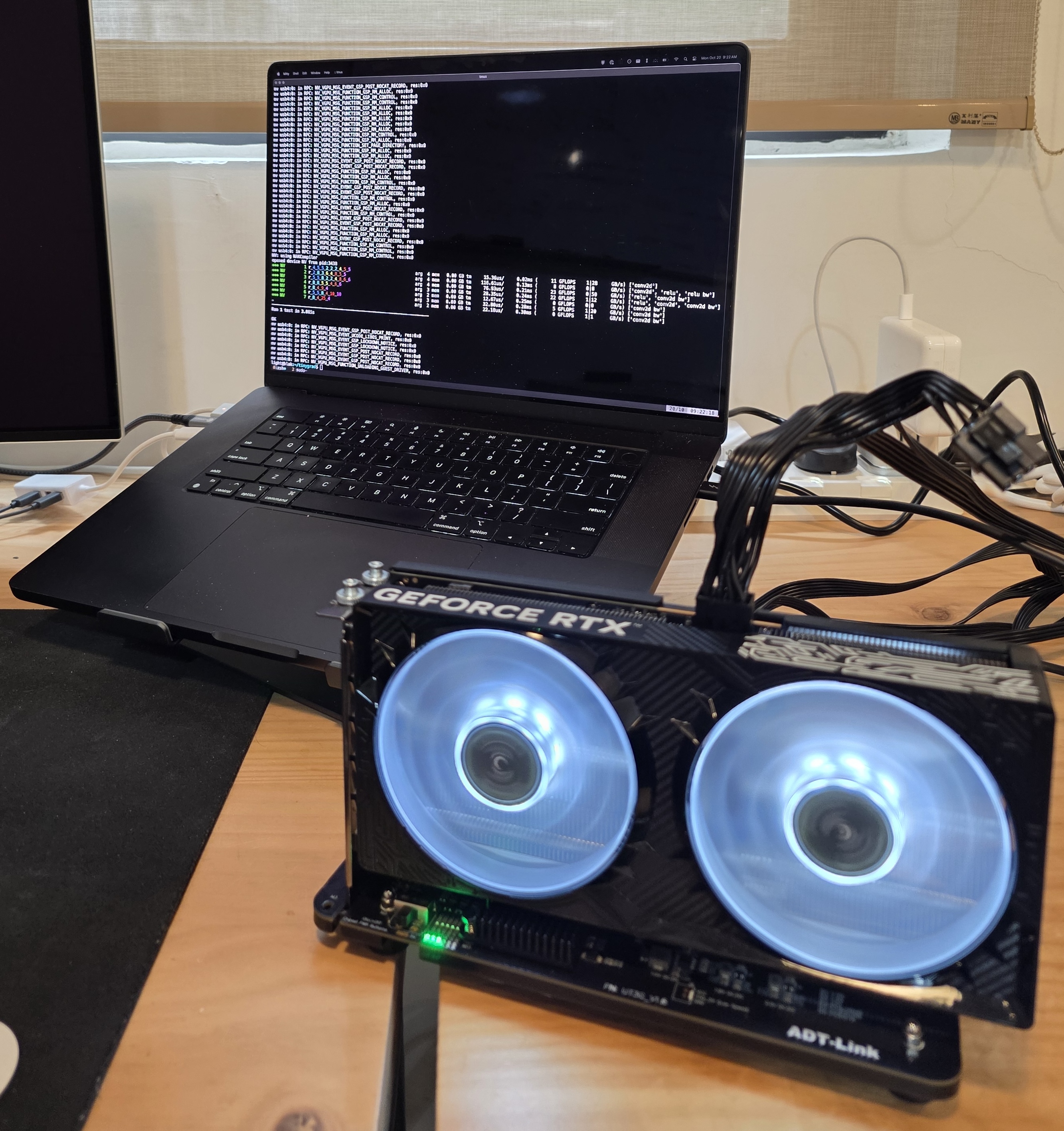
NVIDIA over USB4 on MacBook is ready to try! * ADT-UT3G dock + any 30/40/50 series GPU * Disable SIP * Install driver `extra/usbgpu/tbgpu` * Install NVK compiler `brew install tinymesa` * Test with: `DEBUG=2 NV_NAK=1 NV=1 python3 test/test_tiny.py TestTiny.test_plus`
121
286
78
2,651
262,745
新聞稿沒說清楚的是,在美國生產第一片Nvidia Blackwell晶圓後,接著還是需要運送到台灣做CoWoS封裝,Blackwell晶片生產才算完成。兩年後的今天,如果能在美國開始先進封裝,進度已算超預期。 blogs.nvidia.com/blog/tsmc-b…
9
37
9
467
75,949
It's easier to innovate when you're the original of something. People copying you can only copy a snapshot of your current state. They don't know which aspects of the snapshot are essential and which are random things you'd been about to change anyway.
206
414
88
3,424
224,235
We beat Nvidia’s cuBLAS kernels on B200s in 170 LOC. Using zero CUDA. Just pure Mojo. Here’s exactly how we went from 1% to 106% of Nvidia benchmark perf from scratch (with code) 👇🧵
44
138
19
1,178
122,206
Guido gets it. There are 4 million developers on the CUDA platform that develop highly specific NVIDIA code. With the new wgmma & tcgen05 ISA, porting is 10x harder. Previously with SIMT ISA & wmma API, it was much easier to port
Yes, this is exactly it. 3rd parties develop highly specific NVIDIA code, now any other hardware developer has to spend $$$ to replicate that.
7
11
5
173
27,803