

Software Engineer / Geek / Tech Wizard / Open-Source Developer / GNU Emacs and GNU/Linux User / Wikipedia Editor, Mentor, and Trainer
Poland
Joined May 2010
- Tweets37.2K
- Following436
- Followers3.8K
- Likes15.5K




Pinned Tweet
Finally got a job interview. Fingers crossed. 🤞

ALT Microsoft Teams meeting: "Senior Frontend Developer"

Jakub T. Jankiewicz 🇵🇱 retweeted

People are missing the point of Ginux.
I didn’t create another kernel to compete with Linux. That is idiotic!
In fact I consider the code disposable. Think about that…
Ginux wasn’t the product. The development process was the experiment. The kernel was the evidence.
Could AI, directed by an experienced engineer, could build and validate an extraordinarily complex software system.
In just 11 days, I produced an independent kernel capable of booting Rocky Linux 10 with systemd.
That was the experiment. And while Ginux isn’t a complete Linux aligned kernel, the experiment is complete.
The research paper documents the methodology, results, and limitations.
Since publishing, people have started finding bugs and security issues. That’s fantastic! Independent review is exactly how complex software gets better.
There has already been an initial security review, and there’s a remediation plan sitting in context that I’m considering implementing.
So the question is, since the experiment is complete, do I even do anything further here?
Maybe there is an interesting experiment in measuring how efficiently human-directed AI can fix the problems external reviewers discover?
How much time does it take to reproduce an issue, identify the root cause, implement a fix, and validate the result? How much human intervention is actually required?
That’s potentially an even more interesting situation than the original 11-day experiment.
Because the real question was never whether AI could replace Linux. Even if it can replace some aspects of its functionality, it can’t replicate the community, standards, collaboration, alignment, or stability.
If you still believe that Ginux was designed to be a Linux replacement, you should read the actual paper.
zenodo.org/records/23682548

The creator of CentOS and Rocky Linux built a new OS kernel with AI in just 11 days.
It’s called Ginux, and it can already run selected Linux programs without the Linux kernel underneath.
Gregory Kurtzer guided the design while Codex wrote and tested around 139,000 lines of code.
Written mainly in Rust, Ginux has its own memory management, scheduler and networking. It even boots Rocky Linux 10 with systemd in a virtual machine.
It’s still an experimental prototype, with incomplete compatibility and hardware support. The code is open source under Apache 2.0.
Eleven days to get this far. Now comes the harder part of making it reliable.
Source: github.com/gmkurtzer/ginux


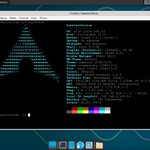
As expected, Omarchy is just a one-person setup.
It doesn't even work on VirtualBox, where Arch Linux works just fine.

ALT ArchLinux with xfce and the terminal showing neofetch with the ArchLinux ASCII-Art logo and system preferences.
Jakub T. Jankiewicz 🇵🇱 retweeted

In September 1992, Unicode had a problem on Unix. Storing characters as 16-bit values could introduce zero bytes that C programs mistook for string terminators. Earlier encodings had compatibility problems of their own.
One evening, Ken Thompson and Rob Pike went to a diner in New Jersey. Thompson sketched a new encoding on a paper placemat.
ASCII stayed exactly as it was. Other characters used multiple bytes, without accidentally introducing null bytes or Unix path separators.
They went back to Bell Labs and started coding. By Friday, their Plan 9 operating system was running entirely on the new encoding.
They called it UTF-8.
Today, it powers over 99% of websites with known character encodings.

My mother failed to install @CorelDRAW 13 on Windows 11. It's not compatible.
AI told her to use @inkscape. TIL: that it can open CorelDraw files.
The #OpenSource won on this one.
Just finished slides for my next talk that I will present in November.
The title is a paraphrase of JFK's quote, "Ask not what your country can do for you; ask what you can do for your country."

ALT LibreOffice Impress with slides showing the first one that looks like a blackboard with the Wikimedia Polska logo and a title that looks similar to what JFK said.
My 9 albums #my9albums

ALT My9Albums. The sound that made @jcubic. Follow the link from the next post to see my picks.

Jakub T. Jankiewicz 🇵🇱 retweeted

I didn’t know my brain was still holding onto this news article I read from 2002, but this tweet pulled it out of me


Jakub T. Jankiewicz 🇵🇱 retweeted

Linus Torvalds used Claude again to remove years-old, slow and insecure Linux kernel code.
The cleanup is now merged into Linux 7.4 and spans 48 commits.
It targets __get_user() and __put_user(), old memory-access helpers that skip user-address checks. Linus says their historical performance advantage disappeared years ago.
He wrote the initial example patch, then used Claude to help apply the same changes elsewhere.
The old calls are gone from generic kernel code, with the interfaces fully removed on x86. Other architectures still retain some uses.
As Linus put it, “we should have done this years ago.”
Source: github.com/torvalds/linux/co…


Jakub T. Jankiewicz 🇵🇱 retweeted

Finally made an about page, it includes my heart rate
neal.fun/about/
My GitHub contributions, every year since 2010: 27,180 in total.
Generate yours: mo.rgan.co/gh/jcubic

ALT GitHub contribution chart consisting of green box mosaics starting from 2010

My GitHub contributions, every year since 2017: 3,643 in total.
Generate yours: mo.rgan.co/gh/Delta456

Thulsa Doom from Norway
Seen them live a few years ago

ALT Metal band on stage. On vocals, James Earl Jones from Conan: The Barbarian


It seems that some people only see Hype.
If you want to use Linux, use something that will work for you.
Omarchy is not a Linux distro. It's one-person setup.

Jakub T. Jankiewicz 🇵🇱 retweeted

anthropic made claude code 3x faster using gzip.
a compression tool from 1992.


