

@UBCEduc Associate Professor | @ALIVEUBC | #PhD | #LearnerAgency | 💔❤️#transplant | Co-Founder @HeartLifeCanada | @jillianne.bsky.social
xʷməθkʷəy̓əm & lək̓ʷəŋən
Joined April 2009
- Tweets10.7K
- Following4.5K
- Followers3.3K
- Likes13K




Pinned Tweet
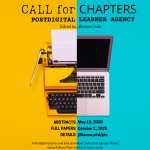
A reminder! Abstracts are due tomorrow! I am happy to extent to Monday if you are interested. DM me here on X or on the other sky app at jillianne.phd
#AcademicTwitter #Postdigital @Agency #CFP #CallforChapters

📣 #CallforChapters: Postdigital Learner Agency: Navigating Hybrid and Algorithmically Mediated Education
📚 Springer | Postdigital Science & Education Series
✍️ Edited by @JillianneCode w Series Eds: Petar Jandrić & James Lamb /1
➡️jillianne.ca/pla
#Postdigital #Agency

ALT A call for chapters on Postdigital Learner Agency: Navigating Hybrid and Algorithmically Mediated Education
𝐉𝐈𝐋𝐋𝐈𝐀𝐍𝐍𝐄 𝐂𝐎𝐃𝐄, 𝐏𝐇.𝐃 🍁☘️🌻🧡 retweeted

🔥 Looking forward to seeing your papers @JCardFail !!! 💜
@HFSA @robmentz @ShashankSinhaMD @EMDeFilippisMD


📢 Call for Papers: The New Frontier of Heart Function in Women.
Guest Editors Drs. Anuradha Lala, Martha Gulati, Novi Yanti Sari, and Diana de Oliveira-Gomes will lead this issue, publishing in February '27.
Categories & topic areas: bit.ly/4vjovuq
Submit by Sept. 15

𝐉𝐈𝐋𝐋𝐈𝐀𝐍𝐍𝐄 𝐂𝐎𝐃𝐄, 𝐏𝐇.𝐃 🍁☘️🌻🧡 retweeted
I love writing by hand.
Taking notes
Journaling
Letters
Cards
✍🏽
Anyone else?

A Norwegian neuroscientist spent 20 years proving that the act of writing by hand changes the human brain in ways typing physically cannot, and almost nobody outside her field has read the paper.
Her name is Audrey van der Meer.
She runs a brain research lab in Trondheim, and the paper that closed the argument was published in 2024 in a journal called Frontiers in Psychology. The finding is brutal enough that it should have changed every classroom on Earth.
The experiment was simple. She recruited 36 university students and put each one in a cap with 256 sensors pressed against their scalp to record brain activity. Words flashed on a screen one at a time.
Sometimes the students wrote the word by hand on a touchscreen using a digital pen, and sometimes they typed the same word on a keyboard. Every neural response was recorded for the full five seconds the word stayed on screen.
Then her team looked at the part of the data most researchers had ignored for years, which is how different parts of the brain were communicating with each other during the task.
When the students wrote by hand, the brain lit up everywhere at once.
The regions responsible for memory, sensory integration, and the encoding of new information were all firing together in a coordinated pattern that spread across the entire cortex. The whole network was awake and connected.
When the same students typed the same word, that pattern collapsed almost completely.
Most of the brain went quiet, and the connections between regions that had been alive seconds earlier were nowhere to be found on the EEG.
Same word, same brain, same person, and two completely different neurological events.
The reason turned out to be something nobody had really paid attention to before her work. Writing by hand is not one motion but a sequence of thousands of tiny micro-movements coordinated with your eyes in real time, where each letter is a different shape that requires the brain to solve a slightly different spatial problem.
Your fingers, wrist, vision, and the parts of your brain that track position in space are all working together to produce one letter, then the next, then the next.
Typing throws all of that away. Every key on a keyboard requires the exact same finger motion regardless of which letter you are pressing, which means the brain has almost nothing to integrate and almost no problem to solve.
Van der Meer said it plainly in her interviews.
Pressing the same key with the same finger over and over does not stimulate the brain in any meaningful way, and she pointed out something that should scare every parent who handed their kid an iPad.
Children who learn to read and write on tablets often cannot tell letters like b and d apart, because they have never physically felt with their bodies what it takes to actually produce those letters on a page.
A decade before her, two researchers at Princeton ran the same fight using a completely different method and ended up at the same answer. Pam Mueller and Daniel Oppenheimer tested 327 students across three experiments, where half took notes on laptops with the internet disabled and half took notes by hand, before testing everyone on what they actually understood from the lectures they had watched.
The handwriting group won by a wide margin on every question that required real understanding rather than surface recall.
The reason was hiding in the transcripts of what the two groups had actually written down.
The laptop students typed almost word for word, capturing more total content but processing almost none of it as they went, while the handwriting students physically could not write fast enough to transcribe a lecture in real time, which forced them to listen carefully, decide what actually mattered, and put it in their own words on the page.
That single act of choosing what to keep was the learning itself, and the keyboard had quietly skipped the choosing and skipped the learning along with it.
Two studies. Two countries. Same answer.
Handwriting makes the brain work. Typing lets it coast.
Every note you have ever typed instead of written went into your brain through a thinner pipe. Every meeting, every book highlight, every idea you captured on your phone instead of on paper was processed at half depth.
You did not forget those things because your memory is bad. You forgot them because typing never woke the part of the brain that would have made them stick.
The fix is the thing your grandmother already knew.
Pick up a pen. Write the thing down. The slower road is the faster one.

𝐉𝐈𝐋𝐋𝐈𝐀𝐍𝐍𝐄 𝐂𝐎𝐃𝐄, 𝐏𝐇.𝐃 🍁☘️🌻🧡 retweeted

Dr. @jilliannec's heart-failure journey began in 2005 with <10% EF & weeks to live. Two transplants, a Harvard post-doc, and co-founding @HeartLifeCanada later, she now champions patient-centered care nationwide. Let's support her mission! ❤️👏

𝐉𝐈𝐋𝐋𝐈𝐀𝐍𝐍𝐄 𝐂𝐎𝐃𝐄, 𝐏𝐇.𝐃 🍁☘️🌻🧡 retweeted

🚨 Just released in @JCardFail - the @HFSA HF Stats 2025 report!
💔1 in 4 Americans will develop heart failure in their lifetime
💲Costs could soar to $858B by 2050
📖 Read the report ➡️ onlinejcf.com/article/S1071-…
📺 Watch the highlights w/ @gcfmd ➡️ youtu.be/0fq_wF4IxoU
#HFStats2025 #heartfailurestats
𝐉𝐈𝐋𝐋𝐈𝐀𝐍𝐍𝐄 𝐂𝐎𝐃𝐄, 𝐏𝐇.𝐃 🍁☘️🌻🧡 retweeted
What a joyous milestone for our #JCFFAMILY Congratulations to @JasonKatzMD @noshreza & the whole @JCFINT team for publishing their 🥇issue!!!
Thank you for your support.
Onward and upward we go. 💜🙏🏽 @HFSA @robmentz @ShashankSinhaMD
#FunctionNotFailure


We are excited to bring you the first issue of JCF-Intersections, where you will find important contributions that embrace and harness the concept of intersections within medicine in their own distinct and powerful ways.
🫀 Read the first issue here: onlinejcfi.org/current

𝐉𝐈𝐋𝐋𝐈𝐀𝐍𝐍𝐄 𝐂𝐎𝐃𝐄, 𝐏𝐇.𝐃 🍁☘️🌻🧡 retweeted
A two-time heart transplant survivor, Dr. @JillianneC brings her lived experience into research and teaching. As co-founder of @HeartLifeCanada and UBC faculty, she’s reshaping how patient engagement is embedded in science. Learn more about her work ➡️ jillianne.ca

𝐉𝐈𝐋𝐋𝐈𝐀𝐍𝐍𝐄 𝐂𝐎𝐃𝐄, 𝐏𝐇.𝐃 🍁☘️🌻🧡 retweeted

Thrilled to share our case report, Nonischemic Cardiomyopathy in Adult-Onset PPA2-Deficient Mitochondrial Disease, was just published in JACC Case Reports! We explore the 🫀🧬diagnostic journey of our amazing patient partner @jilliannec @HeartLifeCanada: jacc.org/doi/10.1016/j.jacca…

𝐉𝐈𝐋𝐋𝐈𝐀𝐍𝐍𝐄 𝐂𝐎𝐃𝐄, 𝐏𝐇.𝐃 🍁☘️🌻🧡 retweeted
Big thanks to @theheartorg & @Medscape for helping to spread the word on how important prevention is across our patients at risk for or living with HF.
@DrMarthaGulati @mvaduganathan @JavedButler1 @CMichaelGibson
@HFSA @ASPCardio
medscape.com/viewarticle/car…

𝐉𝐈𝐋𝐋𝐈𝐀𝐍𝐍𝐄 𝐂𝐎𝐃𝐄, 𝐏𝐇.𝐃 🍁☘️🌻🧡 retweeted
Oof a real privilege to do this “snackable health” 🎥 soundbite with @CMichaelGibson & coauthor-biomarker guru Jim Januzzi & @DrMarthaGulati @BaimInstitute on 1st joint scientific statement @hfsa & @ASPCardio on Prevention in #FunctionNotFailure 🤗
Check out the full statement @JCardFail

Dr’s Gulati, Januzzi, Lala and I discuss the Heart Failure Society of America and The American Society for Preventive Cardiology's new joint statement on the prevention of heart failure. @DrMarthaGulati @dranulala
onlinejcf.com/article/S1071-…
𝐉𝐈𝐋𝐋𝐈𝐀𝐍𝐍𝐄 𝐂𝐎𝐃𝐄, 𝐏𝐇.𝐃 🍁☘️🌻🧡 retweeted
This work is close to my heart ❤️
I’m grateful to join colleagues from @HFSA & @ASPCardio on the 1st joint scientific statement reframing #FunctionNotFailure care—seeing the whole person, across their entire healthspan --- NOT as fragmented problems in silos.🧘♀️
From “at-risk” to advanced HF—prevention must be woven into every stage!
Grateful to @DrMarthaGulati & 🌟colleagues for sharing this vision.
Check it out @JCardFail : onlinejcf.com/article/S1071-…
#CardioPrevention #CKMSyndrome #HeartHealth #HealthScience @rcstarling @DLBHATTMD @JennaSkowronski @CMichaelGibson

𝐉𝐈𝐋𝐋𝐈𝐀𝐍𝐍𝐄 𝐂𝐎𝐃𝐄, 𝐏𝐇.𝐃 🍁☘️🌻🧡 retweeted
📢 Just released! A new scientific statement from @HFSA and @ASPCardio, jointly published in @JCardFail and @AJPCardio places prevention at the forefront of #heartfailure care, marking a pivotal shift in how the field approaches the disease. Read now 🔗 onlinejcf.com/article/S1071-… @dranulala @DrMarthaGulati
𝐉𝐈𝐋𝐋𝐈𝐀𝐍𝐍𝐄 𝐂𝐎𝐃𝐄, 𝐏𝐇.𝐃 🍁☘️🌻🧡 retweeted

Wishing you a joyful and heart-healthy Canada Day!
Whether you’re enjoying nature, relaxing at home, or gathering with loved ones thank you for being part of our journey.
#CanadaDay #HeartHealthCanada #HeartLife #ItsAboutLife

𝐉𝐈𝐋𝐋𝐈𝐀𝐍𝐍𝐄 𝐂𝐎𝐃𝐄, 𝐏𝐇.𝐃 🍁☘️🌻🧡 retweeted
You’re not alone. 💙
HeartLife Academy is your go-to for heart health education—built by patients, backed by science.
🎓 Learn anytime
🧠 Real insights
💬 Lived experience
Start learning: heartlife.academy
#HeartLifeAcademy #PatientVoice #HCM #Cardiovascular

𝐉𝐈𝐋𝐋𝐈𝐀𝐍𝐍𝐄 𝐂𝐎𝐃𝐄, 𝐏𝐇.𝐃 🍁☘️🌻🧡 retweeted

This is excellent to see because it is necessary and because @HeartLifeCanada is a phenomenal patient advocacy organization @MarcBains

🇨🇦 Senator Yonah Martin has tabled Bill S-204—a National Framework for Heart Failure, built in collaboration with HeartLife.
It’s time for policy that reflects lived experience.
🔗 Learn more & take action: heartlife.ca/framework
#BillS204 #HeartLife #ItsAboutLife
𝐉𝐈𝐋𝐋𝐈𝐀𝐍𝐍𝐄 𝐂𝐎𝐃𝐄, 𝐏𝐇.𝐃 🍁☘️🌻🧡 retweeted
Bridging borders, breaking silos. Great to see 🇨🇦 + 🇺🇸 voices come together at #AAHFN2025 to ask the big question:
What should we really be teaching our heart failure patients about self-care? #itsaboutlife


𝐉𝐈𝐋𝐋𝐈𝐀𝐍𝐍𝐄 𝐂𝐎𝐃𝐄, 𝐏𝐇.𝐃 🍁☘️🌻🧡 retweeted
We're at the AAHFN conference! 🫀
Swing by booth 116 to say hi, grab some amazing heart failure resources for your patients—and yes, meet our zebra. 🦓💥 #AAHFN #HeartFailure #HeartLife
𝐉𝐈𝐋𝐋𝐈𝐀𝐍𝐍𝐄 𝐂𝐎𝐃𝐄, 𝐏𝐇.𝐃 🍁☘️🌻🧡 retweeted

Our editorial in @bmj_latest that I had the pleasure of writing with the amazing, talented @Gurleen_Kaur96
Where Are The Women?
#cardiovascularresearch #clinicaltrials #women #Cardiotwitter #womeninclinicaltrials @WomenAs1 @dranulala @Drroxmehran
📎heart.bmj.com/content/heartj…

𝐉𝐈𝐋𝐋𝐈𝐀𝐍𝐍𝐄 𝐂𝐎𝐃𝐄, 𝐏𝐇.𝐃 🍁☘️🌻🧡 retweeted
🎥 Marc & Jillianne are at the BC Legislature today sharing recommendations to strengthen heart failure care in BC:
1️⃣ Fund NT-proBNP testing
2️⃣ Universal access to GDMT
3️⃣ Team-based care for remote & Indigenous communities
📢 More updates to come.
#ItsAboutLife #BCLegislature
𝐉𝐈𝐋𝐋𝐈𝐀𝐍𝐍𝐄 𝐂𝐎𝐃𝐄, 𝐏𝐇.𝐃 🍁☘️🌻🧡 retweeted
“Heart Failure Awareness Week is more than a campaign—it’s a lifeline.” — Jillianne Code, Co-founder of @heartlifecanada
Her lived experience fuels her advocacy. Learn more about @jilliannec's journey: jillianne.ca/bio/
#HeartFailureWeekCan
