
Quantum Compiler Engineer at @QuantinuumQC. Previously: @UChicagoCS, @BrownCSDept.
Chicago
Joined December 2008
- Tweets14.5K
- Following627
- Followers1.5K
- Likes12.4K





Pinned Tweet
My team at @QuantinuumQC is hiring a Principal Quantum Compiler Engineer!
We're tackling some fascinating compiler problems on the path to fault-tolerant quantum computing. Come work with us or please share!
jobs.eu.lever.co/quantinuum/…
Excited to have #SC26 in my home city of Chicago! I'll be at the @QuantinuumQC booth, stop by and say hello if you're attending!

The next era of computing is taking shape at the intersection of quantum and supercomputing. Quantinuum will be at #SC26 next week to show how we’re already bringing that hybrid ecosystem to life.
Learn how we’re connecting systems like Helios, the most accurate quantum computer in the world, with the HPC infrastructure researchers already use. Explore how Nexus provides the developer tools to build hybrid applications and develop expertise that can carry into the fault-tolerant era.
Together with partners including @nvidia, @Oracle and many others, we're hosting more than 15 expert theater sessions at our booth. These talks cover quantum–HPC integration, the latest advances in error correction, real-world use cases, and more.
📍 Booth 4838 | Quantum Junction
📅 November 17–19 | McCormick Place, Chicago
🤝 Book time with our experts: quantinuum.com/blog/super-co…
See you there. @Supercomputing

Kartik retweeted

I asked Fable 5.2 to "go wild" making a game, and all I got was this Pong clone.
And then I played it ...
👇

Kartik retweeted

The next era of quantum computing needs more than extraordinary, fault-tolerant hardware. It needs a platform that puts that power in developers’ hands.
Meet the future of Quantinuum Nexus.
Today, we’re unveiling a multi-year roadmap to evolve Nexus, Quantinuum’s platform as a service, into the industry’s first developer platform designed for the fault-tolerant quantum era.
Nexus will connect application development and deployment across our hardware roadmap, from Helios to Apollo, our universal, fault-tolerant quantum computer planned for 2029.
Our ambition is simple: make building powerful quantum applications easier as we progress toward fault tolerance. Nexus will progressively handle the complexity of error correction, helping developers build programs that grow in capability as the hardware advances.
With Nexus, you can:
🚀 Develop complete applications with fault-tolerant libraries and tools.
⚡ Optimize performance with increasingly automated error correction and resource management.
🌐 Deploy hybrid quantum-classical workflows across enterprise computing environments.
Build today. Be ready for what’s next.
Learn more and explore the roadmap: quantinuum.com/press-release…
Kartik retweeted

I'm thrilled to bring &Truth out of stealth as its co-founder and Chief Science Officer. With a team I'm proud to be part of, we're setting out to specify and prove all the world's software correct and secure.
If you geek out over code people can understand and trust, join us!

We are out of stealth! As AI writes more code, we're building tools to prove programs meet precise requirements, with Lean proofs anyone can independently check. Let's make verified software the norm in every language and application.
Come take a look: andtruth.com
Kartik retweeted
Introducing the judging panel for the Quantinuum SG Grand Challenge 2026!
Since the SG Grand Challenge launched in July, it has brought together more than 200 participants from around the world to explore how quantum computing can tackle challenges across science, AI and industry.
On November 19, our finalist teams will take the stage in Singapore to showcase their solutions and answer questions from a panel whose expertise spans quantum algorithms, research, software and innovation.
Thank you to our judges for contributing their time and expertise, and to every participant for the creativity and dedication that have brought us to this point.
🔹 Prof. Harry Buhrman, Quantinuum
🔹 Prof. Leong Chuan Kwek, Nanyang Technological University / Centre for Quantum Technologies
🔹 Dr. Ross Duncan, Quantinuum
🔹 Dr. Jayne Thompson, Nanyang Technological University
🔹 Dr. Angelina Frank, QAI Ventures
Supported by Singapore’s National Quantum Office and Aqora, the Challenge will culminate in a day of finalist presentations, industry insights and connections across Singapore’s quantum community.
We look forward to seeing you at the finale! Spaces are limited.
Register your interest: twistmedia.sg/events/sggrand…
#QuantumComputing #Quantinuum #SGGrandChallenge

Kartik retweeted

Are people ready to formally specify and verify security-critical properties of all of their software systems, now that our bugfinding tools have finally started to catch up to our bug-introducing abilities?
Kartik retweeted

The trajectory is clear


New on our Frontier Red Team blog: using Claude to formally verify software at large scale.
Formal verification can prove that code is free of certain bugs, but historically it has only been feasible for small codebases (or required a lot of expert time).
With AI models, however, this is beginning to change. In collaboration with @theoremlabs, we used Claude to prove security properties in over one hundred real-world open-source libraries over the span of a few weeks.
Read our research in full here: anthropic.com/research/forma…

Kartik retweeted
Two fault-tolerance milestones were announced over the past two weeks, one from Quantinuum and one from Google.
Because both results focus on improving fidelity and reducing errors, we've received a lot of questions about how they compare. The short answer: both are meaningful advances, but they measure different things.
This week, we announced that we had used our error-correction architecture to achieve a logical fidelity of 99.9995% on Helios, equivalent to just five errors per million operations. Our error rate represented a 100x reduction in errors compared to the best published result across any other modality, which was published by Google in 2024.
Last week, Google announced that it had achieved a fidelity of 99.99% as part of a study on magic states, which are resources used in certain fault-tolerant operations.
The distinction matters because different studies provide insight into different parts of the path to fault tolerance. Google's work measured the fidelity of a resource used in fault-tolerant operations. Our work measured the fidelity of the logical computation that consumes those resources.
In our latest blog, Quantinuum’s David Hayes takes a closer look at what each result measures, where direct comparisons can and cannot be made, and what they tell us about Quantinuum’s leadership on the path to practical fault-tolerant quantum computing.
Learn more here: quantinuum.com/blog/quantinu…

Kartik retweeted

It is a basic principle of American democracy that the government can’t selectively target individuals simply because of their political beliefs or what they say. But that’s exactly what the Trump Administration is doing to Congresswoman Ilhan Omar of Minnesota.
To understand why this is so appalling, it’s important to know the facts. Congresswoman Omar came to this country with her father when she was 12 years old. Five years later, her father became a naturalized citizen. If Ilhan had been 18 at the time, she would have had to apply for citizenship separately. But because she was 17, she became a naturalized citizen automatically.
Congresswoman Omar went on to graduate from college, work as a community organizer, become the first Somali-American legislator elected to public office in the U.S., and win a seat in Congress. There, she has been one of the Trump Administration’s fiercest critics, which has led the president to repeatedly single her out as someone who he believes does not belong in this country.
Now the Administration is actively trying to deport Congresswoman Omar, seemingly based solely on the unsubstantiated theory that she was actually 18 when her father was naturalized, and therefore is not a citizen. Federal agents have raided her home, confiscated personal records, and seized her phone — all to try and uncover a nonexistent smoking gun from 20 years ago that will somehow make their case.
Think about that. The full weight of the federal government is being brought down on a law-abiding elected official because she has dared to criticize the president. And it’s not the first time this has happened. Under President Trump, the Justice Department has repeatedly gone after those he considers his political enemies — from the Attorney General of New York, to the former head of the FBI, to members of the Federal Reserve.
In those cases, the prosecutions either stalled or were dismissed for having no basis in law, and the same is likely to happen in this case. But not before Congresswoman Omar’s life has been turned upside down, her legal bills have piled up, and she’s been forced to spend time fighting unsubstantiated charges instead of serving the people of Minnesota.
The fact that any president, or any administration, is willing to engage in such transparent efforts to intimidate someone should outrage all Americans, regardless of how they feel about Congresswoman Omar’s political views. Because if this becomes the new normal, there’s no reason to believe it will stop with her — or that future presidents, in either party, won’t do the same.
Kartik retweeted
We are closing in on one million error-free operations!
Helios has achieved a logical fidelity of 99.9995%—equivalent to just five uncorrectable errors per million operations. Importantly, errors fell exponentially as we increased the strength of error correction. This is the behavior required to build fault-tolerant quantum computers: add more protection, and the computation becomes exponentially more reliable.
This result also highlights the resource advantages of our architecture. Based on demonstrated color-code scaling, a Quantinuum system could reach a target logical error rate using approximately 30 times fewer physical qubits than a comparable superconducting approach.
This result, using the color code, is coming hot off the heels of our September record with the Helix code. Our ability to run multiple codes at record breaking fidelities showcases our flexible logical architecture and highly accurate trapped-ion technology.
Ultimately, this result highlights the power of Helios in ‘pathfinder’ mode: results like this validate the hardware, error-correction architecture, decoding, and control capabilities that underpin our path to Apollo—our universal fault-tolerant quantum computer planned for 2029.
Read the full story on our blog: quantinuum.com/blog/quantinu…

Kartik retweeted
Quantinuum has achieved a major industry breakthrough that solves a critical error-correction bottleneck and validates our path to delivering a fault-tolerant quantum computer by 2029.
We’ve announced a new world record for quantum error correction, achieving 99.9995% logical fidelity on our Helios commercial quantum computer using our error-correction architecture.
Equivalent to just five errors in a million operations, the result is 10× better than our previous record achieved just last month and 100× better than the best published result on any other hardware modality.
The study also demonstrated a record 12× reduction in logical errors as code distance increased, a critical step toward scalable fault tolerance.
These successive breakthroughs using different codes on the same commercial hardware demonstrate how Quantinuum's flexible error-correction architecture and highly accurate trapped-ion technology work together to enable exponential improvements in accuracy, with performance now within the target range for Apollo, our first universal fault-tolerant quantum computer planned for 2029.
Learn more: quantinuum.com/press-release…
Kartik retweeted

Lean v4.35.0 is out, and it ships with verified kernels.
Run `lake check --paranoid` to recheck your project with every bundled kernel.
Blog post: leodemoura.github.io/blog/20…
Kartik retweeted

In my latest Expert Voices column for @ScienceMagazine, I weigh in on this summer's - and this week's - AI for math news:
AI has solved many math problems, but it has not solved math | Science science.org/doi/10.1126/scie…

Kartik retweeted
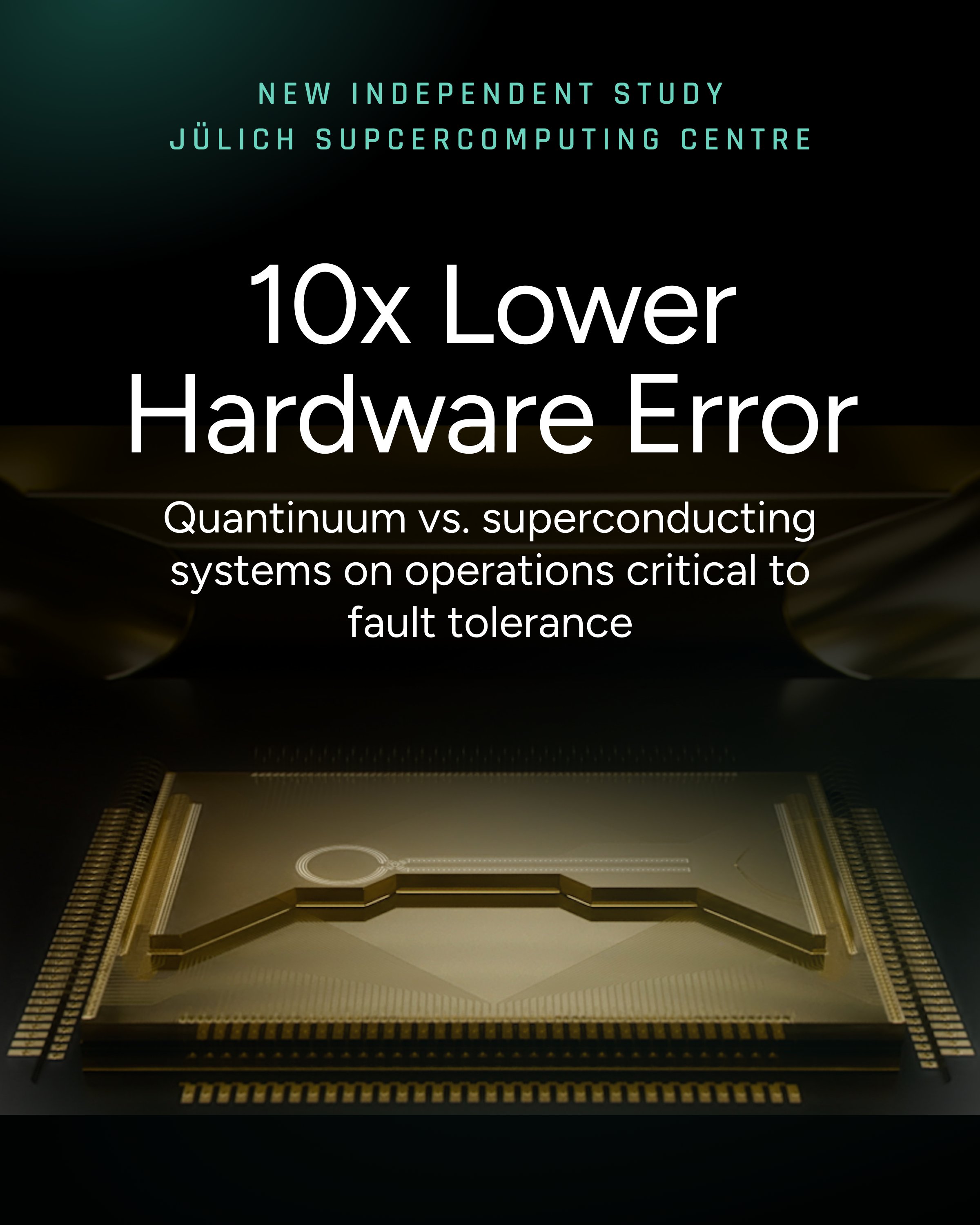
The demands of fault tolerance are bringing Quantinuum’s advantages into sharper focus. A new independent study from the Jülich Supercomputing Centre (JSC) found that Quantinuum's Helios system achieved approximately 10× lower effective hardware error than superconducting systems when evaluating fault-0tolerant operations.
This work builds on earlier independent research from Jülich that found Quantinuum’s systems led in physical-level performance. Now, that advantage is extending into the operations that will underpin fault-tolerant computation.
As we approach large-scale fault tolerance, the gap between quantum computing architectures is becoming increasingly clear.
This study provides further independent evidence that Quantinuum is building the architecture needed to meet that challenge and continuing to raise the performance bar.
Read our blog: quantinuum.com/blog/independ…
Kartik retweeted

An uncomfortable truth for a lot of people is that a lot of the most successful people in any industry are wicked smart. We apply stereotypes based on the loudest people, but its not representative of norms. Most are crazy smart and got to where they are because of it.
I grew up in LA, one of my parents was a TV producer, my wife was an actor, many friends "in the industry." I've been constantly surrounded by it, and some of the stupidest seeming people (cause its their bit) are actually insanely smart and strategic in private. It sometimes is just beneficial for various reasons to... not show that side of you.
My favorite anecdote was when a friend (a model) was dating a phD in physics and a very rude person made some off the cuff degrading comment to model friend about it without realizing model friend has their own phD in math lol. You wouldn't know from their instagram though!
For the quoted video, I don't know Ben Affleck. I don't know how deep his knowledge goes. He's almost certainly not going to be more knowledgable than someone who professionally does this area of work full time, but he also to me on the surface sounds like someone who knows a LOT more than the average person and possibly even the average software engineer (on this topic).
Anyways, this applies to tech too. I see it constantly.

Ben Affleck reveals he writes Python, understands convolutional neural networks, worked extensively with GPUs, and used his celebrity status to get private looks at Google and OpenAI’s video models
“I’ve always been kind of into computers since I was young. Then, when film started to move from analog film to digital, I became more interested in that aspect of it. The visual-effects workflow for many years has included machine learning, so I can write pretty shitty Python scripts and stuff like that.
“With convolutional neural networks, which were the precursors to what the transformer can do, which is much more computation simultaneously, you would do things like look at what’s called a tensor. That’s the numerical translation of a visual image in numbers, like the batch number, the frame number and the red, green and blue values of each pixel in each frame. It’s just that simple. That numeric is called a tensor.
“You’d use a convolutional neural network to identify patterns that reveal what’s called edge detection or feature extraction, which is identifying patterns well enough to know, this is where the window ledge is, so we can more easily take the green-screen image out and replace it with something.
“That was familiar to me early on because, prior to Artists Equity, I had a small visual-effects company. I’ve worked with GPUs a lot too. The visual-effects guys said, ‘Hey, you should see. There are a couple: Google and this other company, OpenAI, are doing really interesting stuff with transformers in video.’
“I’ve learned that I can actually just call up and go, ‘Hey, it’s Ben Affleck. Can I come see what you’re doing?’ Sometimes people say yes, to my astonishment.”
Kartik retweeted
What happens when quantum computing experts and computational chemists spend a week learning from one another?
At Quantinuum’s first InQuanto Summer School, 30 researchers came together in Cambridge for five days of lectures, workshops, and hands-on projects exploring the future of quantum chemistry.
The result was more than technical training. It was a chance to build a shared language, exchange ideas, and apply quantum computing concepts to real-world research problems.
Watch the highlights or read our recap: quantinuum.com/blog/from-the…
Kartik retweeted
My team at @QuantinuumQC is hiring a Principal Quantum Compiler Engineer!
We're tackling some fascinating compiler problems on the path to fault-tolerant quantum computing. Come work with us or please share!
jobs.eu.lever.co/quantinuum/…