Senior People Scientist, Analytics @cultureamp doing all things applied psychology • #rstats • ex-academic
Sheffield, England
Joined May 2015
- Tweets4.9K
- Following1.7K
- Followers2K
- Likes9.3K
Pinned Tweet
I was today years old when I realised that by using four hashes at the start and at the end of the line you can create code sections. Forever gone are the days of frantic scrolling #rstats

Karolina Urbanska retweeted

I’m so excited to finally get to talk about this publicly!
The Swiss @snsf_ch have awarded us $285k to check ~100 important published articles for errors, to foster a culture of error checking & acceptance.
Fewer errors = bonus $ to authors
More errors = bonus $ to reviewers.

Error checking is an important service to science, but it doesn't pay the bills. But what if it did? Introducing ERROR, a bug bounty program for science to systematically detect and report errors in academic publications error.reviews/

Karolina Urbanska retweeted

NEW: Generative AI is already taking white collar jobs
An ingenious study by @xianghui90 @oren_reshef @Zhou_Yu_AI looked at what happened on a huge online freelancing platform after ChatGPT launched last year.
The answer? Freelancers got fewer jobs, and earned much less

Karolina Urbanska retweeted
NEW: we need to talk about UK graduate wages, and the idea that Britain sends too many people to university.
American readers should stick around for the UK/US comparisons 👀
Let’s start with this: the UK graduate wage premium has fallen substantially over the last 25 years

I’m looking for examples of behavioural assessment tools from across disciplines including health, clinical, and environmental behaviour fields. Self-report, observational, anything goes. I’d like to learn more about recent advances in how behaviour is measured and assessed
Karolina Urbanska retweeted

Is GPT psychologically WEIRD? Using the World Values Survey and other psych measures, we seat GPT within a global perspective. The culturally more distant a place is from the US, the lower the correlation with GPT @MohammadAtari90 @blasi_lang @DorsaAmir

Karolina Urbanska retweeted

Worry, depressed affect, anger, anxiety, vulnerability — these are all aspects of trait neuroticism.
But is neuroticism really a trait?
New evidence suggests the answer might be yes!
@AlexGiannelis and @eawilloughby have written a wonderful new paper that supports this contention.
How did they do that and what does that even mean?
Here's the how: They ran a genome-wide association study for neuroticism and found 394 single nucleotide polymorphisms (SNPs) associated with it. Then, they checked if those SNPs had effects that were consistent with Model A - the common pathway model - or Model B - the independent pathway model.
OK, that might not be super clear, so I'll restate; here's what I mean: if a "factor model" is modeling a "real" trait that's "out there" and causes the things we think it causes - in this case, neuroticism - then the common pathway model will fit. That means that the things that cause differences in trait-related responding will act exactly as you'd predict from the factor model. That means that the effects will be on the factor itself! Or in other words, SNPs associated with neuroticism affect neuroticism itself - Model A.
But if neuroticism isn't real, that means that the causes of neurotic responding are just correlated and they're not consistent with a factor model of neuroticism. In that case, the SNPs act directly on the things that you use to measure what you think is neuroticism, but what is really a more diverse construct - Model B.
So what exactly did they find? 394 SNPs were associated with neuroticism, and
- 139 had direct effects on the neuroticism factor
- 81 had direct effects on the facets of neuroticism
- 63 had effects on specific indicator variables, like "embarrassment" or "guilt"
The remaining 111 were ambiguous and couldn't have their effects strongly assigned to any particular part of the model, but 54 of the remaining 111 looked to have effects on neuroticism itself.
So of the assigned SNPs, 49.12% had effects on neuroticism itself, and if you use all the SNPs, 48.98% affected neuroticism itself. Adding in the facet-specific effects, 77.74% of the assigned effects indicated neuroticism measurement was valid. That's great! But it's not all they found.
They also found that, consistent with theory, the genes associated with neuroticism were only significantly expressed in the brain. This is an important part of validation because, if neuroticism was instead found somewhere like the skeleton, we'd know something was wrong.
In animal studies, some of the genes associated with neuroticism have been found to be important for things like
- Abnormal cued conditioning behavior in mice. Animals with these genes are less capable of learning associations between aversive and neutral stimuli.
- Impaired coordination. Animals with these genes show reduced ability to execute integrated movements.
- Decreased exploration in new environments. Animals with these genes spend less time investigating new locations.
There are definitely some cool findings here.
So, what else is neuroticism related to? Glad you asked! Here are the genetic correlations:
Earlier Work
Other analyses using this same method have found support for general intelligence (nature.com/articles/s41562-0…) and found that a general factor of psychopathology wasn't supported (nature.com/articles/s41588-0…).
Twin-Based Studies
If you're interested in earlier results for Big Five/HEXACO personality, check out nitter.cf/cremieuxrecueil/…
Here's the link to this new excellent paper. Go give it a read: biorxiv.org/content/10.1101/…


For several common representations of personality, independent pathway models tend to fit better, even when there's not major measurement error to contend with.

ALT NEO-FFI results from the Dutch Twin Register: https://link.springer.com/article/10.1007/s10519-013-9625-7

ALT California Psychological Inventory results from the National Merit Twin Study: https://link.springer.com/article/10.1007/s10519-012-9548-8

ALT HEXACO results from the TwinsUK: https://www.sciencedirect.com/science/article/pii/S0092656614000312
Karolina Urbanska retweeted

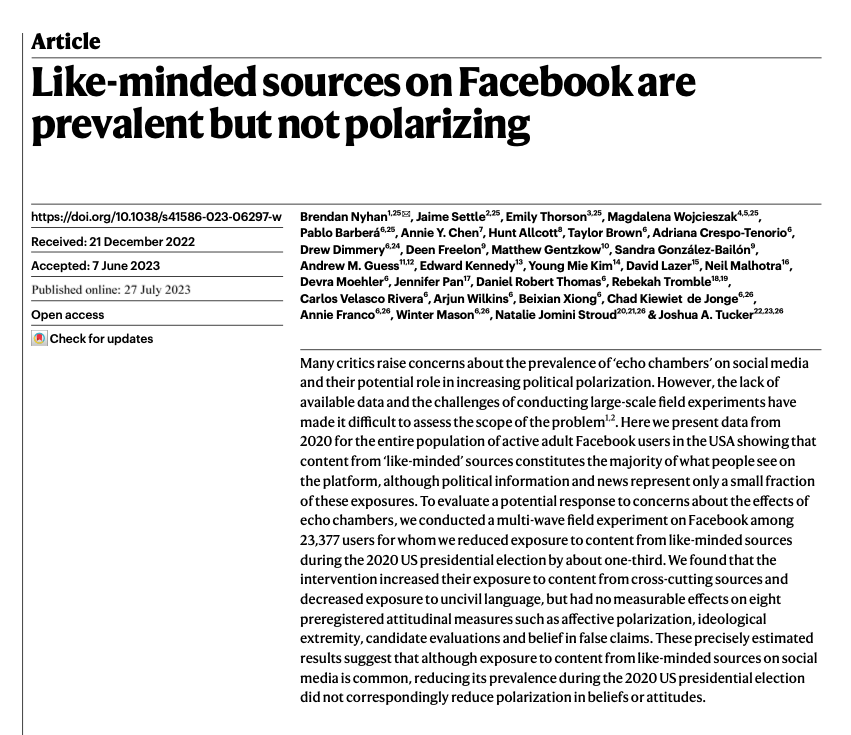
New @nature: Like-minded sources on Facebook are prevalent but not polarizing
nature.com/articles/s41586-0… (open access!)
Our key findings:
-Median FB user gets 50.4% of content from like-minded sources
-But reducing exposure by ~1/3 for 3 months had no measurable effect on attitudes


Karolina Urbanska retweeted

Does simply owning something make you value it more?
This apparent *endowment effect* violates standard econ models, and was one of the main findings that led to the rise of behavioral econ.
But have the findings been misinterpreted? A thread 🧵

Karolina Urbanska retweeted

Beyond happy to see this paper out now in JPSP!
We've all heard that "personality" predicts things... well, 99% of the time that refers to mean levels of personality traits. What about changes in traits? doi.org/10.1037/pspp0000472 (1/9)

Karolina Urbanska retweeted

In PNAS today, Greg Clark documents the inheritance of social status in an impressive dataset on 422,374 people born in England between 1600 to 2022.
Clark finds a strong persistence in social status going from close to distant relatives, which fits a model dating back to RA Fisher's 1918 work on correlations between relatives due to additive genetic effects and assortative mating.
Clark's modeling implies a very high (0.57) correlation between spouses' underlying genetic components affecting social status.
The high correlation between spouses' social status (and underlying genetic components) implies that social status has greater persistence across generations than if spouses were not correlated in their social status.
It is possible that more complicated models may turn out to explain Clark's and other data better. However, Clark shows that a simple model of additive genetic effects and assortative mating (with limited non-genetic inheritance effects, except for wealth) can fit correlations between relatives' social status over a long time period — a time period in which dramatic social changes have occurred in education and employment.
This is a remarkable piece of empirical work that anyone wanting to explain the persistence of social inequalities across generations should take seriously.
pnas.org/doi/10.1073/pnas.23…

Karolina Urbanska retweeted

POOR BUT NOT BY CHOICE(S): Across 27 countries (5,000 participants), our team of 40 researchers found *NO DIFFERENCES* in bias patterns for financial decisions between income groups. NONE.
Economic inequality isn't caused by bad choices.
Open access: nature.com/articles/s41598-0…
I've got some Qualtrics bug where when I select an answer to a question (say, the first response), it automatically selects the first response for all other questions on the same page. Anyone knows what may be the issue?
Karolina Urbanska retweeted

As of today, for the next three weeks, I am ‘locked out’ by my employer, on zero pay, for participating in @UCU’s Marking and Assessment Boycott.
A short thread on why I am participating. 1/6
Hi academic Twitter, long time no see! I will be in Krakow during EASP to catch up with friends - ping me if you’d like to go for a coffee/drink or talk non-academic careers!
2
407
Karolina Urbanska retweeted

Love this example of supporting connection... putting their money where their mouth is!

The City of Boston is offering grants up to $750 for residents, neighbors and community groups who want to build community this summer by hosting a block party on their street.
Applicants should fill out the form below.
docs.google.com/forms/d/e/1F…

Karolina Urbanska retweeted

🚨 New paper 🚨
In an experiment when should you measure a key moderator? Before treatment risks priming bias, but after treatment risks posttreatment bias. In a new paper, we develop methods to bound each type of bias in any experiment.
🔗: arxiv.org/pdf/2306.01211.pdf

Have you ever considered a coaching programme to help your career development but you're not sure if it's for you? A colleague of mine is finishing their qualifications and are looking for people who would like to have an initial 30 mins chat. No commitment. DM for more details.